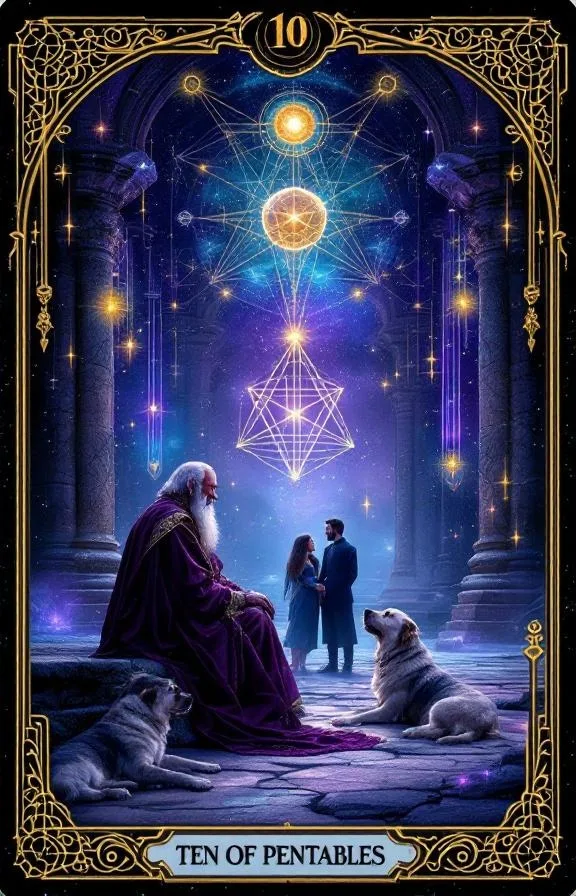
Three generations sit in the courtyard. The children play. The parents watch. And in the corner, wrapped in a robe embroidered with symbols only they can read, the elder sits with dogs at their feet, surveying everything they built — the family, the wealth, the walls, the legacy. The Ten of Pentacles as a person is the patriarch. Or matriarch. The gendered word matters less than what it contains: someone who has spent a lifetime constructing something designed to outlast them.
The personality profile
The patriarch thinks in generations. Where most people plan for next year, maybe five years if they are ambitious, this person plants trees whose shade they will never sit in. They make decisions today that will not fully unfold for decades. This temporal awareness — this deep, almost geologic sense of time — is the defining characteristic of the Ten of Pentacles person and the thing that makes them most difficult for younger people to understand.
They are traditional. Let us be direct about this. The Ten of Pentacles person believes in institutions — family, property, marriage, inheritance, the accumulated wisdom of people who came before. In an era that reflexively questions all tradition as oppressive, this person holds a contrarian position: some of what was handed down is worth keeping. Not everything. Not uncritically. But some of it.
This is the boldest claim in their worldview, and it is frequently misunderstood. They are not resisting change because they fear it. They are insisting that change should be weighed against what already works, and that the burden of proof belongs to the new, not the old. You may disagree with this position. You should at least understand that it comes from experience, not rigidity.
Ten of Pentacles upright as a person
Upright, the patriarch is warmth encased in structure. They host the holiday dinners, keep the family address book, remember everyone's birthday, maintain the house that has become the gravitational center of an extended clan. Their love is expressed through maintenance — of relationships, of property, of traditions that give people a sense of belonging to something larger than themselves.
Their wealth, whether modest or substantial, is managed with legacy in mind. They are the parent who starts a college fund at birth. The grandparent who quietly transfers property into a trust. The uncle who teaches the next generation about compound interest at the kitchen table. Money, for this person, is not about consumption. It is about continuation.
They have a gift for creating stability that extends beyond their immediate family. Their neighborhood trusts them. Their community relies on them. They are the person who organizes, who shows up to meetings, who remembers institutional history because someone has to, and they decided a long time ago that the someone would be them.
Ten of Pentacles reversed as a person
The reversal exposes the shadow of dynastic thinking: the family that has become a prison. The reversed patriarch controls through tradition, using inherited expectations as a mechanism to dictate how younger generations should live, whom they should marry, what careers they should pursue. The phrase "we have always done it this way" becomes a weapon.
Inheritance disputes surface. The wealth that was supposed to unite the family becomes the thing that divides it. The patriarch watches their children fight over assets and realizes, with dawning horror, that they may have built the structure without building the values needed to sustain it.
Sometimes the reversal is simpler and sadder: the person who invested everything in family and received nothing in return. The calls that do not come. The visits that get shorter. The slow, quiet realization that the legacy they spent their life constructing has been taken for granted by the people it was built for. This is perhaps the cruelest version of the reversed Ten of Pentacles — not conflict, but indifference.
Ten of Pentacles as a person in love
The Ten of Pentacles person does not date casually. Every romantic prospect is evaluated, consciously or not, against the question: could I build a life with this person? Could they be the other pillar of the structure? Do they understand what it means to create something that will still stand in fifty years?
Their love is steady, deep, and — this is important — publicly expressed through commitment rather than passion. They want the wedding. They want the shared mortgage. They want the family dinner table with enough chairs for children and eventually grandchildren. These are not bourgeois fantasies to them. They are the architecture of a meaningful life.
The challenge is their inflexibility. A partner who wants a different structure — unconventional living arrangements, chosen family over biological family, a nomadic lifestyle — will find the Ten of Pentacles person genuinely unable to comprehend the appeal. Why would anyone choose instability when stability is available?
Ten of Pentacles as a person at work
They build organizations the way they build families — for permanence. They are the founder who writes a succession plan before the company turns a profit. The CEO who prioritizes culture over quarterly earnings because they understand that culture is what survives leadership transitions and market crashes.
Their work style is methodical and institutional. They document processes. They create systems that function independently of any one person, including themselves. The goal is always to build something that does not need them — the ultimate test of good leadership, and one that most ego-driven leaders fail.
Ten of Pentacles as someone in your life
You recognize this person by the depth of their roots. They live where they have lived for years, possibly decades. They know the neighbors by name. Their refrigerator has photos from three different generations stuck to it with magnets from places the family has visited together.
Relating to them means understanding that they see you not as an individual in isolation but as a node in a network. You are someone's child, someone's friend, someone's colleague — and your place in these webs of connection matters to them. This is not reductive. It is contextual. They believe that people make more sense when you understand where they come from, and they are usually right.
Frequently asked questions
What kind of person does the Ten of Pentacles represent?
The Ten of Pentacles represents a patriarch or matriarch — someone whose life is organized around the creation and maintenance of lasting structures, whether those are families, businesses, communities, or traditions designed to outlive the person who built them.
Is the Ten of Pentacles as a person positive or negative?
Positive in its upright expression, where the desire for legacy creates genuine stability, warmth, and intergenerational connection. The shadow side appears when tradition becomes control, when wealth creates division rather than unity, or when the person's identity becomes so fused with the structure they built that they cannot tolerate any deviation from their blueprint.
How do you recognize a Ten of Pentacles person?
They are rooted. Visibly, obviously rooted. They have lived in the same place for a long time. They know family histories — theirs and yours. They ask about your parents. They save things. Their home feels like a home that has been lived in, layered with the evidence of accumulated years, and walking through the door feels less like entering a house and more like entering a story.