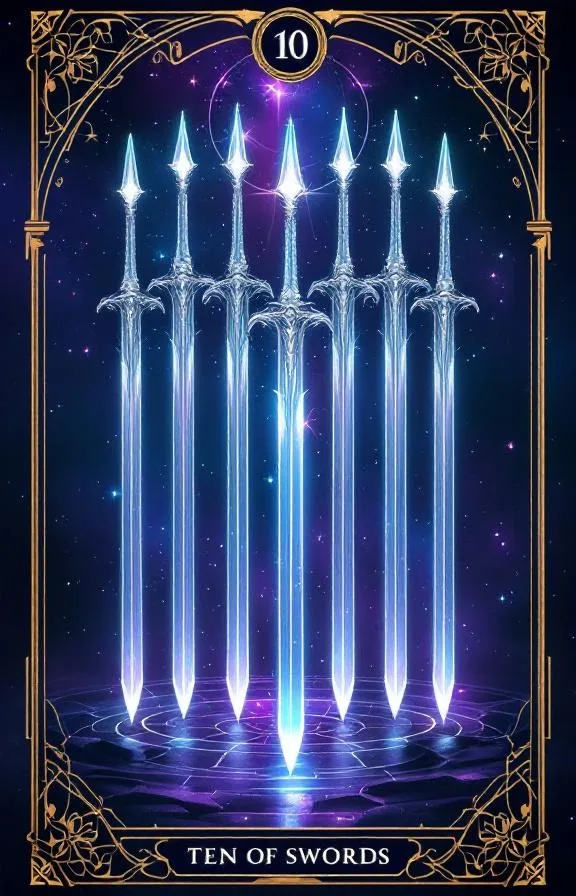
It is over. Whatever you have been trying to save, sustain, or resuscitate — the Ten of Swords says stop. Not "take a break." Not "reassess." Stop. The thing is done. Ten swords in the back, face down on the ground, sky dark. There is no version of this image that leaves room for "maybe it will work out." The Ten of Swords as advice is not cruel. It is merciful. It is the card that finally tells you what you have been refusing to accept, so you can stop wasting your life on something that ended a while ago.
The advice
Accept the ending. Fully, without reservation, without the secret hope that acceptance might somehow reverse the outcome. It will not. The Ten of Swords is not a negotiating position. It is a fact.
Here is what makes this card's advice genuinely useful rather than merely brutal: it confirms that you have hit the bottom. Ten is the maximum number of swords. There are no more. Whatever catastrophe has unfolded, whatever defeat you have suffered, whatever has been destroyed — this is the worst of it. The only direction from here is up, because there is no more down available.
That might not feel comforting right now. Rock bottom rarely does in the moment. But there is a specific kind of freedom that arrives when you stop bracing for the next blow. When the worst has already happened, you can stop fearing it. Fear of loss requires something left to lose. The Ten of Swords has already taken the inventory. You are standing — or lying — in the aftermath, and the aftermath is where rebuilding begins.
The card's most counterintuitive advice: do not fight the ending. Do not appeal it, protest it, or try to resurrect what has died. Let it be over. The energy you are spending on denial and resistance is energy you will desperately need for what comes next. And something does come next. Notice the horizon in the card. It is not dark. Dawn is there. Faint, distant, but present. The Ten of Swords always contains the sunrise, but you can only see it if you stop staring at the swords.
Ten of Swords upright advice
Upright, the Ten of Swords advises you to surrender — not to the person or situation that defeated you, but to reality. The distinction matters. Surrendering to reality means accepting what has happened without sugarcoating it. It does not mean the outcome was fair, justified, or deserved. It means it happened, and your power now lies in how you respond to the aftermath, not in changing facts that are already facts.
The upright card strongly advises against martyrdom. There is a temptation, when you have been deeply hurt, to construct an identity around the wound. To become The Person Who Was Betrayed, or The Person Who Lost Everything. The Ten of Swords says: this happened to you. It is not who you are. The moment you make your worst experience your defining characteristic, you give it power over every future experience.
Stop telling the story of your defeat to everyone who will listen. Tell it once. Tell it fully. Then begin the next story.
The upright card also advises you to examine what led here. Not with blame — that is unproductive — but with the clinical curiosity of someone conducting a postmortem. What went wrong? Where were the warning signs? What would you do differently? This examination is not self-punishment. It is the extraction of usable intelligence from wreckage.
Ten of Swords reversed advice
Reversed, the Ten of Swords suggests that recovery has started but you are resisting it. You have become so accustomed to the pain that its absence feels wrong. Suspiciously quiet. Like the other shoe has not dropped yet.
The reversed card says: the other shoe dropped. You are past the worst. The anxiety you feel about things getting better is a residual effect of prolonged suffering, not a prediction of more to come. Let the recovery happen. Do not sabotage the new beginning because you are still loyal to the old ending.
Alternatively, the reversed Ten of Swords can indicate that you are prolonging the ending unnecessarily. Still checking their social media. Still driving past the old office. Still rehearsing what you should have said. The ending happened. Your continued engagement with it is voluntary, and the reversed card advises you to stop volunteering.
There is also the possibility that a situation you thought was completely dead is showing signs of life. The reversed Ten of Swords is cautious about this: make sure you are not confusing a twitch with resurrection. Some endings look reversible from certain angles but are not. Check your hope against the evidence before investing again.
Ten of Swords advice in love
In love, the Ten of Swords is as direct as it gets: this relationship, in its current form, is over. The breakup, the betrayal, the final fight — it already happened. The advice is not about whether to try again. It is about how to survive the end without losing yourself in it.
Grieve. But grieve with a deadline in mind — not for the grief itself, which has its own timeline, but for the behaviors that accompany it. The midnight calls to your ex. The analysis of what went wrong that has become an obsession rather than a process. The daily checking of their online activity. Give these behaviors a specific end date. "I will allow myself to check until April 1st. Then I stop." Structure helps when emotions cannot provide it.
For those who were betrayed: the Ten of Swords validates your pain entirely. What happened to you was real, and it hurt as much as you say it did. But the card also says that the person who hurt you does not get to define your future unless you let them. The swords are in your back. Pull them out. They are not structural — they are just stuck.
If the Ten of Swords appears in a relationship that has not technically ended but feels dead: the card is asking why you are still performing the rituals of a relationship that has no life in it. Fear of alone? Financial entanglement? Hope? Name the reason. Then evaluate whether that reason is sufficient to continue.
Ten of Swords advice in career
The Ten of Swords in career readings corresponds to the unambiguous professional catastrophe. The firing. The bankruptcy. The complete failure of the business. The project that imploded publicly. The deal that fell through at the last moment, taking everything with it.
The career advice is paradoxically optimistic: this kind of clean break, however painful, often produces better outcomes than a slow professional decline would have. Being fired sometimes creates career changes people would never have made voluntarily. Failed businesses often generate the specific expertise needed to build successful ones. The destruction contains seeds.
But the card's immediate advice is not about silver linings. It is about damage assessment. What is actually gone? What survived? What skills, relationships, and resources remain intact? The emotional experience of total loss rarely matches the material reality. When the dust settles, most people discover they retained more than the catastrophe suggested.
For those who caused their own professional downfall through poor decisions: the Ten of Swords does not offer comfort, but it offers something more valuable — clarity about what not to do next time. The lesson is written in the most permanent ink available: failure. Learn it. Then move.
Action steps
- Name the ending. Say it, write it, acknowledge it without qualifiers. "This is over." Not "This might be over" or "This is over unless." Complete the sentence and let it stand.
- Conduct a postmortem. Within one week of accepting the ending, write a clear-eyed analysis: what happened, why, what you contributed to the outcome, what was beyond your control. Keep it under two pages. This is for your files, not for publication.
- Find the dawn in the card. Identify one small thing in your current situation that contains possibility. It does not need to be exciting or inspiring. Just real. A skill you still have. A person who still supports you. A direction that is now available because the old one closed.
- Set one forward-facing goal. Not a recovery goal — a new goal. Something unrelated to what you lost. This begins the process of building an identity that is not organized around the wound.
FAQ
What does the Ten of Swords mean as advice?
The Ten of Swords as advice tells you to accept a definitive ending and stop fighting reality. The card recognizes that you have experienced a painful conclusion — a relationship, a career phase, a belief, a plan — and advises you to stop trying to revive what is dead. Its guidance is simultaneously honest and hopeful: yes, this is the worst. No, it will not stay this way. Dawn is visible on the horizon, but you will not reach it while you are still lying among the swords.
Is the Ten of Swords the worst card in tarot?
It is the most dramatic, but not necessarily the worst. The Ten of Swords represents a definitive ending, which — while painful — contains a crucial mercy: certainty. Unlike cards that indicate prolonged suffering, gradual decline, or agonizing indecision, the Ten of Swords draws a clear line. It is over. That clarity, painful as it is, allows you to stop guessing and start rebuilding. Many people report that after the initial shock, the Ten of Swords produced a strange relief — the exhausting uncertainty was finally replaced by a fact they could work with.
How long does recovery from a Ten of Swords situation take?
The card does not specify a timeline, and recovery varies enormously based on what was lost and the support available. What the card does indicate is that the absolute bottom has been reached — meaning every day forward contains the potential for improvement, even if the improvement is initially imperceptible. Most significant Ten of Swords recoveries — career rebuilds, post-betrayal healing, identity reconstruction — take months rather than weeks. The card advises patience with the process while maintaining forward movement. You do not need to rush the recovery. You just need to keep moving toward the sunrise at whatever speed you can manage.
