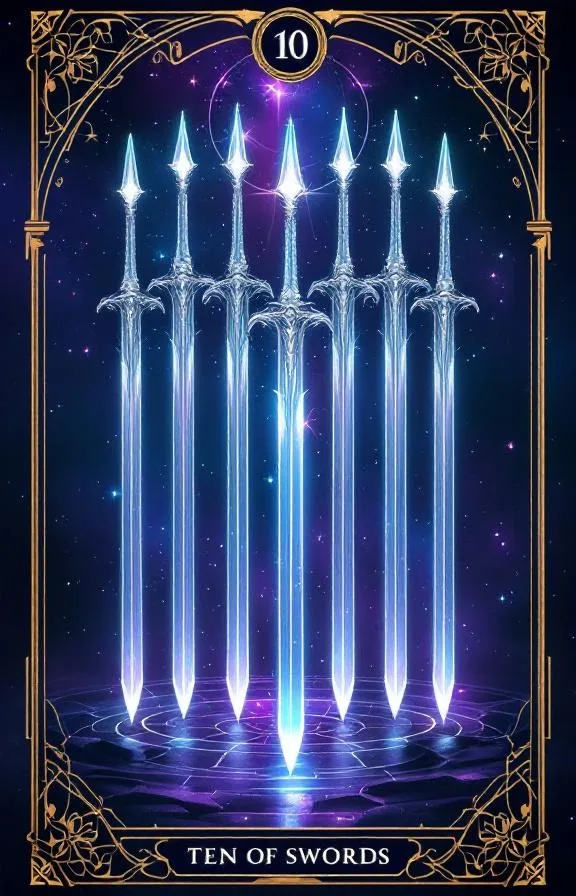
They have hit bottom so many times they could draw you a map of it. Here is where the marriage ended. Here is where the business collapsed. Here is where the diagnosis arrived. And here — right here — is where they stood up, brushed the dirt off, and started again. The Ten of Swords person is not defined by their catastrophes. They are defined by the simple, stubborn fact that they keep getting up.
The personality profile
The Ten of Swords person has survived something — or several somethings — that would have permanently broken most people. They carry this survival in their body: in the way they hold themselves, in the particular steadiness of their gaze, in the dark humor they deploy when the conversation gets too close to something real. They have been to the worst place they can imagine and discovered that the worst place is not actually the end. It is just the bottom. And bottoms, by definition, have nowhere to go but up.
What makes this person genuinely remarkable is not their suffering — everyone suffers — but their relationship to it. They have developed a quality best described as operational resilience: the capacity to function during catastrophe rather than after it. They do not wait for the storm to pass before they start rebuilding. They rebuild during the storm. With wet hands and gritted teeth and the absolute conviction that this, too, is survivable, because everything before it was.
There is a particular authority that comes from having already lost everything and discovered that "everything" was not as much as they thought. The Ten of Swords person knows — not believes, knows — that most of what people fear losing is replaceable. Jobs come back. Money comes back. Even love, eventually, comes back. What does not come back is time spent being afraid of loss, and this awareness makes them impatient with people who treat inconvenience as catastrophe.
Ten of Swords upright as a person
Upright, this person is in the middle of their transformation or has recently completed one. The swords are still visible in their back. The wounds have not fully healed. But they are standing, and the act of standing is itself a declaration: I refuse to stay down.
They have a raw honesty that comes from having nothing left to protect. The masks burned off during the crisis. The social performances became impossible to maintain. What remains is something stripped-down and genuine — a personality with no pretense because pretense requires energy they cannot spare for anything nonessential.
People find them magnetic or unsettling. Sometimes both. Their willingness to discuss rock-bottom experiences without shame or drama makes some people deeply uncomfortable. Others find it liberating. The Ten of Swords person has accidentally become the most honest person in the room simply by having nothing left to lie about.
Their optimism, when it appears, is the most trustworthy kind — not naive hope but earned confidence. They are not positive because they have not been tested. They are positive because they have been tested completely and survived.
Ten of Swords reversed as a person
Reversed, this person is either clinging to their victimhood or actively resisting the recovery that is already underway.
The victimhood pattern looks like this: they have experienced genuine devastation and now use that devastation as a permanent identity. They tell the story of their collapse to everyone, not as a processing exercise but as a claim — I have suffered more than you, therefore my suffering exempts me from the expectations you face. This person uses their rock bottom as a pedestal rather than a foundation.
The resistance pattern is subtler. The reversed Ten of Swords person can feel the recovery happening — the first signs of new energy, new interest, new desire — and it frightens them. They have grown accustomed to the bottom. They know its geography. The ascent requires them to hope again, and hope, for someone who has been devastated, feels dangerously close to setting themselves up for another fall. Better to stay down. Safer to stay down.
Elisabeth Kubler-Ross observed that people resist recovery not because they prefer suffering but because suffering has become familiar, and familiarity — even painful familiarity — feels safer than the unknown. The reversed Ten of Swords person embodies this observation perfectly. They are not choosing pain. They are choosing the known over the unknown, and right now, pain is what they know.
Ten of Swords as a person in love
In love, the Ten of Swords person brings everything they have survived into the relationship, and everything they have survived has taught them to value simplicity. They do not need grand romance. They do not need perfection. They need presence. Consistent, undramatic, reliable presence. Show up when you said you would. Call when you said you would call. Be where you said you would be.
Their past experiences can make them cautious about vulnerability, but when they do open up, the openness is total. They have no energy for half-measures. They love with the same ferocity they used to survive — completely or not at all.
The partner who earns a Ten of Swords person's trust receives something extraordinary: the loyalty of someone who knows exactly what it costs to start over and has chosen not to.
Ten of Swords as a person at work
They are the colleague who stays calm during the crisis. While others panic over missed deadlines or lost clients, the Ten of Swords person is already thinking about next steps. They have experienced actual catastrophe, and a bad quarter does not qualify.
This perspective makes them invaluable during organizational upheaval and occasionally frustrating during ordinary operations. They can seem dismissive of problems that feel significant to others but pale compared to their own experiences. The healthy Ten of Swords person has learned to calibrate: just because something is not the worst thing they have survived does not mean it is not important to the person experiencing it.
They are often drawn to roles that involve rebuilding — turnaround management, crisis communications, post-disaster reconstruction, addiction counseling. Any context where their intimate knowledge of rock bottom is an asset rather than a liability.
Ten of Swords as someone in your life
If you recognize this person, resist two temptations. First, do not pity them. They do not want pity. Pity keeps them in the role of victim, and they are actively trying to leave that role behind. Second, do not romanticize their suffering. Their pain was real and it cost them, and framing it as "character building" or "a blessing in disguise" minimizes what they lost.
What they want is simple: to be seen as someone who is more than what happened to them. Acknowledge the past. Respect the journey. Then ask about the future. That question — "what comes next?" — is the one that lights them up, because it assumes there is a next, and for someone who once doubted they would survive the present, that assumption is everything.
Frequently asked questions
What kind of person does the Ten of Swords represent?
The Ten of Swords represents a phoenix — someone who has experienced total devastation and is either in the process of rising from it or has already risen. Their defining quality is resilience that was earned through collapse, not cultivated through comfort.
Is the Ten of Swords as a person positive or negative?
Counterintuitively, this is one of the most hopeful cards when describing a person. The worst has already happened. What follows is recovery, and the Ten of Swords person's capacity for recovery borders on superhuman. The only negative expression is when they refuse the recovery and make their victimhood permanent.
How do you recognize a Ten of Swords person?
They have a dark sense of humor about their own experiences. They stay remarkably calm in situations that make others panic. They speak about their past with a matter-of-fact clarity that suggests deep processing. They are not dramatic about their suffering. If anything, they understate it.