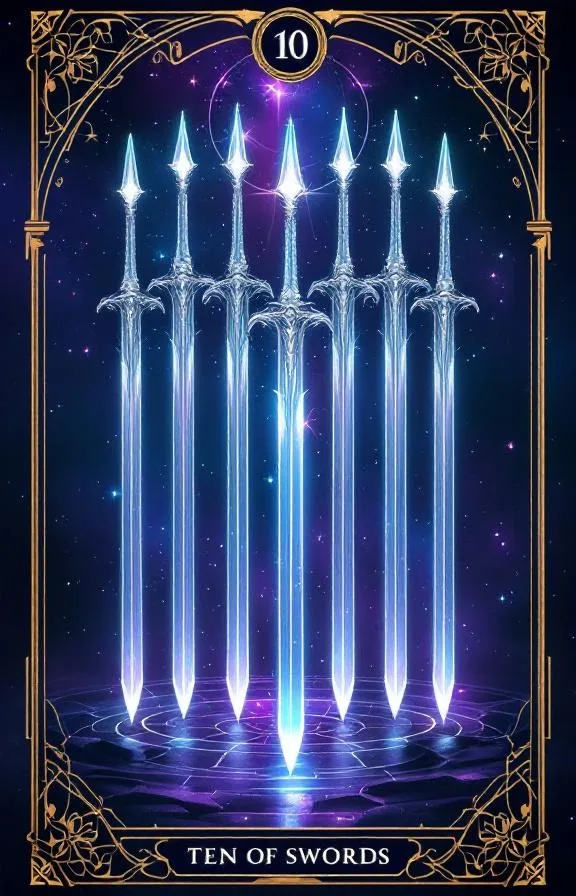
Ten swords in the back. Face down. Done. The Ten of Swords as feelings is the emotional equivalent of hitting the ground after a very long fall — the moment when the worst has actually happened and there is nothing left to dread because the thing you dreaded has arrived. It is devastating. It is also, paradoxically, the end of the devastation.
The core feeling
Devastation at the Ten of Swords level is not a feeling that arrives alone. It is the final collapse of something the person has been trying to hold together — a relationship, a belief about themselves, a life structure they built their identity around. The swords did not all land at once. They accumulated. One betrayal, then another. One failure, then another. The person kept absorbing impacts, kept standing, kept adjusting — until they could not anymore. The tenth sword is not necessarily the worst. It is just the one the body could no longer withstand.
What distinguishes this card's devastation from the Three of Swords' heartbreak is scale and finality. The Three of Swords is a wound. The Ten of Swords is a collapse. The person is not mourning a single loss. They are surveying the total wreckage of something they invested deeply in, and the scope of the damage has temporarily overwhelmed their capacity to process it.
But look at the card carefully. In most depictions, there is a sunrise on the horizon. Dawn is breaking even as the figure lies facedown. This is the card's secret: total devastation and new beginning share the same moment. The person cannot see the sunrise yet because they are looking at the ground. They will see it. Just not now.
Ten of Swords upright as feelings
Upright, the Ten of Swords represents emotions at the bottom. Rock bottom. The specific, concrete, unmistakable bottom where the person stops falling and starts lying still. They feel defeated, exhausted, and fundamentally finished with whatever brought them here. Not finished as in "I've moved on." Finished as in "I have nothing left to fight with."
The emotional texture is not dramatic. That surprises people. They expect the Ten of Swords to feel like screaming. It feels like silence. The screaming happened at Five, Six, Seven. By Ten, the person has run out of protest. What remains is a flat, gray acceptance that is not peace but something closer to surrender — the point where resistance requires more energy than the person has.
There is also a quality of dark clarity. When everything has been stripped away, you see what was underneath. The excuses dissolve. The coping mechanisms are revealed as coping mechanisms. The stories the person told themselves about who they were and why things would work out — those stories are lying in pieces alongside whatever collapsed. In that wreckage, if the person can bear to look, is something useful: the truth of their situation, undecorated and undeniable.
Ten of Swords reversed as feelings
Reversed, the Ten of Swords signals one of the most important emotional transitions in the entire tarot. The figure is getting up. Not quickly. Not gracefully. But the worst is definitively over and something in the person knows it — a stubborn, unreasonable refusal to stay down that cannot be explained by their circumstances because their circumstances still look terrible.
Recovery from Ten of Swords devastation is not linear. The reversed card captures the jerky, uneven process of rebuilding when the foundation has been destroyed. Good days interrupted by sudden drops. Moments of genuine hope followed by the return of grief so sharp it feels like the first day all over again. The person oscillates between "I survived this" and "I cannot survive this" multiple times per day.
The reversed Ten can also indicate someone who is refusing to let go of their devastation — clutching the victim narrative because the alternative, taking responsibility for what comes next, feels more terrifying than the pain of staying down. Some people find an identity in their Ten of Swords moment. Leaving it means becoming someone they have not met yet.
Ten of Swords as feelings in love
In love readings, the Ten of Swords as feelings represents the emotional aftermath of a relationship's worst moment. The affair was discovered. The truth was spoken. The decision was made. Whatever the final blow was, it has landed, and both people are dealing with the crater it left.
When this card represents someone's feelings toward you, they feel that something between you has been irreparably damaged. Not temporarily strained. Irreparably damaged. The word "irreparably" is important because Ten of Swords energy does not believe in repair. Whether that belief turns out to be accurate depends on what comes next, but right now, in this moment, the person has concluded that what you had together has been destroyed.
The most misread aspect of this card in love readings is the assumption that it always means the relationship is over. Sometimes it does. Sometimes it means a version of the relationship is over — the version built on illusions, unspoken agreements, or mutual denial. What grows in its place, if anything, will be different. Potentially better. Definitely harder-won.
Ten of Swords as feelings about you
When the Ten of Swords reflects someone's feelings about you, the association is heavy. You may represent the blow that flattened them — the person who delivered the final truth, the one who left, the one whose actions made the collapse undeniable. Being someone's Ten of Swords is a position you did not choose, and it comes with the weight of their devastation whether or not you caused it.
Give it time. The Ten of Swords is dramatic but temporary. No one stays facedown forever, and when they get up, their feelings about you will evolve.
Ten of Swords as feelings in career
Professionally, the Ten of Swords represents complete professional collapse — the business that failed, the firing that was public, the project that crashed in a way everyone will remember. The person's professional identity has taken a hit so severe that they are questioning whether they can continue in their field.
Here is what most career advice misses about the Ten of Swords: the person does not need a plan right now. They need a moment of complete stillness before the rebuilding starts. The sunrise is coming. The strategy can wait until after dawn.
Frequently asked questions
What does Ten of Swords mean as feelings?
The Ten of Swords represents devastation — the emotional experience of total collapse after a prolonged series of blows. The person feels defeated, emptied out, and unable to see a path forward. It marks rock bottom, which, while agonizing, also marks the point where things stop getting worse.
Does Ten of Swords represent positive or negative feelings?
The immediate feelings are intensely negative: defeat, devastation, the death of hope. But the Ten of Swords carries a hidden positive element — the worst is over. There is nowhere to go but up. The sunrise on the card's horizon is not sarcasm. It is a promise that the person is not yet in a position to appreciate but will, eventually, look back and recognize as the turning point.
What does Ten of Swords reversed mean as someone's feelings?
Someone feeling the reversed Ten of Swords is beginning to recover from a catastrophic emotional blow. The devastation is not forgotten but its grip is loosening. They are in the early, fragile stages of getting back up — testing whether their legs will hold them, checking whether the world is safe enough to re-engage with. Expect unevenness. Recovery from this kind of devastation is not a straight line.
Curious what Ten of Swords means as feelings in YOUR situation? Try a free AI tarot reading and explore the emotional landscape of your cards.