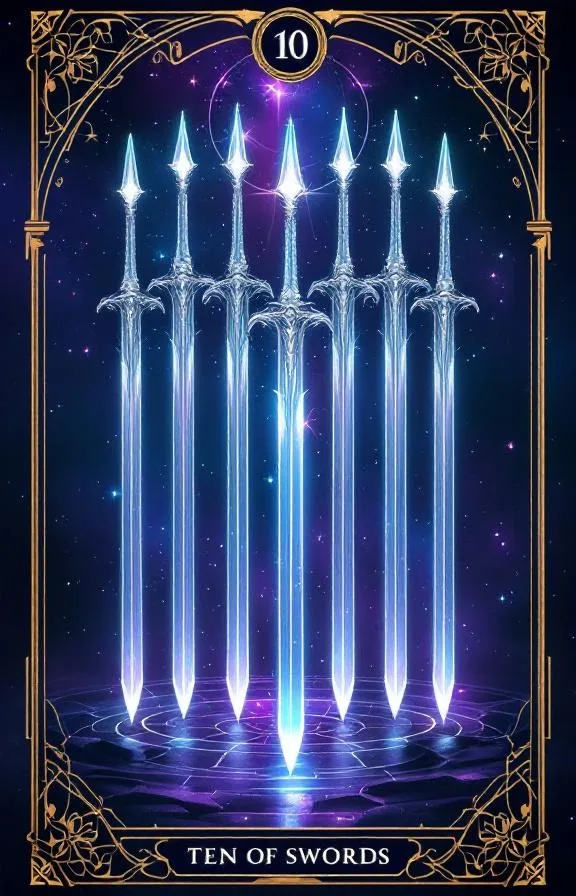
Ten swords in someone's back. Face down. Done. The Ten of Swords is the most dramatic image in the deck, and it's supposed to be — this card deals in finality. But look at the horizon line in the Rider-Waite version. The sun is rising. That detail changes everything about what this "no" actually means for you.
The quick answer
No. The situation you're asking about has reached its natural end, or it's about to. Pushing harder, hoping louder, negotiating with reality — none of it will restart what this card says is finished. The Ten of Swords is blunt. It is also, paradoxically, one of the most liberating cards you can pull. When the worst has already happened, the energy you were pouring into dread becomes available for whatever comes next.
What the Ten of Swords means upright in a yes or no reading
This card's no is not a warning. Warnings come before the thing happens. The Ten of Swords comes after.
Whatever you feared losing — the relationship, the opportunity, the version of events you were hoping for — the loss is already here or so close to arriving that prevention is no longer realistic. Elisabeth Kubler-Ross mapped the stages of grief as denial, anger, bargaining, depression, and acceptance. The Ten of Swords typically shows up somewhere between bargaining and acceptance, right at the moment when you suspect reality isn't going to budge but you haven't fully stopped trying to make it.
The card also confronts martyrdom head-on. If you've been enduring a situation that causes consistent pain while telling yourself the suffering proves your commitment, the Ten of Swords says: enough. The swords aren't badges of honor. They're a signal to get up. There is nothing noble about remaining in a position that is slowly destroying you, and calling it loyalty doesn't change what it's doing to you.
What the Ten of Swords reversed means for yes or no
The sunrise that sat on the horizon in the upright card is now directly overhead. Reversed, the Ten of Swords shifts from devastation to recovery. The answer moves from hard no to conditional maybe.
But recovery doesn't mean the pain wasn't real. You'll be tempted to minimize what happened — rush past the grief, jump into something new just to prove you've moved on. The card advises against that. Genuine recovery requires acknowledging the full weight of what ended before you can build something that isn't just a reaction to the last collapse.
For your yes-or-no question: the answer is becoming yes. Not yet. Give yourself time to heal from a position of honesty rather than haste.
Ten of Swords yes or no in love
Clear no in the upright position. This card appears when a relationship has hit its endpoint — through betrayal, through the slow accumulation of unresolved pain, through the moment when pretending becomes physically impossible. If you're asking whether to stay or reconcile, the Ten of Swords says the situation has played itself out completely.
That doesn't mean you did something wrong by caring. Some connections end not because the love was insufficient but because the dynamic itself was unsustainable. Recognizing that difference is how you avoid the self-blame trap.
Reversed in love, you're moving through the aftermath. You can imagine a future that doesn't include the person or pattern that hurt you. That's the first real sign of emotional recovery, and it should be respected, not rushed into the next relationship as proof that you're fine.
Ten of Swords yes or no in career and finances
No. This card signals job loss, a failed project, the collapse of a venture, or the end of a professional relationship. Fighting to preserve what is clearly over drains resources that belong to whatever comes next.
Financially, the Ten of Swords may point to a significant loss — an investment that didn't return, a setback that feels devastating. The card doesn't minimize that. It does say the loss is finite. The bleeding stops. Recovery begins. But only if you stop trying to bandage a wound that needs to close on its own.
Reversed here carries genuine hope. The worst professional or financial blow is behind you. New opportunities are emerging from what fell apart, or you're discovering that the loss freed you from something that was limiting your growth. This is where the next chapter starts.
Tips for reading the Ten of Swords in yes or no questions
Accept the ending. In the upright position, this card's no is not negotiable. Your energy belongs to what comes after, not what came before. Grief is appropriate. Denial is unproductive.
Notice the sunrise — even at its most severe, the Ten of Swords includes the promise of dawn. What you do after getting up matters more than the fact that you fell. Resist the martyr narrative too. If you catch yourself clinging to the pain as proof of depth or commitment, examine that impulse. Suffering is not a virtue. Learning from it is.
The reversed Ten of Swords is one of the most hopeful reversals in the entire deck. But hope and readiness aren't the same thing. Let recovery unfold at its own pace.
Frequently asked questions
Is the Ten of Swords a yes or no card?
No. It represents the definitive end of a cycle — rock bottom, a painful conclusion you can't reverse or avoid. When it appears, the advice is to release what has ended rather than trying to continue. The silver lining: endings create space for new beginnings, and the worst is already behind you.
What does the Ten of Swords reversed mean for yes or no?
Reversed shifts the answer from no toward hopeful maybe. The worst has passed and recovery is underway. The card recommends patience — jumping into new commitments before fully processing the old one risks repeating the same cycle. Give yourself real time to heal before making the next major decision.
Is the Ten of Swords the worst card in tarot?
It's the most final, not necessarily the worst. The imagery is dramatic, but it depicts a clear ending rather than an ambiguous ongoing threat. Cards like the Five of Cups or the reversed Tower can be harder to sit with because they involve sustained pain without resolution. The Ten of Swords at least gives you the clarity of knowing exactly where you stand — and that sunrise on the horizon.
