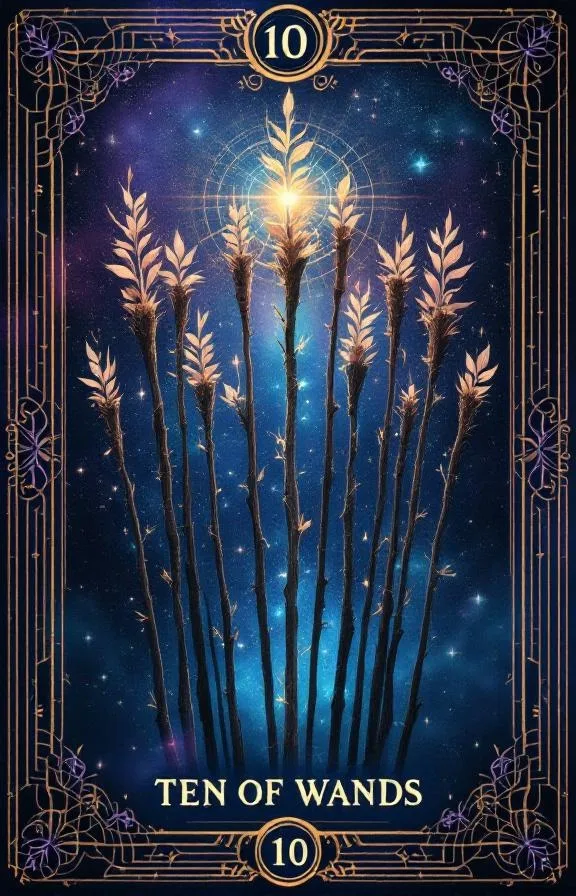
A figure hunched under ten wands, carrying all of them at once, barely able to see the path ahead. The wands are not tied together efficiently — they are clutched in a desperate armful, some sliding, others poking at awkward angles. This is not strategic. This is stubbornness made physical.
The Ten of Wands is the tarot's intervention for people who believe asking for help is the same as admitting failure.
The advice
Delegate. Put some of those wands down. The Ten of Wands appears when you have taken on so much responsibility that the weight itself has become the obstacle — not the individual tasks, but the sheer volume of them crushing your ability to do any of them well.
Here is the hardest thing this card asks you to accept: you chose this. Nobody forced ten wands into your arms. You picked them up one by one, each time telling yourself you could handle just one more. And you could, technically. You are still standing. But barely seeing the road ahead is not the same as walking it effectively.
The advice is not to abandon your responsibilities. It is to distribute them. Some of these wands belong to other people. Some were never yours to carry. And some are obligations you agreed to before you understood the total weight. The Ten says: put down the ones that are not essential to your path and hand off the ones that someone else could carry just as well.
Ten of Wands upright advice
Upright, the card describes a situation where you are overwhelmed by your own success. Strange as that sounds, it is one of the most common problems high-performers face. You said yes to too many opportunities. You took ownership of too many projects. You became the person everyone relies on, and now that reliability is crushing you.
The upright Ten advises radical prioritization. Not gentle re-ordering of your to-do list. Radical cuts. Take the ten wands in your arms and ask of each one: if I could only carry three, would this make the cut? The seven that do not survive that question need to be delegated, delayed, or dropped.
This card also challenges the belief that doing everything yourself is somehow noble. It is not. It is inefficient, unsustainable, and often rooted in control issues rather than genuine necessity. The person who delegates effectively accomplishes more than the person who carries everything, because the delegator can actually see where they are going.
Ten of Wands reversed advice
Reversed, one of two things has happened. Either you have finally started putting wands down — in which case, good, keep going — or the burden has become so overwhelming that you have collapsed under it. Burnout. Complete overwhelm. The inability to move at all because every direction requires energy you no longer possess.
If you have started lightening the load, the reversed Ten encourages you to keep going. You probably stopped too soon. You put down two wands and kept eight, telling yourself that was enough of a reduction. It was not. The reversal says: keep cutting until you can stand upright and see the horizon clearly.
If you have collapsed — if the overwhelm has crossed into burnout, depression, or physical illness — the reversed Ten says this is not a time management problem. It is a boundaries problem. Somewhere along the way, you lost the ability to say no, and the consequences have caught up with you. The recovery starts with one word: no. Practice it. Mean it. Use it before someone hands you an eleventh wand.
Ten of Wands advice in love
In love, the Ten of Wands points to imbalance. One person is carrying the relationship — emotionally, logistically, financially — while the other coasts. The advice is blunt: stop carrying your partner's share and let them feel the weight of what happens when they do not contribute.
This is not about punishment. It is about sustainability. A relationship where one person carries ten wands while the other carries none will eventually collapse, because the carrier either breaks or becomes resentful enough to leave. The Ten says: redistribute now, before the imbalance becomes irreparable.
For singles, this card often indicates that you are too burdened by other commitments to make space for love. Dating requires availability — not just calendar space, but emotional bandwidth. If every wand is spoken for, there is nothing left to offer a new connection. The advice is to lighten your load first, then open the door. Trying to date while carrying ten wands means showing up depleted, and depleted is not attractive. It is exhausting for everyone.
Ten of Wands advice in career
Professionally, the Ten of Wands is the overwork card. You know this already. You feel it in your neck, your sleep, your shortened temper. The question is not whether you are carrying too much — the card already confirmed that. The question is what you are going to do about it.
The career advice is specific: have the conversation with your manager, your partner, your team, or yourself about workload. Not a vague "I am busy" conversation. A specific conversation where you list everything on your plate, identify what can be removed or reassigned, and negotiate a sustainable load.
If you are self-employed, the Ten of Wands says your business model might be the problem. If revenue depends on you personally doing every task, you do not have a business — you have a job that also does not give you benefits. The card advises building systems, hiring help, raising prices to work with fewer clients, or restructuring so that your output does not scale linearly with your effort.
The most counterintuitive advice from this card: doing less will produce better results than doing more. The quality of your work under ten-wand pressure is compromised, even if you cannot see it. Reducing your load does not mean reducing your output — it means concentrating your effort where it has the highest impact.
Action steps
- List everything you are currently responsible for. Everything. Work tasks, personal obligations, emotional labor, side projects. Seeing the total in writing is the first step toward accepting that the load is unsustainable.
- Circle the three responsibilities that only you can do. Not the ones you prefer to do yourself. The ones that genuinely cannot be done by anyone else. Delegate, delay, or eliminate the rest.
- Say no to the next request that arrives. Whatever it is. Practice the muscle. The Ten of Wands exists because you said yes too many times. The cure is learning to say no before the weight becomes unbearable.
- Block two hours this week with nothing scheduled. Literally nothing. The Ten of Wands has consumed all your margin. You need space to think, recover, and remember what it feels like to see the road ahead clearly.
FAQ
Is the Ten of Wands telling me to quit my responsibilities?
No. It is telling you to carry fewer of them. There is a critical difference between abandoning your obligations and distributing them more intelligently. The card does not advise irresponsibility — it advises sustainability. Keep the responsibilities that are genuinely yours and central to your goals. Hand off the ones you absorbed by default, obligation, or inability to say no. The goal is a load you can carry while still seeing where you are walking.
How do I delegate when I believe nobody can do it as well as I can?
That belief is exactly the problem the Ten of Wands is diagnosing. The figure carrying ten wands is not demonstrating excellence — they are demonstrating an inability to trust others with shared work. The honest truth: other people might do it differently, and some of those differences might actually be improvements. Even if their version is 80% as good as yours, you gain the capacity to focus your full energy on the 20% that requires your specific skills. Perfection across ten tasks is worse than excellence across three.
What happens if I keep carrying all ten wands?
The card answers this directly through its imagery: you stop being able to see the path ahead. Chronic overload leads to diminishing returns, deteriorating quality, physical health consequences, and eventual burnout. The Ten of Wands is not a sustainable state — it is a crisis state. The figure in the card is moments from either reaching their destination or dropping everything. If you do not choose which wands to put down, eventually your body or your circumstances will choose for you. Deliberate reduction is always preferable to involuntary collapse.