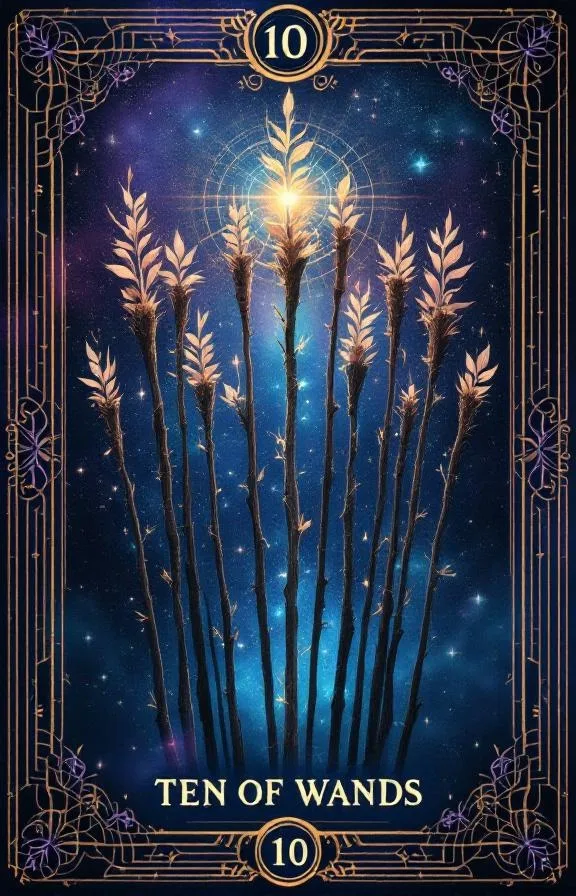
Picture carrying grocery bags from the car in one trip. All of them. Even the heavy ones. Even though you could make two trips and your back is already complaining. You refuse to put any down because stopping would mean admitting this was too much, and somewhere along the way you decided that admitting things are too much is not something you do. That stubborn, compressed, slightly ridiculous determination to carry everything alone — that is the emotional landscape of the Ten of Wands.
The core feeling
Burden. The weight of having taken on too much and the even heavier weight of feeling unable to set any of it down.
This is not the same as sadness or depression. A depressed person often cannot identify what is wrong. The Ten of Wands person knows exactly what is wrong — they have a detailed inventory of every obligation, every emotional responsibility, every promise they made that they are now struggling to keep. The problem is not confusion. The problem is overload. They said yes too many times, or they were the only person willing to carry something that should have been shared, and now the accumulated weight has become their identity. They do not know who they would be without it.
Psychologist Barry Schwartz explored a version of this in his work on the paradox of choice — specifically, how having too many options and obligations creates a paralysis that masquerades as dedication. The Ten of Wands person is not lazy. They are the opposite of lazy. They are so committed to carrying their responsibilities that they have forgotten they were supposed to be walking toward a destination, not just holding things up.
Ten of Wands upright as feelings
Upright, the Ten of Wands represents someone who feels emotionally crushed by the weight of what they are carrying — but keeps carrying it. The feelings are a specific cocktail of resentment, exhaustion, and misplaced pride. They resent the burden. They are too proud to share it. They are too exhausted to figure out which pieces could be set down safely.
In emotional terms, this person tends to express care through labor. They do things for people rather than telling people how they feel. They solve problems. They handle logistics. They absorb other people's stress. The way they show love is by making sure nothing falls apart, and the cost of this approach is that nobody sees how close they are to falling apart themselves.
Here is the uncomfortable truth about this card: some of what the person is carrying, they chose. Not all of it — some burdens are genuinely imposed from outside. But some of them were picked up voluntarily, sometimes to feel needed, sometimes to avoid the vulnerability of asking for help. The Ten of Wands as feelings always contains this thread of complicity in one's own overload.
Ten of Wands reversed as feelings
Reversed, something gives. The person either drops the load — intentionally or through collapse — or begins the process of figuring out what they can release. The emotional experience depends on which version is happening.
If the release is intentional, the feeling is a mix of guilt and profound relief. Setting down responsibilities that you have carried for a long time triggers both liberation and the anxiety of "who am I if I am not the person who handles everything?" The identity built around being indispensable is difficult to surrender even when it is destroying you.
If the release is involuntary — burnout, breakdown, a relationship that finally snaps under the weight of unspoken resentment — the feelings are messier. Shame for not being able to hold it together. Anger at everyone who watched them struggle without offering to help. Sometimes, underneath all of that, a strange gratitude that the unsustainable thing has finally ended, because they could not have ended it themselves.
Ten of Wands as feelings in love
In romantic contexts, the Ten of Wands as feelings usually points to someone who feels they are doing more than their share. They carry the emotional labor, the planning, the remembering, the keeping-things-together work that relationships require. And they are running out of willingness to do it silently.
When this card appears as a partner's feelings, pay close attention. The person is unlikely to articulate what they need because the Ten of Wands emotional style is to absorb rather than express. By the time they do say something, they have usually been feeling overwhelmed for weeks or months, and the conversation arrives with a backlog of frustration that makes it seem sudden when it is anything but.
For singles, this card as feelings about a potential relationship can signal reluctance — not lack of interest, but the feeling that adding one more thing to an already unbearable load is impossible right now. The person may genuinely want connection but feel they have no emotional bandwidth left to offer it.
Ten of Wands as feelings about you
When this card represents someone's feelings about you, they experience you as an additional weight. This sounds harsh, but it does not necessarily mean they dislike you. It means that caring about you — thinking about you, worrying about you, managing whatever dynamic exists between you — is one more thing on a list that already exceeds their capacity.
The actionable insight: this person may need you to take something off their plate, not add to it. Showing care means making their life simpler, not more complicated.
Ten of Wands as feelings in career
Professionally, the Ten of Wands as feelings is the most literal card in the deck. The person feels overworked. Not "busy" — genuinely crushed by their workload in a way that has crossed from stressful into physically and emotionally damaging. They are the colleague who answers emails at midnight and has not taken a real vacation in two years and responds to "how are you?" with "busy!" in a voice that is trying very hard to sound cheerful.
The feeling underneath the performance is usually a fear of being replaceable. If they stop being the person who handles everything, what value do they have? That question drives the compulsion to keep picking up wands long after their arms have started shaking.
Frequently asked questions
What does Ten of Wands mean as feelings?
Ten of Wands represents the feeling of being emotionally overburdened — carrying too many responsibilities, too many worries, or too much of other people's weight. The person cares deeply but has taken on more than they can sustain, and the strain is becoming visible.
Does Ten of Wands represent positive or negative feelings?
Mostly negative in terms of how the person feels, though the underlying motivation is often positive — the burden comes from caring too much, not too little. The pain is real, but so is the dedication that created it. It is a card of exhaustion born from genuine commitment.
What does Ten of Wands reversed mean as someone's feelings?
Reversed, it indicates someone who is beginning to let go of burdens — either by choice or because they have hit their breaking point. They may be delegating, withdrawing, or finally acknowledging that they cannot carry everything alone. The dominant feeling is relief mixed with guilt about setting things down.
Curious what Ten of Wands means as feelings in YOUR situation? Try a free AI tarot reading and explore the emotional landscape of your cards.