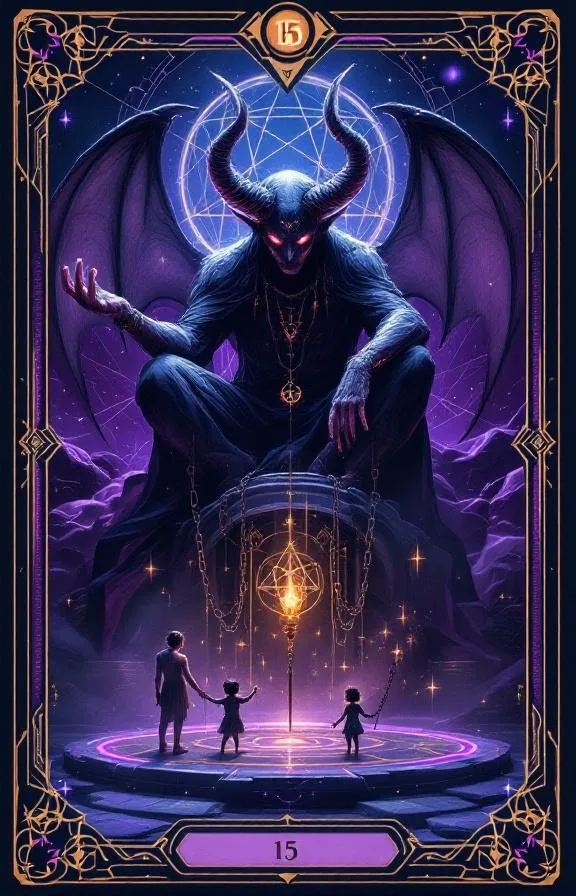
He walks into the bar and every head turns. Not because he is the best-looking person in the room — though he might be — but because he carries himself with a confidence that suggests he knows something you do not and is thoroughly enjoying that advantage. The Devil person is magnetic, dangerous, and more honest than most people give them credit for. They are the friend who talks you into the terrible idea you secretly wanted to do anyway, the ex you cannot stop thinking about, the colleague who somehow gets away with saying exactly what everyone else is censoring. They are fun. God, they are fun. And they are expensive.
The personality profile
The Devil archetype produces a person with an unusually direct relationship to desire. Most people maintain a careful distance between what they want and what they allow themselves to pursue. Social conditioning, fear of judgment, internalized rules about who they should be — these barriers keep desire in check. The Devil person has either dismantled those barriers or never had them in the first place.
This does not make them immoral. It makes them amoral, which is a crucial distinction that most people miss. The Devil person is not trying to violate your value system. They are simply operating outside of it. They pursue pleasure, power, sensation, and experience with a directness that feels liberating to some and predatory to others, depending largely on how comfortable the observer is with their own desires.
Their charisma is real and it is strategic. The Devil person understands human motivation at a level that would make most psychologists envious. They know which buttons to push because they have spent their lives studying the control panel. This knowledge can be used to manipulate, and sometimes it is. But it can also be used to liberate. The best version of the Devil person helps you see the chains you did not know you were wearing.
The Devil upright as a person
Upright, the Devil person is someone who has made peace with the shadow. They know their appetites, their darker impulses, their capacity for selfishness — and they have integrated these into a personality that is startlingly whole. They do not pretend to be better than they are. This radical self-honesty is their greatest strength and the source of their magnetic pull.
They are permission granters. Around the Devil person, you suddenly find yourself doing things you would normally suppress. Saying the unsayable opinion. Ordering the dessert. Quitting the job you hate. They do not pressure you into these things. Their own unapologetic existence simply makes your self-imposed restrictions feel optional, which — and this is the uncomfortable truth the Devil person exposes — they always were.
Here is the controversial take: most people need a Devil person in their life. Not as a permanent fixture. Not as a partner, necessarily. But as a periodic encounter that reminds them how much of their behavior is driven by fear of judgment rather than genuine values. The Devil person forces a reckoning with the question of what you actually want versus what you have been taught to want. That reckoning is uncomfortable. It is also essential.
The Devil reversed as a person
The reversed Devil person has lost the playful edge. What remains is the manipulation without the charm, the desire without the self-awareness, the pursuit of pleasure without any understanding of cost. They become the addict, the compulsive liar, the person who uses people the way other people use objects — functionally, without attachment, and with full disposal after use.
They gaslight. The reversed Devil person will convince you that your boundaries are unreasonable, your jealousy is controlling, your needs are excessive. They reframe their behavior so skillfully that you end up apologizing for being upset by something they did. This is not a skill — it is a weapon, and the reversed Devil person wields it without conscience.
The chains in the tarot image are loose. The figures could leave if they wanted to. The reversed Devil person makes sure you never notice how loose the chains actually are. They create dependency through intermittent reinforcement — occasional warmth in a sea of neglect, just enough connection to keep you hoping for more. B.F. Skinner documented how variable reinforcement schedules produce the most persistent behaviors in laboratory settings. The reversed Devil person runs this experiment on humans.
The Devil as a person in love
In love, the Devil person is intoxicating. There is no other word that captures it. They make you feel alive in a way that rewires your definition of alive. Colors seem brighter when they are around. Food tastes better. Music sounds different. The intensity of their attention, when directed at you, produces a biochemical response that is indistinguishable from actual addiction — and that comparison is not metaphorical.
The problem is sustainability. The Devil person in love operates at a frequency that human relationships cannot maintain indefinitely. The early phase is extraordinary. Electric. Unlike anything you have experienced. The middle phase, where the intensity needs to stabilize into something sustainable, is where things collapse. They get bored. You get exhausted. The gap between the highs and the lows widens until the lows become unbearable and the highs become the only thing keeping you there.
Loving a Devil person well — and being a Devil person who loves well — requires acknowledging this pattern and actively building structures that contain it. Boundaries. Space. Honest conversation about what each person can actually sustain.
The Devil as a person at work
Professionally, the Devil person excels in roles that leverage their understanding of human desire. Marketing, sales, entertainment, negotiation, politics. They are the closer, the person you bring in when the deal needs to happen today. They read the room faster than anyone else and they know exactly what to offer each person at the table to get them to say yes.
Their risk is ethical drift. The Devil person in a high-pressure environment will cut corners that others would not, justify shortcuts with results, and gradually normalize behavior that began as an exception. They need guardrails — not because they lack intelligence, but because their tolerance for moral ambiguity is higher than most people's.
The Devil as someone in your life
You will recognize the Devil person by your own response to them. Do you feel simultaneously attracted and uneasy? Do you find yourself doing things around them that you would not normally do? Do conversations with them leave you buzzing with energy and slightly uncertain about your own judgment? That is the Devil archetype at work.
The key to relating to them is maintaining your own center. The Devil person does not respect people they can overwhelm — not because they are cruel, but because overwhelming someone is too easy to be interesting. Push back. Say no. Hold your ground. The Devil person who encounters genuine resistance becomes their most interesting self, because you have just become the one person in the room who is not playing the game they already know how to win.
Frequently asked questions
What kind of person does The Devil represent?
The Devil represents a charismatic provocateur with an unusually direct relationship to desire, power, and pleasure. They are magnetically attractive, deeply self-aware in their upright form, and skilled at reading human motivation. They challenge social conventions and force the people around them to examine what they actually want.
Is The Devil as a person positive or negative?
Both, simultaneously, which is exactly what makes them The Devil. Upright, they offer genuine liberation from unconscious patterns and self-imposed limitations. Reversed, they become manipulative and exploitative. The critical variable is self-awareness — a Devil person who understands their own power and uses it with intention is a force for growth. One who operates on autopilot is dangerous.
How do you recognize a Devil person?
Trust your nervous system. The Devil person produces a specific physiological response: heightened alertness, increased heart rate, a feeling of being both drawn in and warned. They are the person who makes you slightly reckless, who you think about more than seems proportional, and whose absence creates a void that feels larger than it should given how much time you actually spent together.