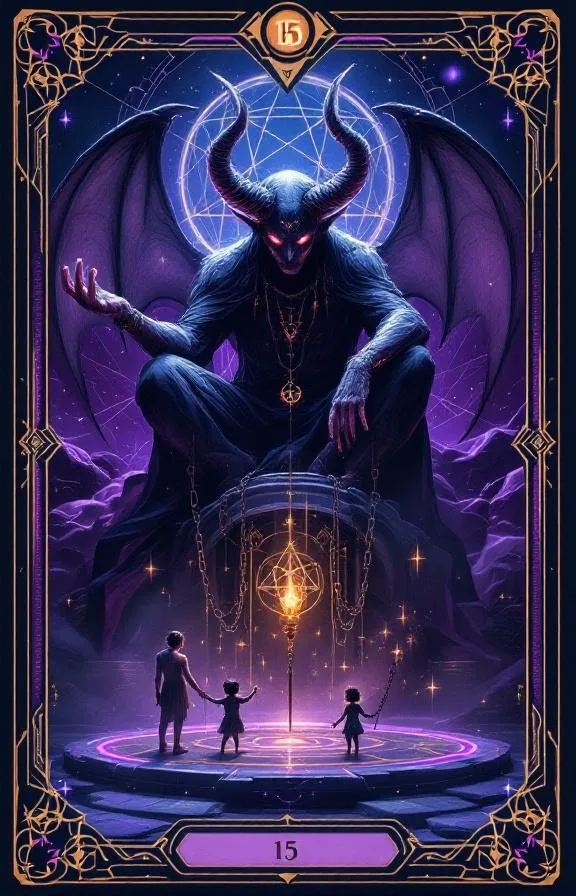
Most people misread The Devil when it appears in an emotional context. They see horns and chains and assume it means something sinister. But the emotional reality this card points to is far more common and far more human than that — it is the experience of wanting something so intensely that the wanting itself becomes the dominant feeling, eclipsing reason, perspective, and sometimes even self-interest. You know the sensation. A craving that organizes your entire day around it. A person whose text notification rewires your nervous system. The Devil as feelings is the card of emotional gravity so strong it bends your orbit.
The core feeling
The Devil's emotional signature is obsession — not the clinical kind that requires intervention, but the ordinary kind that most people experience at some point and rarely discuss honestly. It is the feeling of being pulled toward someone or something with a force that feels external, even though it originates entirely inside you. The chain around your neck looks locked. It is not. But taking it off would mean confronting the emptiness underneath the fixation, and that prospect is more frightening than the fixation itself.
Dorothy Tennov coined the term "limerence" in 1979 to describe this exact emotional territory — an involuntary state of intense romantic longing that distorts perception, creates emotional dependency on reciprocation, and persists even when the person experiencing it recognizes it as irrational. The Devil as feelings occupies the space where limerence shades into compulsion. The difference between "I really like this person" and "I cannot stop thinking about this person even though I know it is not good for me."
What makes The Devil psychologically honest — and why I think it is one of the most underrated cards in emotional readings — is that it refuses to pretend desire is always noble. Sometimes what you feel most intensely is not what serves you best. That tension between intensity and wisdom is the card's real territory.
The Devil upright as feelings
Upright, The Devil as feelings indicates a consuming emotional fixation. The person experiencing this is deeply, magnetically drawn to someone or something and they are fully aware of the pull. This is not casual interest. It is the kind of feeling that wakes you at 3 AM, that turns a phone into a surveillance device, that makes you rehearse conversations that may never happen.
The person may feel simultaneously exhilarated and trapped. The intensity itself becomes addictive — even the pain of uncertainty feels preferable to the flatness of not caring. They have built an emotional dependency that feels like need rather than choice, and they may struggle to distinguish between love and attachment, between genuine connection and the neurochemical loop of anticipation and reward.
There is often a sexual dimension. The Devil's upright energy is embodied, urgent, physical. The feelings are not just in the head — they register in the body as heat, tension, restlessness. Someone experiencing these feelings toward you is not thinking about long-term compatibility. They are thinking about proximity. About contact. About the next time.
The Devil reversed as feelings
Reversed, The Devil signals the beginning of emotional release from an obsessive pattern. The chains are loosening. The person is starting to see their own feelings with clarity — recognizing that what felt like passion may have been compulsion, that what they called love may have been a fear of being alone wearing a costume.
This is not a comfortable emotional state. Liberation from obsession comes with withdrawal, and withdrawal feels like loss even when the thing being lost was harmful. The person may oscillate between relief and grief, between "I'm finally free" and "but I miss the intensity." Breaking an emotional addiction follows the same neurological pattern as breaking any other kind. The brain protests the removal of its preferred stimulation.
In some readings, The Devil reversed indicates someone who has already gained enough distance from their fixation to feel embarrassed by how consuming it was. They look back at their own behavior — the constant checking, the emotional spirals, the compromises they made to stay close to the source — and feel a sharp, clarifying shame. That shame, uncomfortable as it is, is actually a sign of recovery.
The Devil as feelings in love
In romantic readings, The Devil as feelings is the most honest representation of the "I know this isn't healthy but I cannot stop" experience. The person is consumed by their partner or love interest in a way that has crossed from enthusiasm into dependency. They may idealize the other person. They may tolerate treatment they would advise a friend to walk away from. The feelings are real — intensely, undeniably real — but they are running on a loop that has more to do with the person's internal wiring than with the actual relationship.
When The Devil represents a partner's feelings toward you, the attraction is powerful but possessive. They want closeness, but their version of closeness can look like control — needing to know where you are, getting disproportionately upset by small distances, interpreting independence as rejection. This is not necessarily malicious. Often it is someone whose attachment system runs hot, someone who learned early that love was unreliable and developed an intensity of grip as compensation.
For established relationships, The Devil as feelings suggests a bond that has become more about habit and fear than about genuine choice. Both partners may be staying because leaving feels impossible rather than because staying feels right. The emotional texture is heavy, charged, and strangely intimate — two people bound by their mutual inability to let go.
The Devil as feelings about you
When The Devil represents someone else's feelings about you, you have become their fixation. They think about you more than they would admit. You occupy a disproportionate amount of their mental real estate, and they are not entirely comfortable with how much power that gives you over their emotional state.
This can feel flattering. Being the object of someone's obsession provides a particular kind of validation — the sense that you matter intensely to another person. But it is worth recognizing what this card actually describes: the person's feelings are more about their own internal dynamics than about who you actually are. You have become a screen onto which they project their needs. The version of you they are obsessed with may have limited resemblance to the version of you that exists.
The Devil as feelings in career
Professionally, The Devil as feelings describes an unhealthy emotional attachment to work, status, or financial security. The person feels chained to their career — not because they love it, but because they have built an identity around it that they cannot imagine dismantling. The golden handcuffs are emotional, not just financial.
This can also indicate feelings of being trapped by a toxic work environment or a manipulative colleague. The person knows the situation is damaging them, but the comfort of the familiar — even a harmful familiar — feels safer than the uncertainty of change. They keep showing up, keep tolerating it, keep telling themselves "it's not that bad" while their body accumulates the stress their mind refuses to acknowledge.
Frequently asked questions
What does The Devil mean as feelings?
The Devil represents obsessive, consuming feelings — desire that has crossed from healthy attraction into fixation. It signals an emotional state where wanting something or someone has become the organizing principle of the person's inner life, often at the expense of balance and self-awareness.
Does The Devil represent positive or negative feelings?
Neither, exactly. The feelings are intensely real and powerful, but they tend to be binding rather than freeing. Upright, the intensity can feel thrilling but usually involves some loss of autonomy. Reversed, the card indicates growing awareness that the intensity was masking a deeper issue — which is uncomfortable but ultimately healthier.
What does The Devil reversed mean as someone's feelings?
Reversed, The Devil means someone is waking up from an emotional obsession. They are beginning to see the pattern clearly — the dependency, the compulsion, the ways they surrendered their own judgment to the pull of the fixation. The feelings are shifting from "I need this" to "I needed to believe I needed this." It is a painful but genuine form of emotional growth.
Curious what The Devil means as feelings in YOUR situation? Try a free AI tarot reading and explore the emotional landscape of your cards.