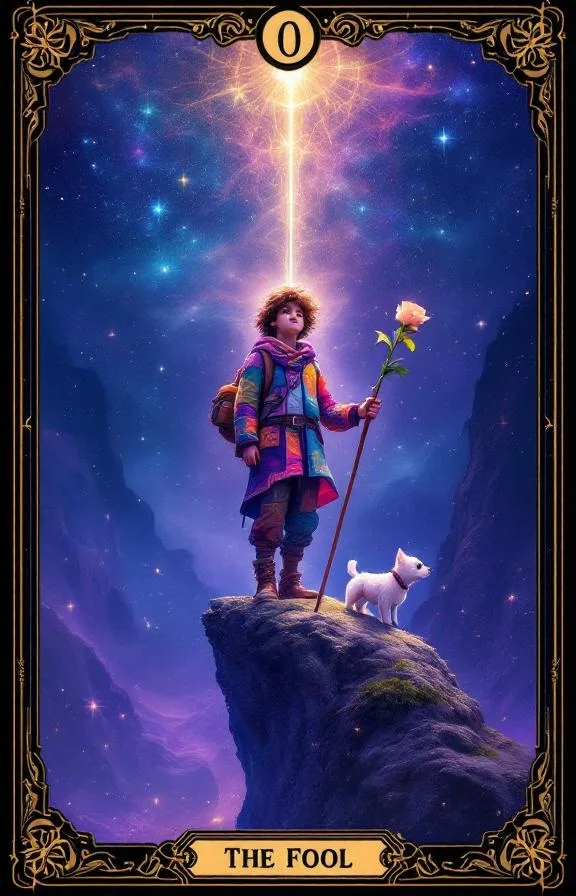
There is a specific feeling most people can recall if they try: the morning before a trip to a country you have never visited, or the first day at a job that excites and terrifies you in equal measure. Your stomach is doing something unusual. Your thoughts keep jumping forward. That particular blend of giddiness and vertigo — where anticipation overpowers caution and the unknown feels more magnetic than threatening — is the emotional territory The Fool occupies when it shows up as feelings in a reading.
The core feeling
The Fool's dominant emotional energy is uncalculated openness. Not optimism exactly, because optimism implies a prediction that things will work out. This is something more raw — the willingness to step forward without requiring a guarantee. Psychologically, it maps onto what Barbara Fredrickson identified in her broaden-and-build theory: certain emotional states — joy, interest, awe — literally expand our perceptual field and make us more willing to explore, experiment, and take social risks. The Fool as feelings represents that broadened state turned up to maximum volume.
What makes this card psychologically interesting is that The Fool's openness is pre-rational. It arrives before the cost-benefit analysis. Before the spreadsheet of pros and cons. Before the friend who says "are you sure about this?" The feeling exists in a narrow window between impulse and evaluation, and people experiencing it often describe a sense of lightness that borders on recklessness. They know, on some level, that they are exposed. They just don't care yet. This is not naivety, though it can look identical from the outside — naivety assumes safety because it cannot imagine danger, while The Fool's energy assumes possibility because the desire to move forward has temporarily made the dangers feel small.
The Fool upright as feelings
When The Fool appears upright as someone's feelings, the person is experiencing a rush of emotional freedom. Constraints that normally govern their behavior — fear of rejection, concern about looking foolish, anxiety about the future — have loosened their grip. They feel unburdened. Available. Ready to say yes to something they would normally deliberate over for weeks.
This often shows up at the very beginning of an emotional experience. A new crush. A sudden creative inspiration. The impulse to quit everything and start over. The feeling has a quality of "first morning" to it — everything sharper and more vivid because the emotional filters that normally dull experience have been temporarily removed. Genuine joy, but it carries an edge of vulnerability the person may not fully register.
Someone feeling The Fool's upright energy tends to act before they think. They text back immediately. They make grand gestures. They commit to things with their whole chest. The feeling is contagious — but it can also make others nervous, because the lack of calculation reads as instability to anyone operating from a more guarded position.
The Fool reversed as feelings
Reversed, The Fool's emotional energy turns inward and stalls. The openness is still there somewhere underneath, but it has been blocked by something — usually fear dressed up as practicality. The person wants to leap. They can see the edge. But their feet will not move.
This creates a particular kind of emotional frustration. The desire for freedom presses against an internal resistance that shows up as procrastination, self-sabotage, or a sudden obsession with worst-case scenarios. Often what is holding the person back is an old experience of having been punished for spontaneity — a relationship where enthusiasm was mocked, a risk that went badly enough to install permanent caution.
Reversed Fool feelings can also signal recklessness that has already happened and is now producing regret. The leap was taken without looking, and the landing was hard. The emotional state is a queasy mix of "I should have known better" and the recognition that part of them would do it again.
The Fool as feelings in love
In romantic contexts, The Fool as feelings almost always indicates the early, intoxicating phase of attraction where another person feels like an undiscovered country. The feeling is butterfly-adjacent but bigger — less "do they like me?" and more "I want to know everything about this person and I don't care what it costs." It is the emotional state that makes people drive three hours for a first date or stay up until 4 AM talking to someone they met that afternoon.
When this card represents a partner's feelings, it suggests they are emotionally available in a way that is unusual for them. Defenses are down. The walls they normally maintain have been set aside, at least temporarily. Worth appreciating — but it also means the person is more easily hurt than they appear. The confidence of The Fool's energy can mask genuine vulnerability.
For established relationships, The Fool as feelings indicates a renewal — a second wind where one or both partners rediscover the sense of adventure that originally drew them together. Moving cities, opening a business together, starting a family. The shared feeling is "we don't know exactly what we're doing, and that's exciting."
The Fool as feelings about you
When The Fool represents how someone else feels about you, they see you as a fresh possibility. Something about your presence disrupts their routine emotional patterns. You make them want to try things. You make the world feel slightly larger than it did before you showed up.
This is flattering, but worth understanding clearly: the person's feelings are partly about you and partly about what you represent. You have become associated with freedom, novelty, and potential. That association can be powerful and genuine, but the person has not yet seen you fully — they are responding to the version of you that fits their desire for something new.
The Fool as feelings in career
At work, The Fool as feelings signals someone who is emotionally energized by a new professional direction. They feel entrepreneurial. Restless. The current structure feels too small, and something — a project, a role, a completely different field — is pulling them forward with an urgency that overrides practical concerns like salary stability or title progression.
This emotional state produces some of the best professional work people are capable of, because the internal censor that normally edits ideas has been temporarily silenced. It also produces some of the worst professional decisions. Enthusiasm without due diligence is just momentum without direction.
Frequently asked questions
What does The Fool mean as feelings?
The Fool represents feelings of excitement, openness, and willingness to take emotional risks. It signals a state where someone feels free from their usual fears and defenses — ready to embrace something new without needing guarantees.
Does The Fool represent positive or negative feelings?
Mostly positive. Upright, it carries genuine joy and emotional availability. Reversed, the energy becomes anxiety, hesitation, or regret after impulsive action. Even reversed, though, the underlying desire for freedom and new experience remains — it is just struggling to express itself constructively.
What does The Fool reversed mean as someone's feelings?
Reversed, The Fool indicates someone who wants to open up but feels blocked by fear, past disappointment, or self-doubt. They are drawn to you or to a situation but cannot act on it. They may have already acted too quickly and now feel exposed about how much they revealed.
Curious what The Fool means as feelings in YOUR situation? Try a free AI tarot reading and explore the emotional landscape of your cards.