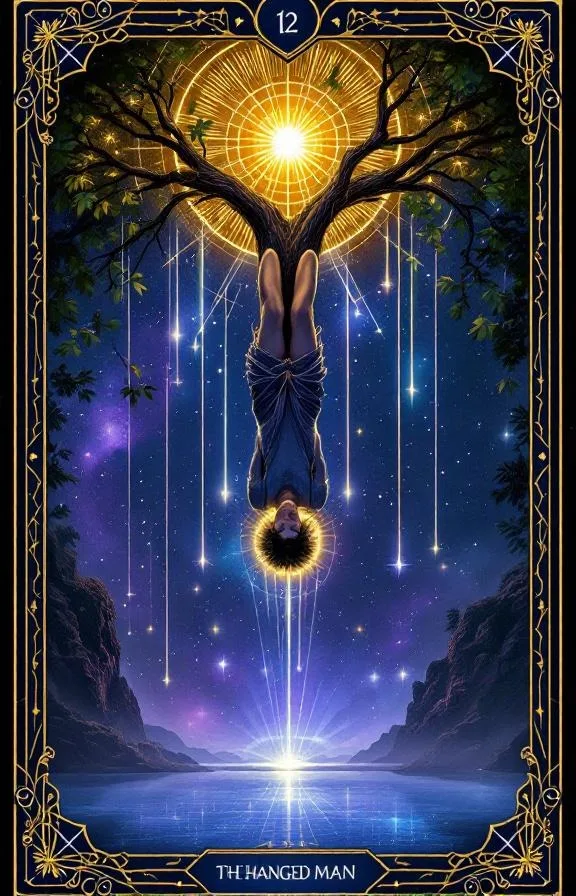
He is the one at the dinner party who has been quiet for forty minutes and then says something that rearranges how everyone at the table thinks about the topic. The Hanged Man person lives at an angle to the world. Not against it. Not above it. Just tilted enough that they see patterns and connections that escape people standing upright. They are comfortable in the pause where everyone else is scrambling for the next move. They are the friend who took a year off to live in a monastery and came back somehow more functional, not less.
The personality profile
The Hanged Man personality is defined by a willingness to wait that borders on the supernatural. In a culture that worships speed, productivity, and visible progress, this person sits still. Not because they are lazy — the Hanged Man person often works intensely, just on timelines that make no sense to outside observers. They spend three months thinking about a decision that someone else would make in an afternoon. Then they make it in a single sentence and it is obviously, infuriatingly correct.
Their worldview tends toward the paradoxical. They distrust binaries. They see the trap in most either/or framings and refuse to choose between options they believe are both wrong. This drives action-oriented people absolutely insane. "Just pick one!" people shout at them, and they smile in a way that makes the shouters want to throw things.
What looks like passivity is actually perception operating at a different speed. The Hanged Man person is processing inputs that most people filter out — social dynamics that no one else noticed, emotional undercurrents in a conversation, the thing someone almost said but swallowed. They catch the swallowed thing. They always catch the swallowed thing.
The Hanged Man upright as a person
Upright, the Hanged Man person is someone who has genuinely learned to derive insight from surrender. They have faced situations where every option was wrong, and instead of forcing a bad choice, they chose to wait — and discovered that waiting itself was the answer. This is not a lesson most people learn. Most people who are forced to wait simply endure it. The Hanged Man learned something from it.
They make remarkable advisors. Because they do not rush to judgment, their perspective has a depth that quick thinkers often lack. When you bring a problem to the Hanged Man person, they will not immediately offer solutions. They will ask questions. Strange questions, sometimes. Questions that seem unrelated until you realize, twenty minutes later, that they were circling toward the actual issue beneath the issue you presented.
Their sacrifice is real, though. The Hanged Man person has usually given up something significant to become who they are — conventional ambition, social approval, the comfort of fitting in. They chose a path that looked like losing to everyone around them and discovered it was a different kind of winning. But the giving up was not painless, and most Hanged Man people carry a quiet awareness of what their unconventional path cost them, even when they would not trade it.
The Hanged Man reversed as a person
The reversed Hanged Man is stuck. Genuinely, profoundly, frustratingly stuck. The contemplative patience of the upright version has collapsed into stagnation. They are not waiting for insight anymore. They are just waiting. The pause that was once pregnant with possibility has become barren, and they have confused the act of staying still with the virtue of patience.
This person martyrs themselves. Constantly. They sacrifice without being asked and then resent the people they sacrificed for. They take the worst shift, the smallest room, the coldest seat — and they make sure you know about it, not through direct complaint (that would violate their self-image as the selfless one) but through a constant low hum of suffering that fills every interaction.
The reversed Hanged Man has also lost the ability to make decisions. Not because they are weighing options with careful deliberation, but because every option terrifies them equally. They have become so accustomed to the suspended state that commitment to any direction feels like a kind of death. They would rather hang indefinitely than risk choosing wrong.
The Hanged Man as a person in love
In romance, the Hanged Man person loves differently. They are not performative. They will not flood you with grand gestures or constant verbal affirmation. Their love shows up in attention — in remembering things you said once, months ago, that you have already forgotten yourself. In noticing when your mood shifts before you have processed the shift. In being present in a way that is almost unnerving because most people are only partially present, and you have grown accustomed to that partial attention.
The difficulty is pace. The Hanged Man person commits slowly. Agonizingly slowly, if you are the type who knows what they want and cannot understand why someone needs six months to decide whether this is a relationship or a really long audition. They are not playing games. They are genuinely deliberating. The investment they make once they do commit tends to be profound and lasting, but getting there requires a tolerance for ambiguity that not everyone possesses.
Carl Jung observed that the psyche resists rushing, that genuine transformation requires a period of incubation where the old self dissolves before the new one can form. The Hanged Man person applies this principle to love whether they have read Jung or not. They do not fall in love. They descend into it, carefully, with their eyes open, checking the depth at every stage.
The Hanged Man as a person at work
Professionally, the Hanged Man is the strategist who sees five moves ahead but cannot always explain why. They are maddening in deadline-driven environments because their best work emerges on its own schedule, which rarely aligns with the project timeline posted in the conference room. When given autonomy, they produce insights that change the direction of entire projects. When micromanaged, they produce nothing.
They gravitate toward research, philosophy, therapy, creative direction, and any role that rewards deep thinking over fast output. They are terrible in sales. Terrible.
The Hanged Man as someone in your life
You recognize the Hanged Man person by the quality of their silence. Most people are silent because they have nothing to say. The Hanged Man person is silent because they have too much to say and are selecting. When they do speak, the room shifts.
Relating to them requires accepting that their timeline is not your timeline and that pressuring them to speed up will produce either withdrawal or resentment. Ask them what they are thinking. Then wait. The answer, when it arrives, will be worth the pause.
Frequently asked questions
What kind of person does The Hanged Man represent?
The Hanged Man represents a contemplative, unconventional thinker who gains wisdom through patience and voluntary surrender. They see the world from angles that elude more action-oriented personalities, and their insights often arrive in unexpected forms.
Is The Hanged Man as a person positive or negative?
The upright expression is deeply positive — a person of rare wisdom who has genuinely learned from letting go. Reversed, the same traits curdle into stagnation and martyrdom. The difference is whether the stillness is purposeful or merely stuck. A Hanged Man who has lost their sense of purpose becomes someone who confuses suffering with depth.
How do you recognize a Hanged Man person?
Look for the quiet observer who seems comfortable when everyone else is anxious. They are the person who does not rush to fill silences, who asks unusual questions, and whose advice tends to arrive sideways — not as direct instructions but as reframings that make you see your situation differently.