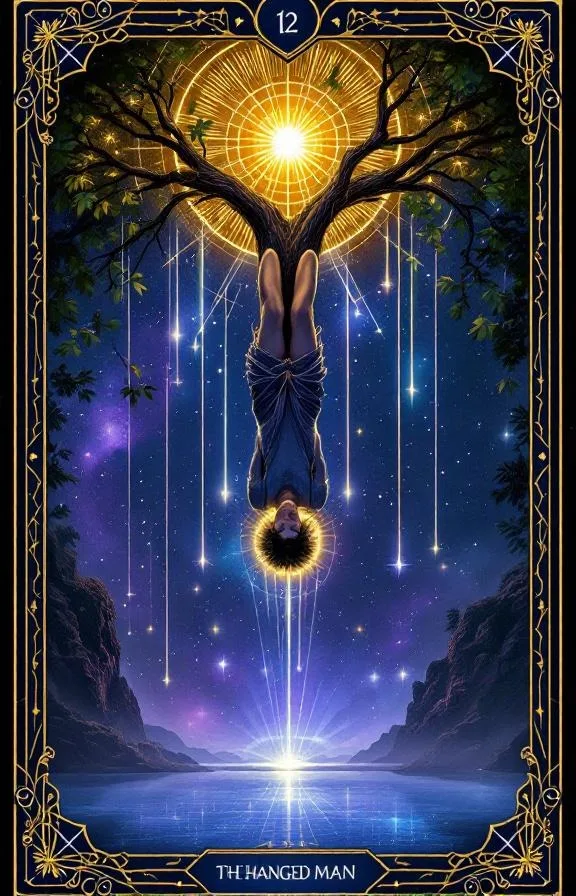
There is a moment in the middle of a long illness, or a stalled negotiation, or a relationship that refuses to move forward or end, when something inside you just stops fighting. Not giving up — that implies defeat. Something quieter. The muscles you did not realize you were clenching finally release. The Hanged Man as feelings captures that specific surrender: the emotional state of choosing to hang suspended, to stop forcing outcomes, and to discover what becomes visible only when you stop thrashing.
The core feeling
Surrender gets a bad reputation because people confuse it with weakness. The Hanged Man's version of surrender is closer to what Zen traditions call wu wei — effortless action, or more precisely, the discipline of not acting when action would be counterproductive. The feeling is paradoxical. You are stuck, but the stuckness has become peaceful. You have exhausted your strategies, your plans, your attempts to push the situation into the shape you wanted, and in the exhaustion you have found something unexpected: rest.
Psychologically, this maps onto the concept of radical acceptance described by Marsha Linehan in her work on dialectical behavior therapy. Radical acceptance does not mean approving of your circumstances. It means stopping the internal war against reality. The Hanged Man as feelings represents the moment that war ends — not with victory or defeat, but with the recognition that fighting reality is the primary source of suffering, and you can just stop.
The feeling is disorienting at first. Then strangely spacious. Like stepping off a treadmill and realizing how much energy the running was consuming.
The Hanged Man upright as feelings
Upright, The Hanged Man indicates someone who has voluntarily entered a state of emotional suspension. They are not being held hostage by circumstances — they have chosen to pause. To wait. To let the situation reveal its own logic before imposing theirs.
This is an uncommon feeling in a culture that treats hesitation as failure. The person experiencing upright Hanged Man energy has decided that the most powerful thing they can do right now is nothing. Not the lazy nothing of avoidance, but the intentional nothing of a person who understands that some situations need time to ripen and premature action would only complicate them. This takes genuine courage, which is why the traditional card imagery shows the figure peaceful rather than distressed.
Their emotional landscape is characterized by receptivity. They are absorbing information. Noticing patterns. Seeing the situation from angles that were invisible while they were busy reacting. People around them may interpret this stillness as passivity or indecision. It is neither. It is the emotional equivalent of a photographer waiting for the exact right light.
The Hanged Man reversed as feelings
Reversed, the surrender collapses into stagnation. The person is stuck, but unlike the upright position, they have not chosen it and they are not at peace with it. They feel trapped. Suspended against their will. Every instinct says move, act, fix this — and every attempt to do so fails or makes things worse.
This produces a feeling that is genuinely agonizing. Helplessness without acceptance. The reversed Hanged Man person is hanging upside down and all the blood is rushing to their head and they cannot find the rope to cut themselves free. They may lash out at people who suggest patience, because patience implies a timeline and they cannot see one.
There is also a version of the reversed Hanged Man where the person is clinging to a sacrifice that has outlived its purpose. Staying in a difficult situation because they have invested so much suffering in it that leaving feels like wasting the suffering. Sunk cost fallacy, but emotional rather than financial. They keep hanging because the alternative — admitting that the hanging was pointless — is a truth they are not ready to absorb.
The Hanged Man as feelings in love
In romantic contexts, The Hanged Man as feelings signals a willingness to sacrifice personal comfort for the relationship. The person has set aside their ego, their timeline, their need to be right, and is waiting for the other person to arrive at their own readiness. This is love at its most patient and its most painful.
The feeling carries a bittersweet quality that is easy to romanticize and difficult to live with. The person is saying, in effect: "I will wait. I will not pressure you. I will hang here in this uncertain space for as long as it takes." Beautiful in theory. Excruciating in practice. The question worth asking is whether this patience is wisdom or self-abandonment dressed up as devotion.
For couples navigating a rough patch, The Hanged Man as feelings from one partner often indicates they have reached the end of their strategies. They have tried talking, fighting, compromising, giving space — nothing has resolved it. And in the absence of a solution, they have found a temporary peace with the not-knowing. The relationship feels suspended. Frozen. But the ice is thin enough to see through, and what is underneath still matters to them.
The Hanged Man as feelings about you
When The Hanged Man represents how someone feels about you, you have put them in a position of willing vulnerability. They have surrendered something — control, certainty, their usual emotional defenses — because of you. Not reluctantly. Deliberately. They have decided you are worth the discomfort of hanging in uncertainty.
This is a profound form of emotional investment that does not look like investment from the outside. The person may appear passive, even indifferent. Internally, they are holding still with immense effort. Their stillness is not distance. It is discipline.
The Hanged Man as feelings in career
Professionally, The Hanged Man as feelings shows someone who has stopped trying to force their career into a specific trajectory. They may be between roles, waiting on a decision that is out of their hands, or reassessing what they actually want from work after years of pursuing goals that no longer resonate.
The feeling is uncomfortable but potentially generative. The best career pivots often emerge from periods of suspension — when someone stops climbing long enough to notice they are on the wrong mountain. The challenge is tolerating the gap between letting go of the old direction and discovering the new one. That gap is where the Hanged Man lives, and the person feeling this card is learning to live there too.
Frequently asked questions
What does The Hanged Man mean as feelings?
The Hanged Man represents surrender, voluntary suspension, and the paradoxical peace that comes from stopping the fight against circumstances you cannot control. It signals someone who has chosen patience over action — not from weakness, but from the recognition that stillness is the most powerful response available to them right now.
Does The Hanged Man represent positive or negative feelings?
Upright, the feelings are quietly positive — peaceful suspension, spiritual patience, and openness to perspectives that only emerge through waiting. Reversed, the same suspension becomes involuntary and distressing, producing feelings of helplessness, stagnation, and frustrated inability to move forward. The difference is entirely about whether the person chose the pause or had it forced upon them.
What does The Hanged Man reversed mean as someone's feelings?
Reversed, The Hanged Man means someone feels stuck without the consolation of having chosen it. They are unable to act, unable to leave, and unable to find peace with the situation. They may be trapped in a pattern of needless sacrifice — giving up things that matter for a cause or relationship that no longer justifies the cost, but unable to stop because the investment feels too large to abandon.
Curious what The Hanged Man means as feelings in YOUR situation? Try a free AI tarot reading and explore the emotional landscape of your cards.