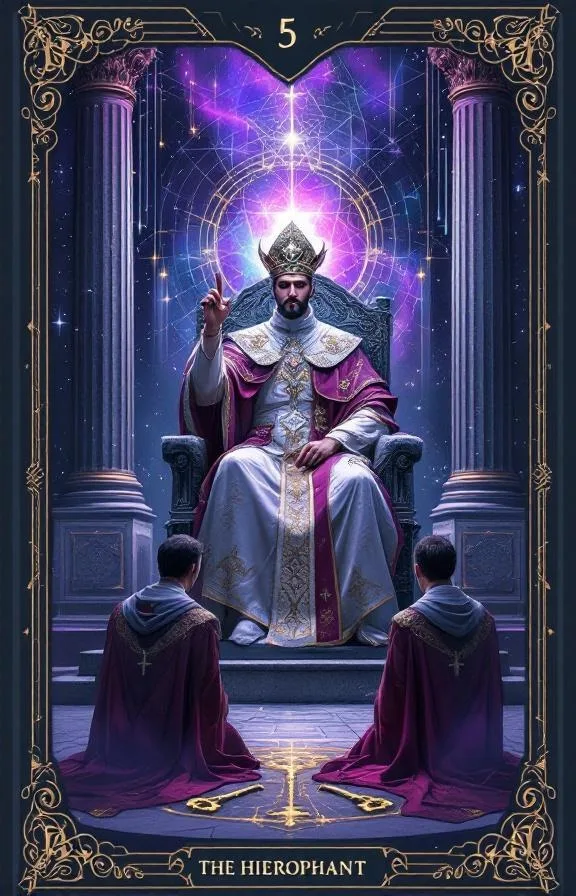
There is a kind of love that shows up on time to every event that matters to you, memorizes the names of your siblings, and asks your father for permission before proposing — even though you told them not to bother. The Hierophant as feelings is devotion with a moral architecture behind it. Steady, principled, and sometimes maddeningly traditional.
The core feeling
Devotion is the word, but it is a specific kind. Not the wild, consuming devotion of someone who would burn the world for you. The Hierophant's devotion is institutional. It follows a blueprint — one inherited from family, culture, religion, or personal ethics built over decades. The person feeling this does not question whether love should involve sacrifice. They already know it does. The question is whether you will meet them inside the structure they believe in.
What makes this psychologically compelling is the way it intersects with moral identity. Jonathan Haidt's research on moral foundations reveals that people differ dramatically in which values anchor their emotional lives. The Hierophant personality leans hard on loyalty, authority, and sanctity as emotional pillars. Their feelings are not just feelings. They are moral commitments. Breaking a promise is not a mistake — it is a sin. This intensity can be profoundly reassuring or profoundly suffocating, depending on whether you share the same foundations.
The Hierophant does not separate how they feel from what they believe is right. For them, these are the same thing. Loving you is a duty they take on willingly, and duty — for this person — is not a lesser form of love. It might be the highest form they know.
The Hierophant upright as feelings
Upright, The Hierophant indicates feelings rooted in genuine commitment and a desire to do things the right way. This person wants to formalize what they feel. They want the relationship to have legitimacy — whether that means meeting your parents, defining the relationship explicitly, moving through traditional milestones, or building something that outside institutions can recognize and bless.
Their emotional experience is one of reverence. They hold you in high regard. They are not casual about you. Every step they take has been considered against their internal code of conduct, and you passed. That is not a small thing. Most people never get past The Hierophant's initial screening.
This is the most misunderstood card in emotional readings. People assume it means boring or conventional feelings. Wrong. It means someone who feels so strongly that they want to bind themselves to you through every mechanism available — vows, shared traditions, merged families, joint bank accounts. The passion is there. It just wears a suit and tie.
There is also mentorship energy here. They may feel a desire to guide you, teach you, share their wisdom. This can be wonderful when the dynamic is mutual. Less wonderful when it becomes condescending.
The Hierophant reversed as feelings
Reversed, the devotion fractures. The person is experiencing a crisis between what they feel and what they believe they should feel. Maybe they have feelings for someone their family would disapprove of. Maybe they are questioning the entire framework they have used to evaluate relationships their whole life. The emotional landscape is one of internal conflict — not about whether they care, but about whether caring in this way is permitted by the rules they live by.
Some people pull this reversal when someone feels trapped by their own commitments. They made promises. They follow a moral code. But the feelings have changed, or new feelings have appeared that contradict the old ones. They are still devoted — but to what? The person, or the idea of the person they committed to years ago?
Another expression: rejection of convention entirely. Someone who has decided that traditional relationship structures are wrong for them and feels liberated by that realization. The feeling is rebellious. Exhilarating. Also potentially chaotic, because dismantling your moral framework while in the middle of a relationship affects everyone involved.
The Hierophant as feelings in love
In love readings, The Hierophant upright is one of the strongest indicators of someone who wants long-term commitment. They are not playing. They are thinking about marriage, cohabitation, shared spirituality, building a family — or whatever the culturally relevant equivalent is for their value system. Their love language is often acts of devotion: remembering anniversaries, maintaining rituals you have built together, defending you in front of others without hesitation.
The attraction is not primarily physical, though physicality matters. It is values-based. They fell for who you are at a fundamental level — your character, your integrity, the way you treat people. And they expect the same evaluation in return. Superficiality offends them.
Reversed in love, expect confusion around commitment. The person wants you but cannot reconcile that want with some other obligation — an existing relationship, family expectations, cultural pressures, religious beliefs. The feeling of being torn is genuine and painful. They are not being indecisive for sport. They are caught between two versions of who they think they should be.
The Hierophant as feelings about you
When someone directs Hierophant energy toward you, they see you as worthy of respect. Deep, structured respect. They probably admire your values, your consistency, or your character. You represent something solid in their emotional world — a person they can trust to behave with integrity.
Reversed, they may feel that you are too conventional. Too rigid. Or they might feel judged by your moral standards. Their feelings about you are complicated by a sense that you represent a system or expectation they are trying to escape.
The Hierophant as feelings in career
Professionally, The Hierophant as feelings means someone sees you as a mentor, a trusted guide, or a keeper of institutional knowledge. They feel respect bordering on reverence. A manager with these feelings views you as integral to the team's moral and operational fabric — you are not just productive, you are exemplary.
Reversed, the feelings shift toward resentment of institutional authority. They may see you as representing outdated processes or gatekeeping knowledge. Alternatively, they feel conflicted about the organizational hierarchy and are projecting that discomfort onto you.
Frequently asked questions
What does The Hierophant mean as feelings?
The Hierophant represents devotion expressed through commitment, tradition, and moral consistency. The person feels deeply but channels those feelings through established structures — they want to formalize and honor what they feel, not just experience it.
Does The Hierophant represent positive or negative feelings?
Upright, strongly positive — genuine commitment, deep respect, and a desire to build something lasting and meaningful. Reversed, the feelings become conflicted: devotion wrestling with doubt, tradition clashing with desire for freedom. The underlying emotion is real either way; the struggle is about whether existing frameworks can contain it.
What does The Hierophant reversed mean as someone's feelings?
They feel caught between what they want and what they believe they should want. There may be genuine care for you, but it is tangled with guilt, obligation to someone or something else, or a growing rejection of the rules they have always followed. Internal conflict defines the emotional experience — not absence of feeling but uncertainty about what to do with it.
Curious what The Hierophant means as feelings in YOUR situation? Try a free AI tarot reading and explore the emotional landscape of your cards.