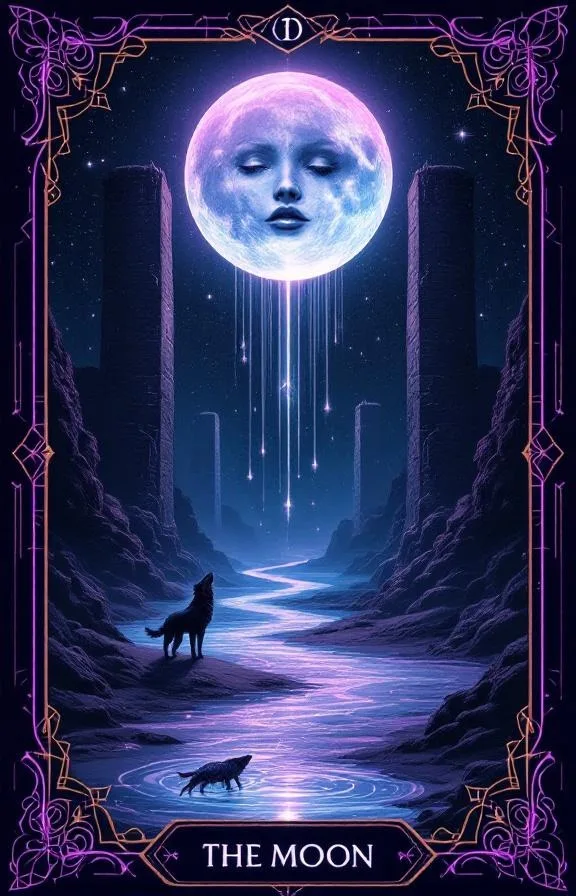
She sent you a text at 2:30 AM that was either the most profound thing you have ever read or completely incomprehensible, and you still cannot decide which. The Moon person lives in the space between clarity and confusion, between what is seen and what is sensed, between the story as it happened and the story as it felt. They are the most intuitive person you know and also, somehow, the most difficult to pin down. Ask them a direct question and you will get an answer that circles the topic like a bird looking for a place to land. They are not being evasive. That is genuinely how their mind works.
The personality profile
The Moon archetype produces a person whose inner world is larger, stranger, and more vividly populated than their outer life suggests. They dream in color. Literally and metaphorically. Their imagination does not shut off when they wake up — it runs continuously, layering the ordinary world with associations, memories, symbols, and emotional textures that most people filter out.
This rich inner landscape gives them extraordinary creative potential and a genuine psychic quality that has nothing to do with palm reading or crystal balls. The Moon person picks up on emotional information that operates below the frequency of conscious awareness. They know when someone is lying before the lie finishes leaving the person's mouth. They feel shifts in group dynamics the way animals sense approaching storms. They walk into a room and within seconds have a read on the emotional weather that would take other people hours to develop, if they developed it at all.
The cost is clarity. The Moon person receives so much subconscious information that distinguishing between genuine intuition and anxiety-driven projection requires constant calibration. Are they sensing that something is wrong, or are they afraid that something is wrong and interpreting the fear as perception? This question haunts them. It never fully resolves. The healthiest Moon people learn to live with the ambiguity. The less healthy ones either trust every feeling uncritically or suppress their intuition entirely, and both strategies produce problems.
The Moon upright as a person
Upright, the Moon person is a creative powerhouse. Their access to the unconscious is not just emotional — it is productive. They write, paint, compose, design, or otherwise create from a place that other people cannot access voluntarily. Their work has a quality of inevitability, as if it came from somewhere rather than being constructed. Because it did. The Moon person is a channel. The best ones learn to refine what comes through without shutting off the flow.
They are also deeply empathic in a way that goes beyond sympathy or compassion. The Moon person does not feel for you. They feel with you. Your sadness becomes their sadness, your anxiety becomes their anxiety, and this porousness is both their gift and their most significant vulnerability. When they tell you they understand what you are going through, they are not being polite. They are being literal.
The upright Moon person tends to have a complex relationship with honesty. They are not dishonest. But they understand — viscerally, not intellectually — that truth has layers, that what is factually accurate and what is emotionally true are not always the same thing, and that the most important truths are often the ones that cannot be stated directly but only approached sideways, through story or metaphor or art.
The Moon reversed as a person
Reversed, the Moon person drowns in their own depth. The rich inner world that gave them creative power and intuitive insight becomes a swamp — overwhelming, undifferentiated, impossible to navigate. Anxiety replaces intuition. Paranoia replaces perception. They see threats everywhere because they can no longer distinguish between real signals and internal noise.
The reversed Moon person lies. Sometimes to others, often to themselves. Not grand, strategic lies — small ones. Evasions, omissions, strategic ambiguities that allow them to avoid confrontations they do not have the emotional resources to handle. They construct a version of reality that is manageable rather than accurate, and they retreat into it the way a frightened animal retreats into a burrow.
They may also struggle with dissociation — a sense of being detached from their own experience, watching themselves from a distance rather than inhabiting their life directly. Depersonalization, derealization, the feeling that the world is not quite real or that they are not quite present in it. These are not character flaws. They are coping mechanisms that the Moon person developed to manage an emotional bandwidth that exceeds what most nervous systems are designed to handle.
The Moon as a person in love
The Moon person in love is unforgettable. Whatever else you say about them, you will never say they were boring. They bring an intensity of feeling and a depth of perception to romantic relationships that can be transcendent — the experience of being truly known by someone who sees the parts of you that you have not shown anyone, including yourself.
They communicate in subtext. The Moon person's declaration of love may not sound like a declaration. It may be a playlist, or a painting, or a description of a dream they had about you, or a long silence during which they held your hand and you felt understood in a way that words would have ruined. If you need explicit verbal affirmation — "I love you, here is why, here is my five-year plan" — the Moon person will frustrate you. If you can learn to read the language they are actually speaking, you will discover a depth of devotion that explicit communicators rarely match.
Their shadow in relationships is projection. The Moon person sometimes falls in love not with the person in front of them but with the version of that person that their imagination has constructed — richer, deeper, more meaningful than the actual human could ever be. When reality intrudes, the disappointment is crushing, not because the partner failed but because the imagined partner was never real.
The Moon as a person at work
Professionally, the Moon person belongs in creative fields. Art, music, writing, filmmaking, design, therapeutic practice, anything that rewards the ability to access unconscious material and give it form. They are terrible with spreadsheets. They will lose the spreadsheet. They will forget the meeting. They will miss the deadline. And then they will produce something that nobody else in the organization could have conceived.
Manage them by protecting their process rather than imposing structure. The Moon person's best work emerges from conditions that look, to the outside observer, like chaos. Leave them alone. Give them deadlines, but make the deadlines soft. Evaluate them by output, not by compliance with procedure.
The Moon as someone in your life
The Moon person is recognized by their elusiveness. You know them for years and they still surprise you. They reveal themselves in layers, and each layer contains another layer, and you are never entirely certain you have reached the center because you are not sure there is a center in the conventional sense. There is a depth. An ongoing unfolding.
Relate to them by learning their language. They will not speak yours — not because they refuse, but because they literally cannot reduce what they perceive to the linear, explicit format that most communication demands. Meet them in metaphor. Sit with the ambiguity. Stop asking "what do you mean?" and start asking "what does it feel like?" You will get much further.
Frequently asked questions
What kind of person does The Moon represent?
The Moon represents a dreamer and intuitive — someone with an unusually rich inner life, powerful creative instincts, and an almost psychic ability to sense emotional undercurrents that others miss. They live at the boundary between consciousness and the unconscious, which gives them access to insight that most people only encounter in dreams.
Is The Moon as a person positive or negative?
Neither purely. The Moon person is complex in a way that resists simple categorization, which is fitting. Upright, their depth and intuition are genuinely extraordinary gifts. Reversed, the same qualities produce anxiety, self-deception, and disconnection from reality. The Moon person's relationship to their own unconscious determines which expression dominates — and that relationship can shift over time.
How do you recognize a Moon person?
They are the one whose eyes seem to be focused on something slightly behind whatever they are looking at. They give answers that feel like riddles. They remember the emotional tone of conversations rather than the words. They are creative, often nocturnal, and possess an uncanny ability to know things about you that you did not tell them. When you ask how they knew, they shrug. They just knew.