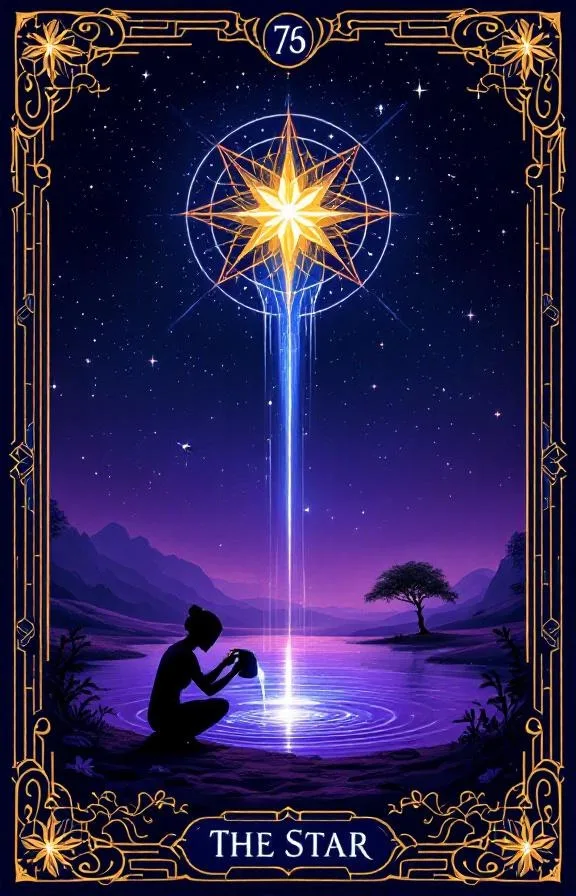
After the worst night of your life, she is the person who shows up at 6 AM with coffee and sits with you on the porch without saying anything for the first twenty minutes because she knows that what you need right now is not advice. The Star person carries a quiet, luminous quality that has nothing to do with cheerfulness and everything to do with having survived their own devastation and come out the other side with their capacity for hope intact. They have seen the worst. They glow anyway.
The personality profile
The Star personality is shaped by recovery. Not the clinical kind, necessarily — though many Star people have that story too — but the broader process of being broken and choosing, deliberately and repeatedly, to heal. The Star person is not someone who avoided pain. They are someone who metabolized it.
This gives them a quality that is difficult to name but immediately recognizable. Serenity is too passive a word. Optimism is too shallow. What the Star person carries is a form of hope that has been stress-tested — hope that persists not because it has never been challenged but because it has been challenged thoroughly and survived. It is hope with scar tissue.
They tend to be genuinely generous. Not performatively generous, not strategically generous, but generous in the way that water is wet — as a fundamental property of their nature. They share resources, attention, time, and emotional energy with a naturalness that occasionally alarms people who are accustomed to generosity being transactional. The Star person gives without keeping count. This is beautiful. It is also unsustainable without boundaries, which is the Star person's primary vulnerability.
The Star upright as a person
The upright Star person is someone who makes other people feel possible. Around them, your problems seem solvable. Your wounds seem healable. Your future seems like something worth investing in. This is not because they minimize what you are going through — they do not. It is because they see your capacity for recovery with the same clarity that they see your pain, and they hold both simultaneously in a way that makes the recovery feel real rather than hypothetical.
They are natural healers, whether they work in healthcare or not. The Star person heals through presence. Through the specific quality of their attention, which is warm without being intrusive and steady without being heavy. Through the way they listen, which makes you feel seen at a depth that most conversations do not reach.
Their vulnerability is depletion. The Star person pours out. Continuously. And they do not always notice when the vessel is running low because they are so focused on what they are giving that they lose track of what they have left. The healthiest Star people have learned to replenish — through solitude, through nature, through creative practice, through whatever fills them back up. The ones who have not learned this lesson burn out in spectacular and heartbreaking ways.
The Star reversed as a person
The reversed Star person has lost their light. This is not melodrama — it is the most precise description available. The quality that defined them, that luminous hope-after-devastation, has been extinguished by exhaustion, by disillusionment, by giving too much for too long without receiving enough in return.
They become cynical. And Star person cynicism has a particular bitterness because it comes from someone who genuinely believed in the possibility of healing and has been forced to question that belief. A cynical person who was always cynical is merely consistent. A cynical person who used to be a source of light is devastating.
The reversed Star may also develop a savior complex. Unable to heal themselves, they double down on healing others, turning their generosity into a form of avoidance. As long as they are focused on someone else's pain, they do not have to confront their own. This pattern can persist for years, producing someone who appears selfless and functional while slowly eroding from the inside. The clinical psychologist Alice Miller wrote about this dynamic extensively — the helper who helps compulsively because stopping would mean feeling the pain they have been running from since childhood.
The Star as a person in love
In romantic relationships, the Star person loves with an openness that can feel miraculous if you have spent your life around people who love guardedly. They are not interested in games, in strategic vulnerability, in the careful rationing of affection that passes for sophistication in modern dating. They love with their whole chest. This is not naivete. They know the risks. They have been hurt. They choose openness anyway.
Their partners often describe a feeling of being "seen" that goes beyond the usual meaning of the word. The Star person does not just pay attention to what you say and do. They perceive what you are becoming — the version of you that has not fully emerged yet — and they love that person too, which gives you the strange and powerful feeling of being loved not just as you are but as you could be.
The risk for the Star person in love is attracting partners who need healing rather than partnership. They draw wounded people the way a porch light draws moths — and while their healing presence is real and valuable, a romantic relationship organized around one person's wound and the other person's light is a relationship with a structural imbalance that will eventually collapse.
The Star as a person at work
Professionally, the Star person thrives in roles that involve restoration, support, and creative expression. Therapy, nursing, teaching, mentoring, counseling, social work, the arts. They are the colleague who notices when someone is struggling before the struggling person has admitted it to themselves, and who offers support in a way that does not feel patronizing.
They struggle in competitive environments where advancement requires diminishing others. The Star person has no appetite for corporate politics. None. They would rather do excellent work quietly than play the visibility games that most organizations reward.
The Star as someone in your life
You recognize the Star person by how you feel after spending time with them. Not during — after. The effects are not always immediate. But hours later, you notice that the problem you were obsessing about seems smaller, that the future seems less threatening, that something in you has settled. The Star person's impact operates on a delay, like medicine that needs time to reach the bloodstream.
Relate to them by giving back. The Star person will never ask for help — this is not a virtue, it is a limitation, and they know it. Check on them. Ask how they are really doing. Refuse to accept the first answer, because the first answer will be "I'm fine." The second answer, if you stay long enough to hear it, might be something quite different.
Frequently asked questions
What kind of person does The Star represent?
The Star represents a healer — someone whose capacity for hope has survived genuine devastation and who radiates a quiet, restorative energy that makes other people feel possible. They are generous, deeply perceptive, and often drawn to roles where they can support others' recovery.
Is The Star as a person positive or negative?
Overwhelmingly positive in the upright position. The Star person is one of the most healing presences you can encounter. Reversed, their light dims into cynicism or compulsive caretaking. Even in the reversed state, their impulse is toward healing — they have simply lost access to the hope that made their healing effective.
How do you recognize a Star person?
Pay attention to the feeling they leave behind. After interacting with a Star person, most people report feeling lighter, more hopeful, and more capable — even if the conversation was about something difficult. They have a quality of attention that is warm without being overwhelming, and a way of being present that makes you feel genuinely seen rather than merely observed.