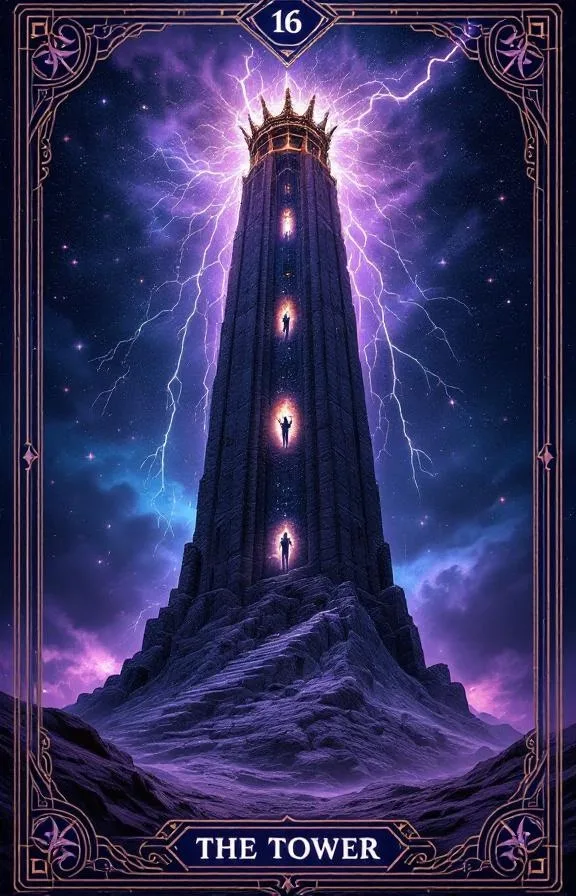
The emotional experience of The Tower is one that most people recognize instantly but struggle to articulate: the moment when something you believed — about a person, a relationship, yourself — collapses in a single revelation. Not a gradual erosion. A sudden structural failure. The floor you were standing on turns out to have been hollow all along, and the sensation of falling through it is not just metaphorical. Your body registers it as actual freefall. Heart rate spikes. Hands go cold. The world rearranges itself in seconds, and the version of reality you inhabited five minutes ago no longer exists.
The core feeling
The Tower's emotional core is shock — the violent, disorienting kind that rewrites your understanding of what is true. This is not disappointment, which assumes you expected something better. This is the obliteration of the framework you were using to interpret events. Psychologist Ronnie Janoff-Bulman described this as the shattering of "assumptive worlds" — the fundamental beliefs about safety, predictability, and meaning that we construct unconsciously and rely on completely until they break.
The specific quality of Tower feelings is their involuntary nature. You cannot prepare for them. You cannot manage them in real time. They arrive as an ambush and they dismantle your composure before your conscious mind has finished processing what happened. The feeling is raw, electric, and strangely clarifying. In the wreckage of the old understanding, things that were previously hidden become suddenly, painfully visible.
The Tower upright as feelings
When The Tower appears upright as someone's feelings, they are in the middle of an emotional earthquake. Something has happened — a discovery, a betrayal, an unexpected truth — that has demolished a belief structure they depended on. They feel destabilized at a foundational level.
The person may be experiencing rage, grief, disbelief, or all three simultaneously. The dominant sensation is that the ground has moved. Certainties they organized their emotional life around have been exposed as false, and the realization is too recent and too large to integrate. They are in the blast radius, still covered in dust, not yet capable of assessing the damage.
One of the most disorienting aspects of Tower feelings is that they often come with an unwelcome clarity. The person can suddenly see things they were previously blind to — patterns of deception, their own complicity in maintaining an illusion, the gap between what they told themselves and what was actually happening. This clarity is a gift, but it does not feel like one. It feels like being dragged into bright light after years in a comfortable dark room.
The Tower reversed as feelings
Reversed, The Tower describes feelings in the aftermath of a shock — or the dread of a shock that has not yet arrived. The person senses that something is structurally wrong but is trying to prevent the collapse rather than allow it. They are shoring up walls that need to come down, reinforcing beliefs they suspect are false, maintaining appearances that cost them more energy every day.
This produces a distinctive emotional state: chronic, low-grade dread. The person feels as though they are living on borrowed time. They flinch at unexpected phone calls. They read subtext in every conversation. They know, in a way they will not admit to themselves, that the thing they are protecting is already broken. They just cannot face the demolition.
In some cases, reversed Tower feelings indicate someone who has already been through the upheaval and is now navigating the rubble. The shock has passed, but the emotional landscape is unfamiliar. They feel exposed, disoriented, and unsure which of their old feelings were genuine and which were artifacts of the structure that collapsed.
The Tower as feelings in love
In love readings, The Tower as feelings is one of the most intense cards that can appear. It signals feelings that have been fundamentally disrupted — by infidelity, by a revelation that changes how one partner sees the other, by a sudden ending that neither person saw coming, or by a truth that was buried so long its emergence feels like an explosion.
The person experiencing these feelings is emotionally shattered in the present tense. Past tense analysis is not available to them yet. They cannot put the experience into perspective because they are still inside it, still falling. The relationship they thought they understood has been revealed as something different from what they believed, and the emotional whiplash between "who I thought you were" and "who you apparently are" is the source of the devastation.
Here is an uncomfortable truth about The Tower in romantic contexts: the destruction it represents is almost always necessary. The structure that fell was built on something that could not hold — a lie, an illusion, an avoidance. The feelings are agonizing, but they are also the beginning of something more honest. Nobody asks for this particular beginning. It is the emotional equivalent of surgery without anesthesia, and its only justification is that the alternative — continuing to live inside a compromised structure — would eventually cause more damage than the collapse itself.
The Tower as feelings about you
When The Tower represents how someone feels about you, you have shattered something in their emotional world. This is not mild disruption. You have changed how they understand themselves, their situation, or their relationship with you in a way that cannot be undone.
Depending on the context, this can mean they feel betrayed by you, fundamentally surprised by you, or shaken awake by something you said or did. You have become the catalyst for an internal collapse that was probably overdue but is no less painful for being necessary. Their feelings toward you right now are likely a storm of contradictions — anger mixed with reluctant gratitude, loss mixed with the first stirrings of relief.
The Tower as feelings in career
The Tower as career feelings points to professional upheaval experienced at the emotional level — a layoff that strips away identity, a project failure that exposes uncomfortable truths about competence or commitment, a workplace revelation that makes the job feel impossible to continue.
The person does not just feel professionally disrupted. They feel personally destabilized, because the boundary between "what I do" and "who I am" was thinner than they realized. The job loss or career shock is forcing a confrontation with questions they successfully avoided for years: What do I actually want? What was I tolerating? What did I build, and was any of it real?
Frequently asked questions
What does The Tower mean as feelings?
The Tower means feelings of shock, upheaval, and sudden emotional disruption. Something fundamental has shifted — a belief has been shattered, a truth has emerged, or a situation has collapsed without warning. The dominant feeling is disorientation, accompanied by an unwelcome but undeniable clarity about what was real and what was not.
Does The Tower represent positive or negative feelings?
The immediate feelings are intensely painful — shock, betrayal, loss of certainty. But The Tower is not ultimately a card of destruction for its own sake. It demolishes what was false to make room for what is true. The feelings, while devastating in the moment, often mark the beginning of a more honest emotional chapter. Most people recognize this only in hindsight.
What does The Tower reversed mean as someone's feelings?
The Tower reversed describes someone living in anticipatory dread or post-shock numbness. They either sense that an emotional upheaval is coming and are desperately trying to prevent it, or they have already been through the worst and are wandering through the aftermath, unsure what to rebuild or whether rebuilding is even possible yet.
Curious what The Tower means as feelings in YOUR situation? Try a free AI tarot reading and explore the emotional landscape of your cards.