She speaks four languages, has lived on three continents, runs a small business, plays cello at a level that could have gone professional, and somehow still has time to be the most present listener you have ever encountered. Not because she is superhuman. Because she is complete. The World person has reached a level of integration that most people spend their lives approaching — a wholeness that is not about having everything figured out but about having made peace with everything they are, including the contradictions. They are the rarest archetype in the tarot because they embody the end of a journey that most people are still walking.
The personality profile
The World personality is defined by completion. Not perfection — the World person is not flawless, and they will tell you so with a directness that makes perfectionism look like the neurosis it is. Completion means something different. It means they have integrated the lessons that the other twenty Major Arcana cards represent. The Fool's openness, the Magician's will, the High Priestess's intuition, the Emperor's structure, the Tower's capacity for destruction — all of these live in the World person, and none of them dominates.
This produces someone whose most striking quality is range. They can be disciplined and spontaneous. Logical and intuitive. Fiercely independent and deeply connected. These are not contradictions they struggle with. They are poles they move between with a fluidity that makes other people wonder whether they are witnessing a single personality or several.
The psychologist Mihaly Csikszentmihalyi, famous for his research on flow states, observed that the most creative and fulfilled individuals share a quality he called "complexity" — the ability to contain opposite tendencies and deploy the right one for the right situation. The World person is the living embodiment of this complexity. They are aggressive and nurturing, introverted and extroverted, playful and serious — and they are all of these things authentically, not performatively.
The World upright as a person
The upright World person has finished something. A cycle, a phase, a chapter of development that most people abandon partway through. This completion gives them a groundedness that is difficult to destabilize. They have already been the Fool and the Emperor and the Hermit and the Tower. They know what each of those experiences teaches. They do not need to learn those lessons again.
What you notice first is their ease. Not laziness — ease. They move through life with a minimum of friction because they are not fighting themselves. The internal civil wars that consume most people's energy — should versus want, head versus heart, ambition versus contentment — have been largely resolved. Not perfectly. Not permanently. But sufficiently to free up enormous amounts of energy for living rather than deliberating.
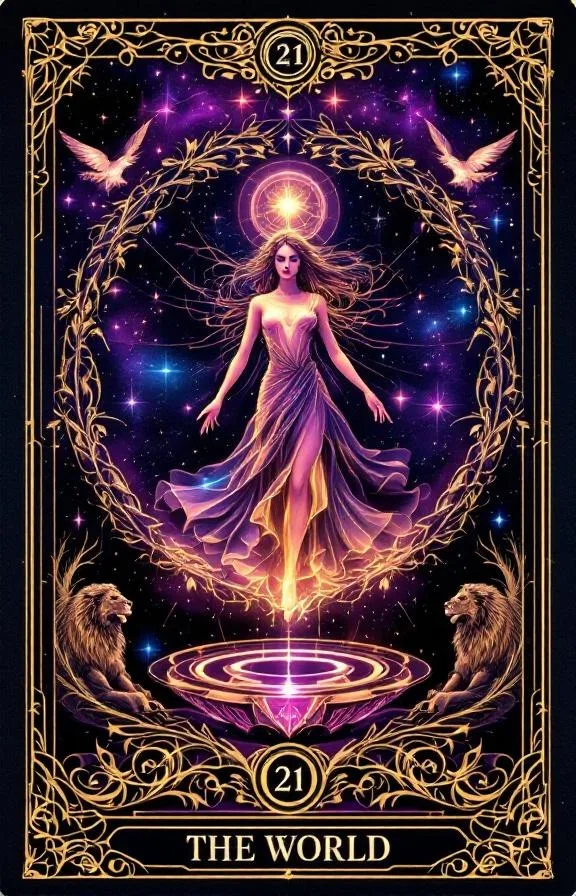
They are also remarkably comfortable with boundaries. The World card depicts a figure within a laurel wreath — enclosed but dancing. The World person has learned where they end and the world begins, and they have stopped trying to be everything to everyone. This makes them paradoxically more generous, because what they give comes from fullness rather than from the desperate need to be needed.
Their presence is expansive. Around the World person, possibilities multiply. Ideas flow. Projects gain momentum. Connections form between people who had no reason to connect. This is not charisma in the conventional sense — it is not about the World person being the center of attention. It is about the World person creating conditions in which everyone else can be fully themselves.
The World reversed as a person
The reversed World person is someone standing at the finish line who refuses to cross it. The journey is essentially complete — the lessons have been learned, the growth has occurred, the new self is ready to emerge — but something keeps them circling the final lap. Fear of what comes after. Fear that the next cycle will require starting over as the Fool. Fear that completion means ending.
They stagnate at a high level. This is particularly frustrating for the people around them because the reversed World person is clearly capable. They have the skills, the wisdom, the experience. They just will not use them. They polish the thesis forever and never submit it. They plan the trip for years and never book the ticket. They describe the business they want to build with such precision that you can see it, and they never build it.
The reversed World person may also develop a painful nostalgia for earlier phases of the journey. They romanticize the struggle. The growth periods, the crises, the transformations — these felt meaningful in a way that completion does not. Completion feels suspiciously like peace, and the reversed World person does not trust peace. They have spent so long navigating chaos that stillness feels like something has gone wrong.
The World as a person in love
In love, the World person is the most complete partner available. They do not need you. This is their most attractive and most terrifying quality. They are with you because they choose to be, daily, actively, with full awareness that they would survive your absence. This sounds cold on paper. In practice, it is the opposite. Being chosen by someone who does not need you is the highest form of romantic affirmation because it cannot be explained by dependency, loneliness, or fear of being alone.
They bring their wholeness into the relationship, which means they have access to the full range of relational skills that other archetypes possess only in fragments. They can be nurturing without losing themselves. Passionate without being obsessive. Honest without being cruel. Independent without being distant. The integration that defines them as individuals defines their partnership as well.
Most relationship problems stem from incompleteness — one partner looking to the other to provide what they cannot provide for themselves. The World person has done most of that internal work already. What they seek in partnership is not completion but companionship. Someone to dance with, not someone to lean on. Someone who brings their own wholeness to the table and creates something with the World person that neither could create alone.
The World as a person at work
Professionally, the World person is the renaissance soul who excels in multiple domains and connects between them in ways that specialists cannot. They are the polymath, the interdisciplinary thinker, the person who sees the link between the marketing problem and the engineering constraint and the customer insight that nobody else considered because everybody else was working in silos.
They make extraordinary leaders — not because they are the smartest person in the room, but because they understand every type of person in the room. They have been the creative and the analyst. The dreamer and the executor. The rebel and the builder. This breadth of internal experience gives them a management versatility that specialized leaders cannot match.
Their professional risk is boredom. The World person has usually mastered their current role long before the organization recognizes it, and they need either constant novelty or a move to the next cycle.
The World as someone in your life
You recognize the World person by their groundedness. In a room full of people performing various versions of themselves, the World person is simply being. No performance. No posture. No strategic self-presentation. They are comfortable in a way that is not passive but complete — the comfort of someone who has already asked and answered the hard questions about who they are.
Relating to them is surprisingly easy, because the World person has very little ego investment in how you perceive them. Disagree with them and they will consider your perspective with genuine interest. Challenge them and they will engage without defensiveness. Tell them something about themselves they had not considered and they will absorb it with a curiosity that less integrated people reserve for information that confirms what they already believe. The World person is still learning. They just no longer need to be right.
Frequently asked questions
What kind of person does The World represent?
The World represents a renaissance soul — someone who has achieved a rare level of personal integration, combining qualities that most people experience as contradictions. They are simultaneously disciplined and spontaneous, logical and intuitive, independent and connected. They embody the completion of a significant developmental cycle and carry the accumulated wisdom of every stage they have passed through.
Is The World as a person positive or negative?
The most positive archetype in the Major Arcana. The upright World person's wholeness is genuine and inspires similar integration in others. Reversed, they stagnate at the threshold of completion, circling achievements they will not finalize. Even reversed, they are not destructive — just frustratingly incomplete, which is ironic given what the card represents.
How do you recognize a World person?
Look for the person who seems equally comfortable in any setting — the boardroom and the campfire, the gallery and the kitchen, the debate and the silence. They do not change who they are based on context. They simply emphasize different facets of a personality that contains genuine multitudes. Their range is the giveaway. If someone seems impossibly well-rounded, they are probably a World archetype, and the roundedness is not impossible — it is just rare.
