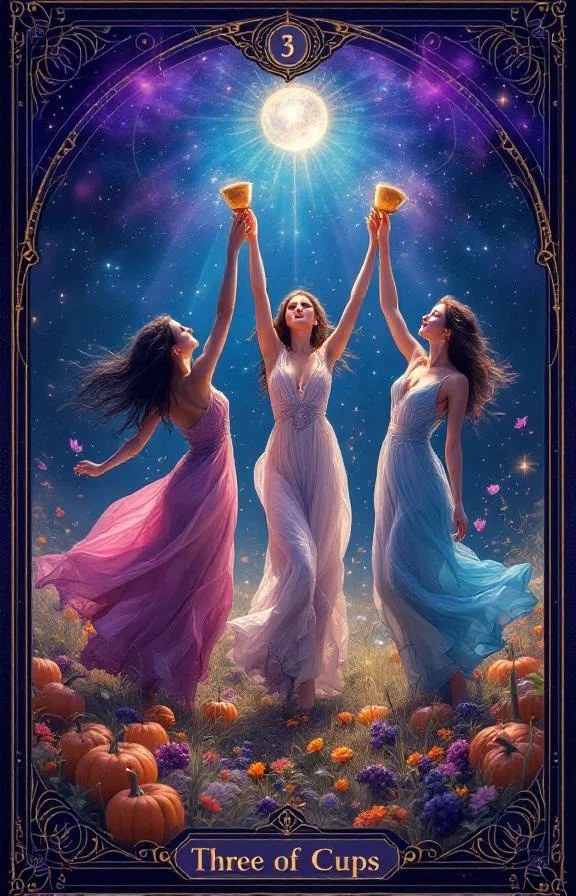
You walk into a room and something in your body unclenches. The people here know you — not the curated version, but the actual you who laughs too loudly and cares about weird things. Nobody is keeping score. Nobody needs you to be anything other than present. The Three of Cups as feelings is that specific relief: the bone-deep recognition that you have found your people, and they have found you.
The core feeling
Belonging sounds simple until you try to describe its absence. Then you realize it was load-bearing all along. Developmental psychologist Abraham Maslow placed belonging squarely in the middle of his hierarchy — after safety, before esteem — and that placement reveals something important: humans can survive without belonging, but they cannot thrive. The Three of Cups represents thriving. The emotional state where survival concerns have receded far enough that joy becomes possible, and that joy is specifically communal.
What separates belonging from mere inclusion is reciprocity. You can be included on a guest list and still feel like a stranger. Belonging requires that your presence matters to the group as much as the group's presence matters to you. The Three of Cups shows three figures raising their cups together, and the emotional content of that image is not celebration alone — it is the particular warmth of celebrating with people who would notice if you were missing.
Three of Cups upright as feelings
Upright, the Three of Cups is uncomplicated joy shared with others. The person feeling it is experiencing one of the rarest emotional states available to adults: happiness without qualification. Not "happy, but..." Not "happy as long as this lasts." Just happy. In community. With people who amplify rather than diminish.
The emotional texture here is effervescent. Laughter that builds on itself. Inside jokes that would mean nothing to outsiders but mean everything to the people sharing them. A conversation that jumps between three different topics simultaneously and nobody gets lost because everyone is operating on the same frequency. This is the feeling of a dinner that was supposed to end at ten but somehow it is one in the morning and nobody wants to leave.
Most adults have to work to access this state because adult socialization comes with layers of performance and obligation. The upright Three of Cups indicates that those layers have temporarily dissolved. The person is experiencing social connection as it existed in childhood — spontaneous, ungoverned, pure.
Three of Cups reversed as feelings
Reversed, belonging fractures into exclusion. The person feels outside the circle, whether through explicit rejection or the subtler pain of watching others connect in ways they cannot seem to access. The party is happening. They are technically present. But the ease that everyone else seems to share does not extend to them, and pretending otherwise takes enormous energy.
Sometimes the reversed Three indicates social exhaustion — an introvert who has exceeded their capacity for group interaction, or someone whose friendships have become obligations rather than sources of genuine pleasure. The gatherings continue but the joy has leaked out of them. What remains is performance: smiling at the right moments, contributing to conversations without actually wanting to be in them.
There is a sharper reading too. The reversed Three of Cups can signal the pain of friendships that have shifted without acknowledgment — the slow discovery that people you considered close have been meeting without you, or that the group dynamic has reorganized around your absence without apparent difficulty. That particular sting is difficult to articulate without sounding petty. It is not petty. It is grief.
Three of Cups as feelings in love
In romantic readings, the Three of Cups as feelings points to a relationship embedded in community. The person does not just love their partner privately — they love the life they have built together, the shared friendships, the social world they inhabit as a unit. Breaking up would mean losing not just a partner but an entire ecosystem of belonging.
When this card appears as someone's feelings about a new romantic interest, it often indicates that attraction has been amplified by social context. They met through friends. Their social circles overlap naturally. The relationship feels endorsed by the people whose opinions matter most. This kind of communal approval should not matter as much as it does — but honestly, the relationships that have social support built in from the start tend to last longer than those that begin in isolation.
For couples, the Three of Cups suggests a phase where the relationship is outward-facing and joyful. Date nights have become dinner parties. Weekends involve other people. The couple is drawing energy from their community rather than draining it, and the relationship is stronger for the exposure.
Three of Cups as feelings about you
When the Three of Cups represents someone's feelings about you, they associate you with warmth and social ease. You are not their escape from the world — you are their bridge into it. Around you, they feel more connected to others, more able to relax in groups, more confident that they belong. You make the party better by being there.
This is a specific kind of emotional significance. You may not be their deepest confidant or their most passionate attachment. You are something rarer: the person who makes their social life feel like home.
Three of Cups as feelings in career
Professionally, the Three of Cups indicates someone who feels genuine camaraderie with their colleagues. The team works. Not in the corporate-retreat-forced-bonding sense, but in the way that makes Monday mornings bearable and Friday afternoons feel earned. The person values their workplace primarily because of the people in it, and that valuation is mutual.
This card also shows up when professional achievements are being celebrated collectively — a product launch, a successful quarter, a milestone that the team reached together. The feelings are pride mixed with gratitude mixed with the specific pleasure of knowing that the people around you contributed to something you all care about. Genuine teamwork. It is rarer than motivational posters would suggest.
Frequently asked questions
What does Three of Cups mean as feelings?
The Three of Cups represents the feeling of genuine belonging — the emotional warmth that comes from being part of a group where your presence matters and joy is shared freely. It signals communal happiness and deep social connection.
Does Three of Cups represent positive or negative feelings?
Upright, it is overwhelmingly positive — one of the most joyful cards in the deck, indicating real friendship, celebration, and the particular happiness that only comes from feeling at home among your people. Reversed, the feelings shift toward social isolation, exclusion, or exhaustion with social obligations that have lost their authenticity.
What does Three of Cups reversed mean as someone's feelings?
Someone experiencing the reversed Three of Cups feels disconnected from their social world. They may be dealing with the pain of exclusion, the exhaustion of maintaining friendships that have become performative, or the quiet grief of realizing that a group they valued has moved on without them. The desire for belonging is still strong — the experience of it is what has broken down.
Curious what Three of Cups means as feelings in YOUR situation? Try a free AI tarot reading and explore the emotional landscape of your cards.