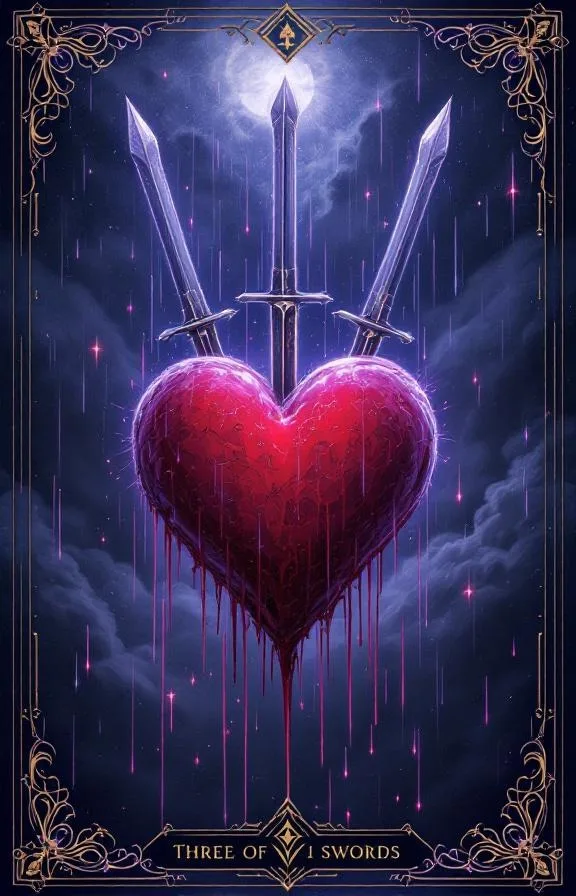
Nobody wants to see this card. Three swords piercing a heart against a gray sky — the imagery leaves nothing to interpretation. But the Three of Swords as advice is not warning you that pain is coming. It is telling you that pain is already here, and your job right now is to stop running from it.
The advice
Feel it. That is the entire instruction. Not "find the silver lining." Not "stay positive." Not "everything happens for a reason." Feel the pain that is present in your life right now, because the only way past grief is directly through the center of it.
This is genuinely terrible advice by modern standards. We live in a culture that treats negative emotions as problems to be solved — productivity obstacles to be optimized away with the right mindset, the right supplement, the right morning routine. The Three of Swords pushes back against all of that. Some pain is not a problem. It is a process. And the process cannot be accelerated by pretending it is not happening.
The reason this card appears as advice — rather than as a prediction or a warning — is usually because you are already engaged in some form of emotional avoidance. Working too much to avoid thinking. Staying busy to avoid feeling. Rationalizing a loss before you have actually grieved it. "It was for the best" is often true and always premature when spoken in the first weeks of heartbreak. Let the loss be a loss first. You can extract meaning later.
Here is the bold claim: the willingness to sit with pain without immediately converting it into a lesson or a narrative of growth is the single most underrated emotional skill. Most people cannot do it for more than a few minutes. The Three of Swords asks you to do it for as long as it takes.
Three of Swords upright advice
Upright, the Three of Swords gives you permission to grieve openly. Whatever happened — betrayal, rejection, loss, the shattering of an illusion you had been maintaining — acknowledge it without softening the edges. You do not need to be "fine" right now. You do not need to demonstrate resilience on a timeline that makes other people comfortable.
The upright card also advises honesty about what hurts. Sometimes we grieve a sanitized version of our actual pain because the real source feels too petty, too shameful, or too complicated to admit. If what hurts most about the breakup is not the loss of love but the loss of the future you imagined, say that. If what stings about the betrayal is not the act itself but that you saw it coming and chose to ignore the signs, acknowledge that.
Precision about pain is not self-indulgence. It is the prerequisite for healing that actually sticks rather than healing that performs recovery while burying the wound deeper.
Three of Swords reversed advice
Reversed, the Three of Swords suggests you are either prolonging pain unnecessarily or refusing to acknowledge it at all. Both are forms of avoidance, just in opposite directions.
Prolonged pain: if you are revisiting the same wound months or years after the event, replaying conversations, maintaining anger as a way of staying connected to what you lost — the reversed card says this is no longer grief. It is habit. And habits can be changed.
Suppressed pain: if you have convinced yourself you are "over it" without ever having been properly in it, the reversed card warns that unprocessed grief does not disappear. It relocates. It shows up as irritability toward people who do not deserve it, as anxiety without a clear source, as an inability to trust that has nothing to do with the current situation and everything to do with the old one you never addressed.
The reversed Three of Swords advises you to seek support. Not as a sign of weakness. As a recognition that some pain is too heavy to process alone.
Three of Swords advice in love
In love, this card's advice is to let heartbreak be heartbreak. If a relationship has ended or been damaged by betrayal, the Three of Swords says: do not rush to dating apps to prove you are desirable. Do not immediately rewrite the relationship as something that "was never that good anyway." Do not perform healing for social media.
Grieve the specific person, the specific moments, the specific future you lost. Generic grief heals generically. Specific grief heals completely.
For those still in a relationship where the Three of Swords appears: something has been said or discovered that cannot be unsaid or undiscovered. The advice is not necessarily to leave. It is to stop pretending the wound does not exist. Address it directly — in conversation, in therapy, in whatever format allows both people to be honest about the damage without performing okay-ness.
If the card relates to a pattern of choosing partners who hurt you, the advice shifts: the pain you need to feel is not about this particular person. It is about the older wound that makes this type of person feel familiar. Psychologist Harville Hendrix observed that we are often drawn to partners who recreate unresolved childhood dynamics. The Three of Swords says look at the pattern, not just the latest instance.
Three of Swords advice in career
Professional heartbreak is rarely discussed but very real. The project you poured yourself into that got canceled. The promotion that went to someone less qualified. The mentor who turned out to be using you. The company culture you believed in that revealed itself as a facade.
The Three of Swords advises you to take the professional loss personally — because it was personal, regardless of how many times someone tells you "it's just business." Denying the emotional reality of career setbacks does not make you more professional. It makes you disconnected from the information those emotions carry.
Feel the anger about the unfair decision. Feel the humiliation of the public failure. Feel the grief of the path that closed. Then — and only then — begin the strategic assessment of what comes next.
For career-related betrayals specifically: document what happened while the details are fresh. Not for revenge. For clarity. Understanding exactly what occurred and why will be invaluable in recognizing similar dynamics in the future. The Three of Swords wants you to learn from pain, but it insists that learning comes after feeling, never instead of it.
Action steps
- Give yourself a grief window. Set aside twenty minutes daily where you allow yourself to feel whatever comes up — without judgment, without trying to fix it, without scrolling through your phone. Just sit with it. When the timer ends, get up and continue your day.
- Write the uncensored version. In a document no one will see, describe exactly what happened and exactly how it made you feel. Include the petty parts, the ugly parts, the parts you are ashamed of feeling. Then close the document. You do not need to reread it. The writing itself is the process.
- Resist the narrative. For at least two weeks, refuse to construct a "what I learned from this" story. The lesson will emerge on its own timeline. Forcing meaning onto fresh pain produces platitudes, not insight.
FAQ
Is the Three of Swords always about heartbreak?
Not always, but always about pain that needs to be felt rather than avoided. Sometimes the heartbreak is romantic. Sometimes it is the loss of a friendship, a belief, a self-image, or a dream. The common thread is that something you cared about has been damaged or destroyed, and the card's advice is the same regardless of the specific source: acknowledge the pain fully before trying to move past it.
What should I do if the Three of Swords appears reversed as advice?
The reversed position suggests one of two things: either you are stuck in pain that has become a comfort zone, or you are suppressing pain that needs expression. Examine honestly which pattern fits your situation. If you have been grieving the same loss for an extended period without movement, the advice is to seek professional support and begin the work of releasing. If you have been avoiding your pain through distraction or denial, the advice is to create space — safely, with support if needed — to let the feelings surface.
Does the Three of Swords mean things will not get better?
No. The Three of Swords is specifically about a phase, not a permanent state. Its advice is about how to move through that phase effectively — by feeling rather than suppressing. The card actually implies that things will get better, but only if you do the uncomfortable work of experiencing the pain now rather than storing it for later. Grief that is fully processed becomes a scar. Grief that is avoided becomes a wound that reopens at inconvenient moments for years.