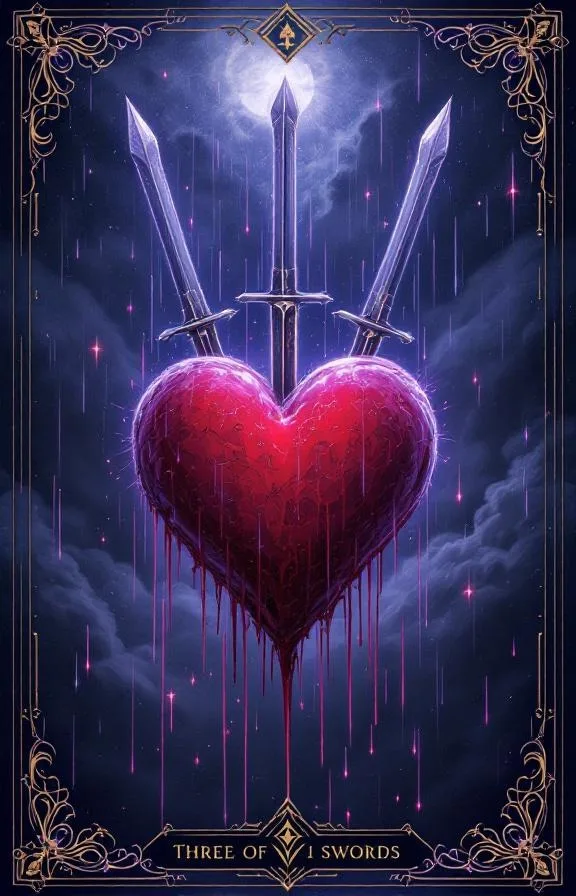
There is a person at the support group who always knows exactly the right thing to say. Not the platitude. Not the script. The real thing — the sentence that makes you feel less alone in your pain because it could only come from someone who has been exactly where you are now. That person carries the Three of Swords. They earned their wisdom the hard way, and it shows.
The personality profile
The Three of Swords person is defined by heartbreak they have transformed into understanding. This is not someone who merely survived difficult experiences. This is someone who sat with their pain long enough to learn its architecture — where it lives in the body, what triggers it at unexpected moments, how grief and love and anger can occupy the same breath.
Most people run from emotional pain. They numb it, distract from it, spiritualize it into something more palatable. The Three of Swords person ran too, for a while. But at some point they stopped running and turned around to face what was chasing them. That moment of turning changed everything. It gave them a capacity for empathy that goes beyond sympathy, beyond "I'm sorry that happened to you," all the way to "I know exactly what that room looks like at 3 AM."
Carl Jung wrote extensively about the concept of the wounded healer — the idea that a therapist's own suffering, when integrated rather than repressed, becomes their greatest clinical tool. The Three of Swords person proves this principle outside the therapy room. They are not certified. They do not charge by the hour. They just understand pain the way a swimmer understands water: from the inside, intuitively, without needing to think about it.
Three of Swords upright as a person
Upright, this person has done the work. They have grieved what needed grieving, forgiven what could be forgiven, accepted what could not be changed, and emerged with a quiet strength that makes them extraordinarily safe to be around during other people's darkest moments. They do not flinch at tears. They do not rush you through your sadness. They sit with you in it.
Their emotional intelligence is hard-won rather than theoretical. They know that grief is not linear because theirs was not. They know that "getting over it" is a lie because they tried. They know that sometimes the most helpful thing a person can do is say "this is terrible and I am here" without offering a solution.
The upright Three of Swords person has a particular talent for creating spaces where honesty is possible. People tell them things. Strangers on airplanes, colleagues in break rooms, friends who have been holding something inside for months. There is something about this person's presence that communicates permission — permission to be hurt, to be angry, to be unfinished.
Three of Swords reversed as a person
Reversed, the wound is still open. This person has experienced significant heartbreak but has not integrated it. Instead of transforming pain into wisdom, they have made it the center of their identity. They are defined by what happened to them rather than by what they have become since.
The reversed Three of Swords person tells their story too often and to the wrong people. Not because they are seeking attention — though it can look that way — but because they are seeking a witness who can finally make the pain make sense. Every retelling is an attempt at processing that never quite completes.
They may also project their heartbreak onto others. Every romantic prospect is evaluated through the lens of past betrayal. Every friendship is tested for loyalty before trust is offered. They have built such elaborate defenses against being hurt again that they have effectively made connection impossible. The walls they built to protect themselves have become a prison.
There is a particular cruelty in the reversed Three of Swords: the person's pain is genuine, but their relationship to it has become self-destructive. They use their suffering as evidence that the world is fundamentally unsafe, and this belief — held tightly enough, long enough — becomes self-fulfilling.
Three of Swords as a person in love
In love, the upright Three of Swords person brings a depth of emotional understanding that most partners have never encountered. They do not panic at conflict. They do not treat disagreement as a threat. They have already survived worse, and this gives their love a groundedness that feels like shelter.
They are also, frankly, a little sad. There is a melancholy underneath even their happiest moments — an awareness that love and loss are not opposites but companions. This can be deeply attractive or deeply unsettling depending on what their partner is looking for. Some people want a love that pretends pain does not exist. The Three of Swords person cannot offer that.
What they can offer is radical honesty about emotional experience. They will not hide their scars or pretend their history does not affect the present. They will tell you about the thing that broke them open, and they will listen when you tell them yours. The relationship they build may not be the lightest one you have ever had, but it might be the most real.
Three of Swords as a person at work
Professionally, they gravitate toward helping roles. Counseling, social work, nursing, crisis intervention, addiction recovery. They can also be remarkably effective writers, artists, or musicians — anyone who channels personal experience into work that connects with others emotionally.
Their professional vulnerability is burnout. They absorb other people's pain like a sponge absorbs water, and without strong boundaries, they can drown in it. The healthiest Three of Swords professionals are the ones who have learned that empathy without self-care is just shared suffering.
Three of Swords as someone in your life
If this person is in your life, honor what they have been through without defining them by it. They are more than their wounds, even when they temporarily forget that. When they share their pain with you, resist the urge to fix it. They are not looking for solutions. They are looking for someone who can sit in the dark with them without reaching for the light switch.
The best thing you can do for a Three of Swords person is remind them — gently, consistently — that their pain was a chapter, not the whole book.
Frequently asked questions
What kind of person does the Three of Swords represent?
The Three of Swords represents a wounded healer — someone who has experienced significant heartbreak and, through processing that pain, developed an extraordinary capacity for empathy and emotional understanding. They are the person others turn to in crisis because they have been in crisis themselves.
Is the Three of Swords as a person positive or negative?
It depends entirely on their relationship to their own pain. Integrated, their suffering becomes their greatest gift — a depth of compassion that most people never develop. Unintegrated, it becomes a cage, trapping them in cycles of re-injury and victimhood.
How do you recognize a Three of Swords person?
People open up to them quickly and without quite knowing why. They carry a visible gentleness that comes from having been broken and rebuilt. They tend to be quiet in groups but extraordinary one-on-one. They ask questions about how you feel that most people never think to ask.