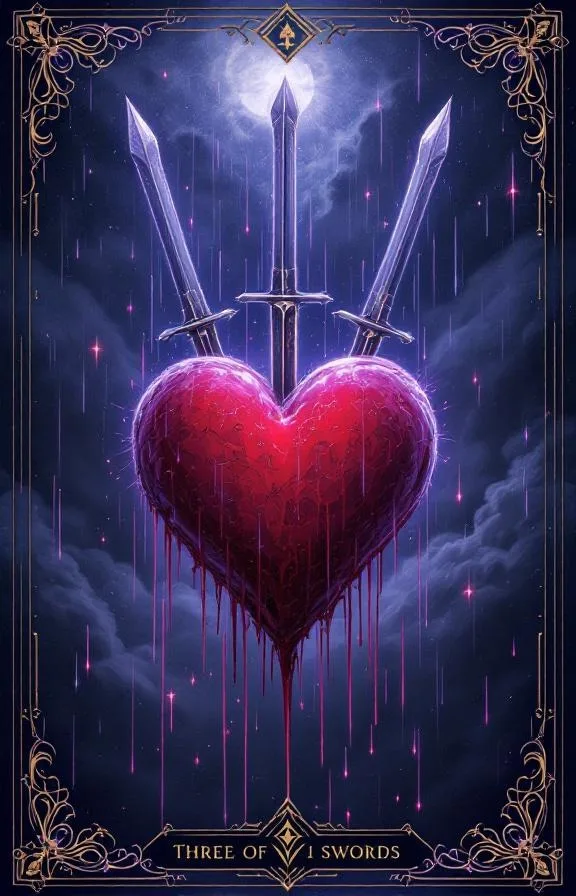
There is no softening this one. Three blades through a heart, rain pouring down, and nothing in the image suggesting the pain will end soon. The Three of Swords as feelings is grief in its rawest form — the kind that arrives when a truth you already suspected is finally confirmed and the last exit from denial closes behind you.
The core feeling
Heartbreak is not a single emotion. It is a cascade. Shock first, even when the blow was expected. Then the peculiar stillness that follows shock, where the brain delays processing because the full weight of what happened would be too much to absorb at once. Then the waves start — anger, sorrow, betrayal, self-blame — arriving in no particular order and sometimes all at once.
What distinguishes Three of Swords heartbreak from ordinary sadness is that it requires participation from the intellect. This card belongs to the suit of Swords — air, thought, communication. The pain here is not simply felt. It is understood. The person knows why it hurts. They can articulate the betrayal, name the loss, trace the exact moment things went wrong. That understanding does not reduce the pain. Often it intensifies it, because the mind keeps replaying the evidence, building its case, proving over and over what the heart already knows.
Psychologist George Bonanno, who spent his career studying grief and resilience at Columbia, found that most people are more resilient than the grief-processing industry assumes. But he also found something the Three of Swords captures perfectly: the period immediately after a loss, before resilience kicks in, is genuinely terrible, and there are no shortcuts through it. You sit with the swords in your heart and you feel them. That is the only way forward.
Three of Swords upright as feelings
Upright, the Three of Swords represents feelings at their most exposed. No defense mechanisms are working. No rationalization provides comfort. The person is in the acute phase of emotional pain — the part where it hurts to breathe, where familiar songs become unbearable, where the body itself seems to revolt against the information the mind has delivered.
The upright position suggests this pain is fresh or freshly acknowledged. Maybe the betrayal just happened. Maybe the loss is recent. Or maybe the truth was there for months and the person finally stopped running from it, which means the wound is old but the experience of actually facing it is new. Either way, there is no buffer between them and the hurt.
One thing the Three of Swords does not contain is numbness. The person feeling this card's energy is painfully, exquisitely present. They wish they were numb. Numbness would be a mercy. Instead, every nerve is firing.
Three of Swords reversed as feelings
Reversed, the Three of Swords indicates one of two emotional trajectories. The first is the slow, uneven process of healing — the swords are being removed, but removal hurts almost as much as the initial piercing. The person is doing the work of recovery. Processing. Journaling. Talking to friends until the friends are exhausted. Some days feel like progress. Other days feel like starting over.
The second trajectory is suppression. The person has pushed the pain underground, not because they have healed but because they cannot afford to keep feeling it at full volume. Work needs doing. Children need feeding. The mortgage does not pause for heartbreak. So they function, and they are functional, but underneath the competence is a wound that has not been cleaned and is starting to infect other areas of their emotional life — their ability to trust, their willingness to be vulnerable, their tolerance for intimacy.
Distinguishing between these two trajectories matters. One leads somewhere. The other leads to the same card appearing again later, louder.
Three of Swords as feelings in love
The Three of Swords in a love reading is the card nobody wants to see. It represents feelings of betrayal, rejection, or the devastating clarity that comes from realizing a relationship is not what you believed it was. Infidelity. Broken promises. The discovery that someone you trusted completely was not who they presented themselves to be.
When this card represents someone's feelings toward you, the situation is painful and honest. They feel hurt by something you did or something the relationship revealed. This is not casual disappointment. The three swords suggest multiple wounds — perhaps a pattern of hurts rather than a single incident, or a single incident that damaged trust on multiple levels simultaneously. They are grieving the version of the relationship they thought they had.
Here is the thing most readings gloss over: sometimes the Three of Swords in love readings is not about a villain. Sometimes two decent people hurt each other because their needs were genuinely incompatible. No betrayal. No cruelty. Just the heartbreak of wanting different futures and realizing too late that no amount of love bridges that gap.
Three of Swords as feelings about you
When the Three of Swords represents someone's feelings about you, you are associated with pain in their emotional landscape. This does not necessarily mean you caused the pain. You might remind them of a loss. You might represent a truth they were not ready to face. You might be the person who stayed honest when everyone else told them what they wanted to hear.
Being associated with someone's Three of Swords energy is isolating. They may avoid you, not because they dislike you but because seeing you activates something they are not ready to process. Give them space. The association may shift once the healing progresses.
Three of Swords as feelings in career
In professional contexts, the Three of Swords represents the emotional aftermath of professional betrayal or devastating news. A layoff they did not see coming. A colleague who took credit for their work. The realization that a company they gave years to does not value them the way they valued it.
The feelings here are complicated by the expectation that professionals should not have feelings. The person may be told to "keep it professional" or "not take it personally" while processing something that is, in fact, deeply personal. The Three of Swords reminds us that separating work from emotion is a useful fiction that collapses under enough pressure.
Frequently asked questions
What does Three of Swords mean as feelings?
The Three of Swords represents heartbreak — acute emotional pain caused by betrayal, loss, or the shattering of an illusion. The feelings are raw, intellectually clear, and impossible to avoid. This card signals that someone is in the thick of grief, not on the other side of it.
Does Three of Swords represent positive or negative feelings?
The Three of Swords represents painful feelings, but pain is not the same as negativity. The card indicates honest confrontation with a difficult truth, and that confrontation, while agonizing, is ultimately necessary for genuine healing. Avoiding the Three of Swords means avoiding the truth, which creates worse problems over time.
What does Three of Swords reversed mean as someone's feelings?
Someone experiencing the reversed Three of Swords is either healing from a significant emotional wound or suppressing the pain to keep functioning. In healing, they are processing grief in waves and slowly removing the sources of hurt. In suppression, they appear fine while carrying unresolved pain that affects their ability to trust and connect. The key difference is whether they are feeling through the pain or working around it.
Curious what Three of Swords means as feelings in YOUR situation? Try a free AI tarot reading and explore the emotional landscape of your cards.