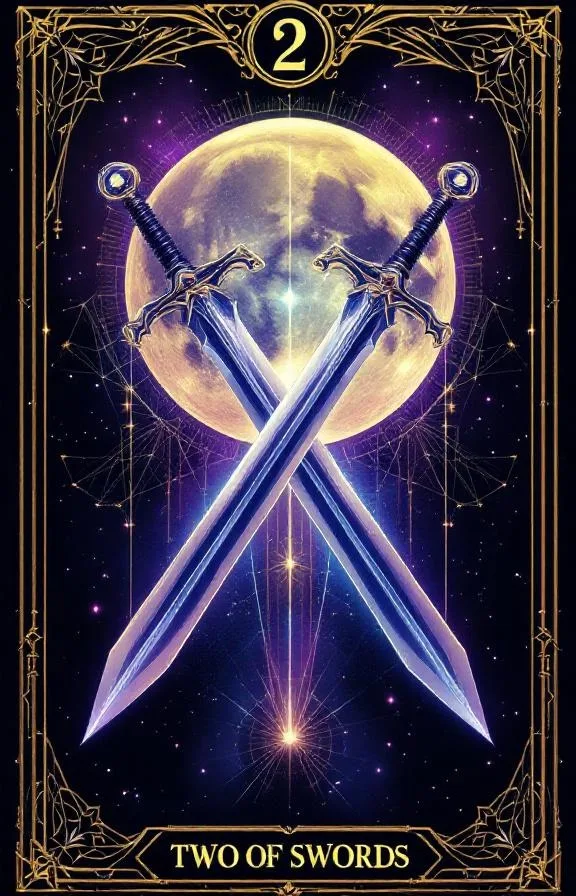
The blindfold is not protecting you. That is the first thing to understand about the Two of Swords as advice. The figure in this card sits with crossed swords, eyes covered, deliberately blocking out the information that would make the decision obvious. The card's message is not "wait for more clarity." It is "you are manufacturing your own blindness, and it is time to stop."
The advice
Indecision has a shelf life. Past a certain point, refusing to choose becomes its own choice — and usually the worst one available. The Two of Swords as advice recognizes that you are stuck between two options and that both carry real costs. Neither path is painless. Neither is risk-free. The card is not pretending otherwise.
But here is what the Two of Swords wants you to understand: the pain of choosing wrong is almost always less than the pain of never choosing at all. A wrong decision can be corrected, redirected, learned from. Permanent indecision just erodes — your energy, your opportunities, your self-trust. Every day spent in the crossed-swords position is a day spent in a defensive posture that protects nothing.
The reason you cannot decide is probably not insufficient information. It is that you want a guarantee neither option can provide. You want to know in advance which choice leads to the better outcome, and no amount of analysis will give you that. The Two of Swords says: choose anyway. Choose knowing you might be wrong. Choose because the act of choosing is itself the breakthrough.
Barry Schwartz's work on the paradox of choice showed that more options and more deliberation time do not produce better decisions — they produce more anxiety and less satisfaction with whatever you eventually pick. The Two of Swords is this research in visual form. Put down one sword. Then the other. Then open your eyes.
Two of Swords upright advice
Upright, the Two of Swords advises you to stop stalling and commit to a direction. Not the perfect direction. A direction. The card acknowledges that you have legitimate reasons for hesitation — both options have merit, both have risk. But the stalemate itself has become the primary problem.
Practical approach: give yourself a forced deadline. Not "soon." Not "when I feel ready." A specific date. Forty-eight hours is usually enough for decisions that have already been analyzed to death. When the deadline arrives, choose. If you still genuinely cannot differentiate between the two options, it probably means either one is fine and the actual obstacle is your fear of commitment, not the quality of the options.
The upright position also suggests that your emotions have useful information your intellect is blocking. You may be so focused on the rational pros and cons that you have ignored your gut response. What does your body tell you? Which option makes your shoulders tense? Which one lets you breathe? The blindfold covers intuition as much as it covers sight.
Two of Swords reversed advice
Reversed, the blindfold is coming off whether you want it to or not. Information you have been avoiding is becoming unavoidable. The decision you have been deferring is being made for you by circumstance, and the reversed Two of Swords advises you to take control of that process before it takes control of you.
This position sometimes indicates that you have already made the decision internally but are delaying the announcement. You know which option you are leaning toward. You know which sword you want to put down. The reversed card says: stop performing indecision for an audience. Stop pretending you are still weighing things when the scale has already tipped.
It can also warn against information overload — seeking more data as a procrastination strategy. At some point, additional research becomes avoidance wearing a productive mask. If you have consulted more than three people about this decision, you are not gathering wisdom. You are crowd-sourcing permission.
Two of Swords advice in love
In romantic situations, the Two of Swords usually appears when you are choosing between two people, between staying and leaving, or between vulnerability and self-protection. The card's advice is the same regardless of the specific dilemma: the limbo is hurting everyone involved more than either resolution would.
If you are choosing between two potential partners, recognize that comparison shopping for humans is inherently flawed. You are not selecting a product. You are choosing whom to invest in, and the returns of that investment depend on the investing itself, not on some objective quality metric you can calculate in advance.
If the choice is between staying in a relationship and leaving: the Two of Swords often means you have been mentally leaving for a while but have not given yourself permission to act on it. Or alternatively, you have been emotionally checked out as a way of protecting yourself from the vulnerability that staying fully present would require.
Either way — decide. And then be fully in whatever you chose. Half-in is the one option the Two of Swords explicitly rejects.
Two of Swords advice in career
Professionally, this card appears when you are paralyzed between job offers, project directions, career paths, or business strategies. The analysis has been done. The spreadsheets are complete. And you still cannot choose because you are waiting for certainty that will never arrive.
The career advice of the Two of Swords is to recognize that most professional decisions are reversible. You can change jobs again. You can pivot strategies. You can course-correct. The irreversible thing is time lost to indecision — the months spent in a role you know is wrong because you could not commit to the alternative, or the quarters spent on a fence when both adjacent fields had opportunities growing in them.
For entrepreneurs: stop A/B testing your fundamental direction. Pick one. Give it six months of genuine effort. Then evaluate. The data you need will come from action, not from more planning.
Action steps
- Flip a coin. Literally. Assign each option to a side. When the coin lands, pay attention to your immediate emotional response. Relieved? Disappointed? That reaction is your answer. The coin is not deciding — it is revealing what you already want.
- Write two letters from the future. One from the version of you who chose Option A, one from Option B. Date them one year from now. Describe what life looks like. Which letter feels more alive?
- Set a 48-hour deadline. After that deadline, you commit. No extensions. No "just one more conversation." The deadline is non-negotiable.
- Tell one person your decision before you are ready. Speaking it aloud to a witness makes it real in a way that thinking about it never will.
FAQ
What does the Two of Swords mean when it appears as advice?
It means stop delaying. The Two of Swords as advice identifies indecision itself as the core problem — not the difficulty of the options in front of you. The card acknowledges that neither choice is perfect but insists that choosing imperfectly is better than the slow corrosion of choosing nothing. Its guidance is to commit to a direction, accept the risk, and move.
Does the Two of Swords mean I should wait for more information?
Almost never. The Two of Swords typically appears when you already have enough information but are using the search for more as a delay tactic. The blindfolded figure is not waiting for data — she is blocking it out. If this card is your advice, the issue is not a lack of information. It is a fear of what the information you already have requires you to do.
How do I know which option the Two of Swords is telling me to choose?
The card does not pick for you. Its advice is about the act of choosing, not the specific choice. However, the card does suggest that your emotional and intuitive responses contain important guidance that your analytical mind may be suppressing. Pay attention to physical sensations, gut feelings, and the option that lets you imagine the future without dread. The blindfold must come off — and what you see first when it does is usually what matters most.
