She sits at the dinner table while her parents argue, eating her pasta in measured bites, making herself so neutral she practically disappears. Thirty years later, she is still doing it. Different table. Different argument. Same vanishing act. The Two of Swords person has turned indecision into an identity, and the scary part is how well it works — for a while.
The personality profile
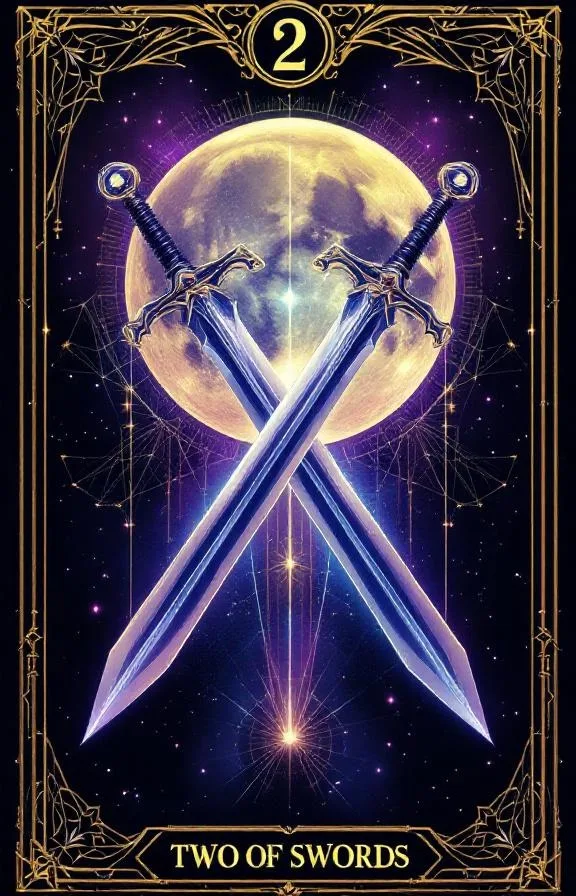
The Two of Swords person exists in a state of perpetual balance that looks like calm from the outside and feels like paralysis from the inside. They are not stupid or unaware. Quite the opposite. They see both sides of every situation with such devastating clarity that choosing one feels like a betrayal of the other. So they choose neither. They hold both swords crossed over their chest and wait for the universe to decide for them.
This is someone who learned early that conflict is dangerous. Maybe their childhood required them to mediate between warring adults. Maybe they discovered that having strong opinions made them a target. Whatever the origin, they developed an extraordinary capacity for seeing multiple perspectives simultaneously and an almost total inability to commit to one of them.
Psychoanalyst Karen Horney identified a personality style she called "moving away from people" — a strategy of withdrawal and emotional detachment used to manage anxiety. The Two of Swords person embodies this pattern with elegant precision. They are not aggressive. They are not pleasing. They simply step back behind a wall of measured neutrality and let the storm pass around them.
Two of Swords upright as a person
Upright, this person presents as calm, rational, and unfailingly fair. They are the friend everyone calls to mediate disputes because they genuinely can hold two conflicting positions without taking sides. In group dynamics, they function as a stabilizer — the person who lowers the temperature in the room simply by refusing to participate in escalation.
Their composure is genuine, not performed. They truly do not experience the hot certainty that drives other people into arguments. They see the merit in your position. They also see the merit in the opposing position. They find dogmatism genuinely confusing.
The upright Two of Swords person is also deeply private. They share selectively. You might know them for years before learning something fundamental about their inner life, and even then, it emerges sideways — in a joke, in a book recommendation, in what they choose not to say.
Two of Swords reversed as a person
Reversed, the balancing act collapses. This person's neutrality stops looking like wisdom and starts looking like cowardice. They avoid decisions so consistently that the decisions get made without them — by default, by deadline, by someone else losing patience and choosing for them.
The reversed Two of Swords person says "I don't know" too often. They say "both options have merit" when someone needs them to say "here is what I think." They mistake passivity for patience. Avoidance for acceptance.
Relationships suffer first. Partners get tired of being the only one who ever makes a call about where to eat, where to live, whether to stay or go. Friends stop asking for their opinion because the opinion never comes. The reversed Two of Swords person ends up isolated — not because anyone pushed them away, but because their refusal to take a position gradually makes them irrelevant to the conversations that matter.
There is anger underneath all that stillness. Unexpressed, unacknowledged, denied, but present. The Two of Swords person does not feel neutral. They feel frozen.
Two of Swords as a person in love
In love, the Two of Swords person is deeply loyal but maddeningly uncommitted in the emotional sense. They show up. They are reliable. They remember your birthday and notice when you change your hair. But asking them how they feel about the relationship produces a response so measured and balanced it tells you almost nothing.
They struggle with vulnerability because vulnerability requires choosing to be exposed, and they avoid choosing anything that cannot be taken back. Saying "I love you" terrifies them — not because they do not feel it, but because the declaration closes doors. It eliminates the safe, neutral ground they have built their entire personality around.
The partner who thrives with this person is someone patient enough to read between their carefully constructed lines and secure enough not to need constant verbal reassurance. The Two of Swords person loves in actions. The words arrive later, if at all, and when they do, they mean everything precisely because they took so long.
Two of Swords as a person at work
They are the employee who thrives in structured environments where decisions follow a process. Give them data. Give them frameworks. Give them criteria. They will produce analysis so thorough it makes the choice obvious to everyone else, even if they themselves still cannot quite pull the trigger.
They make excellent mediators, HR professionals, editors, and analysts. Roles that reward careful thinking over bold action. The problem comes when they are promoted into positions that demand decisiveness. A Two of Swords person in a leadership role will consult, gather input, request more data, form a committee, and schedule a follow-up meeting while the window of opportunity quietly closes.
Two of Swords as someone in your life
If you recognize this person, resist the urge to make their decisions for them. That feels helpful in the short term but reinforces their belief that choosing is someone else's job. Instead, make space for small choices. Low-stakes preferences. "Which restaurant?" is training for "Which life?"
The most important thing to understand is that their neutrality is not apathy. They care deeply. Sometimes too deeply, about too many angles simultaneously. Their paralysis is not an absence of feeling. It is an excess of it, compressed into a shape that looks, from the outside, like nothing at all.
Frequently asked questions
What kind of person does the Two of Swords represent?
The Two of Swords represents a peacekeeper — someone who maintains balance and neutrality to an extraordinary degree. They see all sides of every situation, avoid conflict instinctively, and often struggle with the decisive action their own intelligence has already made possible.
Is the Two of Swords as a person positive or negative?
Their capacity for seeing multiple perspectives is a genuine gift, especially in a world that rewards shallow certainty. But when balance becomes an excuse for avoidance, the gift turns into a trap. The line between open-minded and paralyzed is thinner than most people realize.
How do you recognize a Two of Swords person?
They rarely volunteer strong opinions. They are the last to order at restaurants and the first to say "I'm fine with whatever." Their composure under pressure is remarkable. Their friends describe them as calm. Their partners describe them as impossible to read.