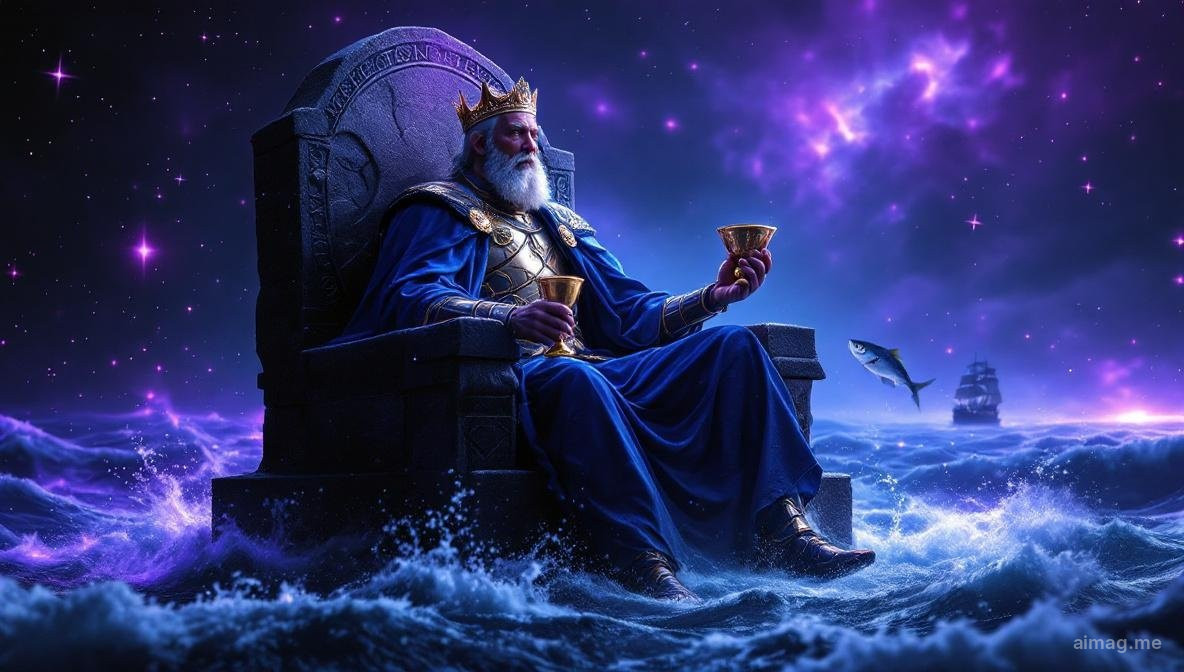
A king sits on a throne that floats on turbulent water. The sea around him is rough — waves churn, a fish leaps to his right, a ship pitches on the swells to his left. Things are happening. The ocean is active, unpredictable, alive with forces that would capsize anyone who tried to fight them. And the King sits in perfect composure. Not frozen. Not indifferent. His eyes are open, his posture is engaged, but his emotional center is steady. He holds a golden cup in one hand and a short scepter in the other. The cup contains what he feels. The scepter represents his authority over how those feelings are expressed. He is not suppressing the ocean. He is sitting in the middle of it without drowning.
That distinction — between suppression and mastery — is the entire meaning of the King of Cups.
In short: The King of Cups represents emotional mastery, not emotional suppression. He sits on turbulent waters without drowning, holding his cup steady amid the storm, embodying the culmination of the Cups suit's journey through feeling. As Air of Water, he has developed the rare capacity to feel everything deeply while maintaining composure, making him the tarot's model of emotionally intelligent leadership and mature love.
King of Cups at a Glance
| Attribute | Detail |
|---|---|
| Rank | King |
| Suit | Cups |
| Element | Air of Water |
| Keywords (Upright) | emotional balance, composure, diplomatic wisdom, mature love, compassionate authority |
| Keywords (Reversed) | emotional suppression, volatility beneath calm surface, manipulation, cold detachment, addiction |
| Yes / No | Yes |

What Does the King of Cups Mean?
The King of Cups is the culmination of the entire Cups suit's journey through emotional experience. Where the Ace of Cups offered raw emotional potential, where the numbered cards traced the arc from first love through grief, nostalgia, illusion, departure, and fulfillment, and where the Page, Knight, and Queen of Cups embodied emotional openness, pursuit, and depth respectively — the King embodies emotional mastery. He has felt everything and learned to hold it all.
The elemental assignment is Air of Water — intellect applied to emotion, the conscious mind's engagement with the world of feeling. This does not mean the King thinks instead of feeling. It means he has developed the capacity to feel fully while maintaining the awareness to manage how those feelings influence his actions. The ocean is real. The turbulence is real. His composure is not a denial of the storm but a relationship with it.
Arthur Edward Waite, in The Pictorial Key to the Tarot (1911), describes the King of Cups as "a man of business, law, or divinity," which seems oddly prosaic for a card depicting a king on a floating throne. But Waite was pointing at something important: the King of Cups operates effectively in the real world. Unlike the Knight, who is always en route, or the Queen, who sits in contemplation, the King functions in the domain of practical life — business, law, authority — while drawing from emotional depths that his peers in those domains may never access.
Rachel Pollack, in Seventy-Eight Degrees of Wisdom (1980), notes that the King of Cups "does not conquer the sea; he sits upon it." She contrasts this with the King of Swords, who masters through cutting clarity, and the King of Pentacles, who masters through material accumulation. The King of Cups' mastery is relational — he does not dominate what he feels but has learned to coexist with it, to let the waves move without being moved by them. This is the emotional equivalent of what martial artists call "rooted flexibility" — soft on the outside, immovable at the center.
Jung's concept of the "wise old man" — the archetype of mature masculine wisdom that integrates both strength and feeling — finds its clearest expression in the King of Cups. Where the Emperor rules through authority and the Hierophant rules through tradition, the King of Cups leads through emotional intelligence. He is the father who listens before he speaks. The leader who considers how decisions will feel, not just how they will function. The mentor who teaches by modeling composure rather than demanding obedience.
In my experience, this card appears for people who have done sustained emotional work — often over years or decades — and have arrived at a genuine equanimity that is not indifference. They feel deeply. They simply no longer feel the need to be carried away by what they feel. The fish leaps, the ship sails, the waves churn, and the King holds his cup steady. Not because the ocean does not affect him but because he has learned that the cup stays upright when you do.
The contrast with other court Kings is instructive. The King of Wands leads through charisma and energy. The King of Swords leads through logic and moral authority. The King of Pentacles leads through wealth and reliability. The King of Cups leads through emotional steadiness — the capacity to remain composed in crisis, to hold space for others' emotions without being overwhelmed, and to make decisions that honor both practical necessity and human feeling. In a world that often treats these as opposing priorities, the King of Cups demonstrates that they are not.

King of Cups Reversed
Reversed, the King of Cups' composure cracks — and what emerges from underneath may be dramatically different from the calm surface that was holding everything in place. The ocean does not disappear when the King falls off his throne. It was always there. The question the reversed King raises is whether the composure was genuine mastery or merely a convincing performance of control.
Emotional suppression — the most common face of the reversal — is not the same as emotional mastery, though they can look identical from the outside. The suppressed King of Cups appears calm, measured, in control. But underneath, unfelt feelings accumulate like water behind a dam. Eventually, they break through: the composed executive who has a breakdown, the steady partner who suddenly explodes in rage over something minor, the person who "never gets angry" and then does something devastating. The reversal asks: are you managing your emotions, or are you just not feeling them?
Manipulation is another dimension. The King's emotional intelligence, reversed, becomes a tool for control — the person who reads emotions accurately and uses that information strategically rather than compassionately. The boss who senses your insecurity and exploits it. The partner who stays calm specifically to make you feel unstable by comparison. Emotional mastery weaponized.
Addiction is the third face, and it is the most insidious. The King sits on turbulent water — water being the suit of feeling, pleasure, and also the element most associated with addiction in psychological symbolism. The reversed King of Cups may use substances, behaviors, or relationships to numb the very feelings he outwardly appears to manage. The cup he holds becomes the cup he drinks from, and what he drinks is not wisdom but escape.

King of Cups in Love and Relationships
Upright
In a love reading, the King of Cups signals the presence or arrival of someone who brings genuine emotional maturity to the relationship — not the maturity of controlled detachment but the maturity of someone who can feel deeply and express those feelings with appropriate measure. This is the partner who stays calm during arguments not because they do not care but because they care enough to not escalate. The partner who can hold your emotions without being overwhelmed by them. The partner who has done their own emotional work and shows up already whole.
If this card represents your current relationship, it indicates a dynamic built on emotional balance and mutual respect — a partnership where both people feel safe enough to be vulnerable because the container is held by someone who knows how to sit with turbulence without capsizing.
Reversed
Reversed in love, the King of Cups can indicate a partner whose emotional composure masks something less healthy underneath — the person who seems steady and grounded but is actually disconnected from their own feelings, or the person whose calm is a control mechanism rather than genuine equanimity. "You're overreacting" said not to de-escalate but to invalidate.
It may also signal a relationship where one partner has shut down emotionally — present in the household, responsible, functional, but emotionally absent. The King sits on the throne but has emptied the cup. He is going through the motions of emotional partnership without actually engaging.
Want to see what the King of Cups reveals about your relationship? Try a free AI reading →
King of Cups in Career and Finances
Upright
Professionally, the King of Cups represents composed leadership — the boss, mentor, or colleague who manages people with emotional intelligence rather than through authority alone. This is the leader whose team performs well not because they fear consequences but because they feel seen, heard, and respected. In any professional context that involves managing people, mediating conflicts, or making decisions that affect others' emotional well-being, the King of Cups is the gold standard.
Financially, the King suggests a balanced approach to money — neither the anxiety of scarcity nor the recklessness of impulse, but the composed management of resources by someone who understands that financial decisions are always also emotional decisions and treats them as such.
Reversed
Reversed in career, the King indicates leadership that has disconnected from the people it serves — the manager who manages spreadsheets but not human beings, the executive whose composure has become coldness. It may also signal a workplace where emotional intelligence is not valued, where vulnerability is penalized, and where the culture rewards the appearance of control over genuine human engagement.
Financially, the reversal warns against financial decisions driven by suppressed emotion — the stress-spending, the revenge-investing, the financial choices made from a place of unacknowledged fear or anger.
King of Cups in Personal Growth
The King of Cups, in personal growth, teaches the difference between emotional maturity and emotional performance — and this distinction may be the single most important lesson in the entire Cups suit. Mature people feel. They feel everything — grief, rage, tenderness, fear, joy. What distinguishes maturity from immaturity is not the range of emotion but the relationship with it: the mature person holds their feelings; the immature person is held by them.
Daniel Goleman, in Emotional Intelligence (1995), coined the term that has become so mainstream it has nearly lost its meaning. But the King of Cups, read carefully, restores it. Emotional intelligence is not being nice. It is not being calm. It is the ability to perceive, understand, and manage emotions — your own and others' — in service of appropriate action. The King's scepter (authority) and cup (feeling) held simultaneously in two hands: that is emotional intelligence as a practice, not a personality trait.
A practical exercise from Jung himself is relevant here. He recommended "active imagination" — the practice of engaging consciously with emotional material from the unconscious without either suppressing it (the reversed King's mistake) or being overwhelmed by it (drowning in the ocean). Sit with a strong emotion. Feel it fully. Then observe it from the position of the King on his throne — not above it, but in the middle of it, steady. Notice that you can feel without acting. You can acknowledge without indulging. You can hold the cup without being the cup. That capacity, practiced, is the King's gift.
Temperance blends opposites into something new. The King of Cups holds opposites — feeling and composure, depth and surface, vulnerability and authority — in dynamic tension without needing to resolve the contradiction. Both cards teach balance. Temperance teaches the balance of mixing. The King teaches the balance of holding.
King of Cups Combinations
- King of Cups + The Empress — Emotionally mature love combined with nurturing abundance. The healthiest possible partnership dynamic: one partner brings composed emotional depth, the other brings warm generative care. Together they create a container where everything can grow.
- King of Cups + The Tower — Even the King's composure is tested by sudden upheaval. The question is not whether the King can prevent the Tower — no one can — but whether his emotional mastery holds through the crisis. If upright, it does. The King who survives the Tower is stronger afterward.
- King of Cups + Queen of Cups — The most emotionally sophisticated partnership in the deck. Two people with genuine emotional mastery meeting each other at depth. The sealed cup and the steady cup side by side. Rare and profound.
- King of Cups + Five of Cups — Emotional mastery meets grief. The King does not bypass the Five's loss — he holds it. This combination suggests the ability to grieve fully without being destroyed by grief, to mourn what was spilled while remaining aware of what remains.
- King of Cups + The Devil — The shadow of emotional mastery. The King's composure confronts its opposite: bondage, addiction, the chains that look loose but hold tight. This combination demands radical honesty about whether the composure is real or whether it conceals something the King has not yet faced.
Frequently Asked Questions
Is the King of Cups the best card for a partner?
Many readers consider the King of Cups one of the most desirable cards to receive when asking about a partner. He represents emotional maturity, composure, genuine depth, and the ability to show up for a relationship without losing himself in it. However, "best" depends on context — some situations call for the King of Wands' passion or the King of Pentacles' stability. The King of Cups is best when what you need most is someone who can feel with you without falling apart.
Does the King of Cups represent a specific zodiac sign?
The King of Cups is most commonly associated with water signs — Pisces, Cancer, and Scorpio — with Pisces being the most frequent association due to its connection with deep emotional waters and spiritual wisdom. However, any person who embodies emotional maturity, composed sensitivity, and intuitive leadership may be represented by this card regardless of their sun sign.
What is the difference between the King and Queen of Cups?
The Queen (Water of Water) dwells entirely in the emotional realm — she understands feeling from the inside, through direct empathic experience. Her cup is sealed; her knowledge is internal. The King (Air of Water) applies conscious awareness to the emotional realm — he understands feeling with enough perspective to manage it effectively in the external world. His cup is open; his composure is visible. She goes deeper. He holds wider.
What is the yes or no answer for the King of Cups?
Yes, with calm confidence. The King of Cups affirms your question with the steadiness of someone who has considered the matter fully — emotionally and practically — and sees a positive path forward. This is not an impulsive yes or a hopeful yes. It is a grounded yes from someone who knows what they are saying and means it.
The King of Cups sits on turbulent water and does not drown, holds a full cup and does not spill, wears a crown and does not need to remind anyone of his authority. He is the promise the Cups suit makes and the proof that the promise can be kept: that a human being can feel everything without being destroyed by any of it. That is not control. It is wholeness. If you are ready to explore the emotional depths with a steady hand, the reading is waiting. Try a free AI-powered reading at aimag.me/reading