You pulled a Cups card and someone told you it is "about feelings." That is like saying the ocean is about water. Technically correct, spectacularly unhelpful. The suit of Cups traces something much more specific — a fourteen-card arc of emotional development that starts with the first unnameable stirring of feeling and ends with the hard-won ability to hold the full weight of human emotion without drowning in it or going numb. Every card between those two points maps a stage you will recognize if you have ever loved someone, lost someone, or sat in a room wondering why you cannot feel anything at all.
In short: The suit of Cups represents the element of Water and maps the complete arc of emotional development — from raw feeling (Ace) through loss, choice, fantasy, and reunion, to the emotional mastery of the court cards. Understanding the suit as a continuous narrative, not 14 isolated meanings, transforms how you read any Cups card in a spread.
The element of Water
Cups correspond to Water in the Western esoteric tradition, and the correspondence is not decorative. Water takes the shape of its container. It flows downhill. It finds the lowest point. It cannot be compressed but it can be frozen, boiled, polluted, or purified. Every one of those physical facts maps onto something true about emotion.

Grief in a supportive community looks different from grief in isolation. Love inside a secure relationship behaves differently from love inside an anxious one. Same water — different container. The container determines the form.
In Jung's four-function model — Thinking, Feeling, Sensation, Intuition — Cups align with the Feeling function: the mode of consciousness that evaluates experience through values, meaning, and relational significance. Not "how do I think about this?" but "what does this matter to me?" That is the question every Cups card asks in some version.
The emotional intelligence connection
The concept of emotional intelligence (EQ) identifies five core components: self-awareness, self-regulation, motivation, empathy, and social skill. The suit of Cups, read as a developmental sequence, traces the acquisition of all five. The numbered cards (Ace through Ten) map the raw experiences that build emotional capacity. The court cards (Page through King) represent progressive stages of emotional maturity — from the Page's first encounter with feeling to the King's composed mastery.
Think of the whole suit as a 14-stage curriculum for learning to perceive, use, understand, and manage emotions. That framing turns a set of fortune-telling images into something genuinely diagnostic.
The numbered cards: experiences that build emotional depth
Ace of Cups — the emotional seed
The Ace is pure potential. A hand emerges from a cloud holding a chalice that overflows before anyone has taken a sip. This is the moment before a feeling has been named, categorized, or decided upon — the first stirring of love, compassion, creative inspiration, or spiritual opening.
Psychologically, the Ace represents the body's signal that something emotionally significant is present. You feel it before you understand it. The Ace asks only one thing: are you willing to receive what is being offered?
| Card | Core theme | Emotional lesson | EQ component |
|---|---|---|---|
| Ace | New feeling | Openness to emotion | Self-awareness |
| Two | Connection | Mutual vulnerability | Empathy |
| Three | Celebration | Joy in community | Social skill |
| Four | Apathy / withdrawal | Recognizing emotional stagnation | Self-awareness |
| Five | Loss / grief | Processing what is gone | Self-regulation |
| Six | Nostalgia / innocence | Integrating the past | Self-awareness |
| Seven | Fantasy / illusion | Distinguishing desire from reality | Self-regulation |
| Eight | Departure / letting go | Walking away from what no longer serves | Motivation |
| Nine | Satisfaction / contentment | Enjoying what you have | Self-regulation |
| Ten | Emotional fulfillment | Harmony in relationships | Social skill |
Two of Cups — mutual recognition
Two figures face each other, cups raised, a caduceus between them. This is connection — not the fantasy of it, not the curated version, but the real, reciprocal exchange of emotional presence. Two people seeing each other and choosing to be seen.
The Two of Cups is not exclusively romantic. It represents any moment of genuine mutual recognition: a friendship that clicks instantly, a therapeutic alliance that forms, a creative partnership producing more than either person could alone. What makes it powerful is the mutuality — both cups raised, both figures present, the exchange flowing both ways.
Three of Cups — communal joy
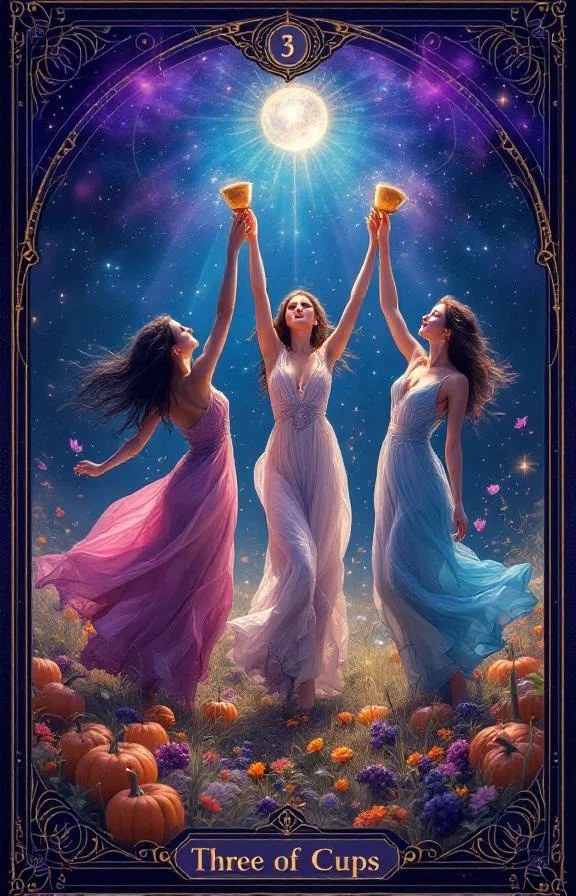
Three figures dance, cups raised, harvest garlands around them. Celebration — the emotional experience of joy shared and amplified by community. The Three represents a psychological truth that certain emotions exist fully only when other people are present. Solitary happiness is real, but shared joy has a quality that solitude cannot replicate.
Your brain literally processes threats as less threatening when a trusted person is nearby. The Three of Cups is the felt experience of that neural reality: you are less alone than you think, and the people you trust enough to celebrate with expand your capacity for joy.
Four of Cups — emotional withdrawal
A figure sits under a tree, arms crossed, three cups before him. A fourth cup is being offered by a divine hand from a cloud — and he does not notice or does not care. This is apathy, boredom, the emotional flatness that follows when feeling becomes routine or when you have been hurt enough to stop wanting.
The Four is the first card in the suit that represents an emotional problem — not loss or pain, but the more insidious condition of having shut down. Not sadness, but the absence of feeling altogether. Clinical psychology calls it anhedonia: the inability to experience pleasure. The Four of Cups is what anhedonia looks like on cardstock.
Five of Cups — grief and loss
A cloaked figure stands before three spilled cups, mourning. Behind the figure, two cups remain standing — but the figure is not looking at them. This is grief: the full attention given to what has been lost, the inability (or refusal) to see what remains.
The Five is the suit's most painful card, and its function is essential. Grief that is not felt does not resolve. The Five does not ask you to "look on the bright side" — it asks you to stand with your loss long enough for the pain to do its work. The two standing cups behind you will still be there when you are ready to turn around. That readiness cannot be rushed.
Six of Cups — nostalgia and innocence
A child offers a cup filled with flowers to another child. The scene is warm, safe, golden with the light of memory. This is nostalgia — the emotional return to a simpler time, a place before complexity and disappointment reshaped your relationship to feeling.
The Six is psychologically double-edged. Nostalgic reflection increases self-continuity, social connectedness, and meaning in life — research confirms this consistently. But nostalgia can also be a form of avoidance: retreating to an idealized past rather than engaging with the complicated present. The card does not tell you which version you are living. You have to figure that out.
Seven of Cups — fantasy and illusion
A figure stands before seven cups floating in clouds, each containing a different vision: a castle, jewels, a wreath, a dragon, a veiled figure, a snake, a glowing figure. This is the card of fantasy, illusion, and the paralyzing overwhelm of too many imagined possibilities.
When options multiply past a certain threshold, decision-making does not improve — it collapses. The figure is not choosing between these visions. The figure is drowning in them. The Seven asks: which of these is real, and which is a projection of desire, fear, or avoidance?
Eight of Cups — walking away
A figure walks away from eight neatly stacked cups, heading toward a mountain pass under a crescent moon. The cups are not broken. Nothing is wrong with them. The figure is leaving something that works but no longer fulfills.
This is one of the hardest emotional actions: choosing to leave something functional but incomplete. The Eight represents the moment when emotional honesty forces you to admit that what you built is not what you need — and to walk away without vilifying what you are leaving behind. Departure without drama. It requires a level of emotional maturity that most people never develop.
Nine of Cups — contentment
A figure sits before nine cups arranged in a semicircle behind them, arms crossed, satisfied. This is the "wish card" — traditionally associated with getting what you wanted. But the deeper reading is about contentment: the emotional state in which you are at peace with what you have.
The Nine represents savoring — the capacity to appreciate and extend positive experience rather than immediately reaching for the next desire. The ability to savor positive experience is a stronger predictor of well-being than the frequency of positive events themselves. The Nine of Cups is not about having everything. It is about enjoying what is present.
Ten of Cups — emotional wholeness
A couple stands with arms raised beneath a rainbow of ten cups, two children playing beside them. The suit's completion — emotional fulfillment expressed through family, community, and sustained relational harmony.
The Ten is not a fairy tale. In the context of the suit's full arc — through loss, withdrawal, fantasy, departure, and grief — this card represents emotional wholeness earned through experience, not innocence. The couple in the image has been through the full cycle. Their joy is not naive. It is informed by everything the preceding cards taught them about what love actually costs and what it actually gives.
The court cards: stages of emotional maturity
The four court cards represent stages of emotional development, from the Page's first tentative engagement with feeling to the King's composed mastery.
Page of Cups — the emotional beginner
A young figure looks with curiosity at a fish emerging from a cup. The beginning of emotional awareness — surprise, wonder, the first encounter with a feeling that does not fit neatly into existing categories. The Page is the inner child encountering emotion with fresh eyes, before learned defenses have taught it to suppress, perform, or manage what it feels.
Knight of Cups — the romantic idealist
A knight rides forward, cup extended, in full romantic pursuit. Feeling in action — the emotional idealist who follows the heart with the confidence (and sometimes the recklessness) of someone who has not yet learned that feeling and wisdom are not always the same thing. The Knight represents the necessary stage where you must pursue what you feel deeply before you can learn discernment.
Queen of Cups — emotional depth and empathy
The Queen sits beside the sea, holding a lidded cup — the only cup in the entire suit that is closed. She sees into others, feels what they feel, and holds emotional space without losing herself in it. The Queen represents empathy at its most developed: the ability to perceive and respond to others' emotional states without being overwhelmed.
The closed cup is the crucial detail. She has access to deep emotional knowledge, but she has learned containment. She does not spill her emotional content on everyone she meets. She opens the cup deliberately, consciously, when the situation requires it. That is the difference between emotional sensitivity and emotional maturity.
King of Cups — emotional mastery
The King sits on a throne surrounded by turbulent water, yet he is calm. A cup in one hand, a scepter in the other. The sea churns around him. Fish leap. A ship rocks on the waves. And the King is composed — not because he does not feel, but because he has learned to hold the full intensity of feeling without being capsized by it.
The King of Cups is the suit's final stage: emotional mastery defined by the ability to remain centered in the presence of strong emotion — your own and others'. This is not suppression. Suppression would be sitting on dry land pretending the ocean does not exist. The King sits in the ocean. He acknowledges every wave. He simply does not let the waves determine his course.
He knows what he feels (self-awareness). He manages it without suppressing it (self-regulation). His emotional depth fuels his purpose rather than paralyzing it (motivation). He understands others' emotional states (empathy). And he leads through emotional presence rather than emotional dominance (social skill). All five EQ components, integrated.
Reading Cups in a spread
When Cups cards appear in a love tarot spread or any reading focused on emotional life, they ask: what are you feeling, and what are you doing with what you feel?
A spread dominated by Cups tells you the situation is primarily emotional — that the path forward runs through feeling rather than thinking, doing, or managing material circumstances. Multiple Cups reversed may point to emotional avoidance, repression, or a period of recovery after overextension.
The absence of Cups is equally meaningful. A reading with no Cups at all may suggest that emotion is being sidelined — that the question you framed in emotional terms ("how does this person feel about me?") might need to be reframed in terms of the suit that actually showed up.
Cups and the other suits
The suit of Cups does not exist in isolation. Its emotional territory interacts with the other three suits:
| Suit interaction | What it means |
|---|---|
| Cups + Wands | Passion — emotion fueling creative action |
| Cups + Swords | Inner conflict — feeling vs. thinking |
| Cups + Pentacles | Grounding — emotion made tangible and stable |
| Cups + Major Arcana | Archetypal emotional themes — soul-level feeling |
The most common tension in readings is Cups vs. Swords — the heart-mind conflict that shows up when what you feel and what you think pull in opposite directions. This tension is not a problem to solve. It is a polarity to hold. The psychologically mature response is not choosing one over the other but integrating both into an answer that honors the truth each carries.
Reversed Cups — deep dives
Each Cups card has its own reversed guide exploring emotional blockages, relationship dysfunction, and the shadow side of feeling:
- Ace of Cups Reversed — emotional blockage, love withheld
- Two of Cups Reversed — broken connections, misaligned values
- Three of Cups Reversed — social exclusion, fake friendships
- Four of Cups Reversed — emerging from apathy, new awareness
- Five of Cups Reversed — acceptance, forgiveness beginning
- Six of Cups Reversed — stuck in past, childhood wounds
- Seven of Cups Reversed — cutting through illusion, decisive action
- Eight of Cups Reversed — fear of leaving, drifting aimlessly
- Nine of Cups Reversed — smugness, wishes that disappoint
- Ten of Cups Reversed — family dysfunction, shattered ideals
- Page of Cups Reversed — emotional immaturity, escapism
- Knight of Cups Reversed — unrealistic romance, broken promises
- Queen of Cups Reversed — emotional manipulation, codependency
- King of Cups Reversed — emotional volatility, coldness
For the general guide to reading all reversed cards, see Reversed Tarot Cards — Complete Guide.
FAQ
What does the suit of Cups represent in tarot? The suit of Cups represents the element of Water and the domain of emotions, relationships, intuition, creativity, and the unconscious. In Jungian terms, it maps onto the Feeling function — the mode of consciousness that evaluates experience through values and relational meaning rather than logic. The 14 cards trace a complete arc of emotional development, from raw feeling (Ace) to emotional mastery (King).
Are Cups cards always about love? No. Cups cover the full spectrum of emotional experience: grief, nostalgia, apathy, creative inspiration, spiritual opening, fantasy, contentment, and emotional maturity. Calling them "love cards" misses most of what the suit addresses. Any situation with a significant emotional dimension — career fulfillment, creative blocks, family dynamics, grief, personal growth — falls within the suit of Cups.
What does it mean when you get a lot of Cups in a reading? Multiple Cups cards indicate the situation is primarily emotional and that the way forward involves engaging with feeling rather than analyzing, managing, or acting. It may signal a period of emotional intensity — positive or challenging — that demands attention to your inner life. If most are reversed, that pattern often points to emotional avoidance or exhaustion.
How does the suit of Cups relate to emotional intelligence? The suit, read as a developmental sequence, maps onto the five components of emotional intelligence: self-awareness (Ace, Four, Six), self-regulation (Five, Seven, Nine), motivation (Eight), empathy (Two, Queen), and social skill (Three, Ten). The court cards represent progressive stages of emotional maturity, with the King embodying all five components at once.
Curious what your emotional life looks like in card form right now? Start a free tarot reading and see which Cups cards appear — they will show you what your heart already knows.