She kept the bedroom exactly the way he left it. Fifteen years. The soccer trophies on the shelf, the glow-in-the-dark stars on the ceiling, the comforter with the faded dinosaurs. Her son had not lived there since he was seventeen. He was thirty-two now, married, living in another state, with kids of his own. But every time she passed that room, she opened the door and stood there for a moment, breathing in something that no longer existed.
When her husband finally suggested converting the room into a home office, she wept for three days. Not because the suggestion was unreasonable — she knew it was perfectly reasonable. But the room was not a room anymore. It was a time machine. And dismantling it meant accepting that the version of her son who lived in that room, the one who needed her, who ran to her when he fell — that boy was gone. The man who replaced him loved her, visited at Christmas, called on Sundays. But he was not that boy.
She did not want the room. She wanted 2009.
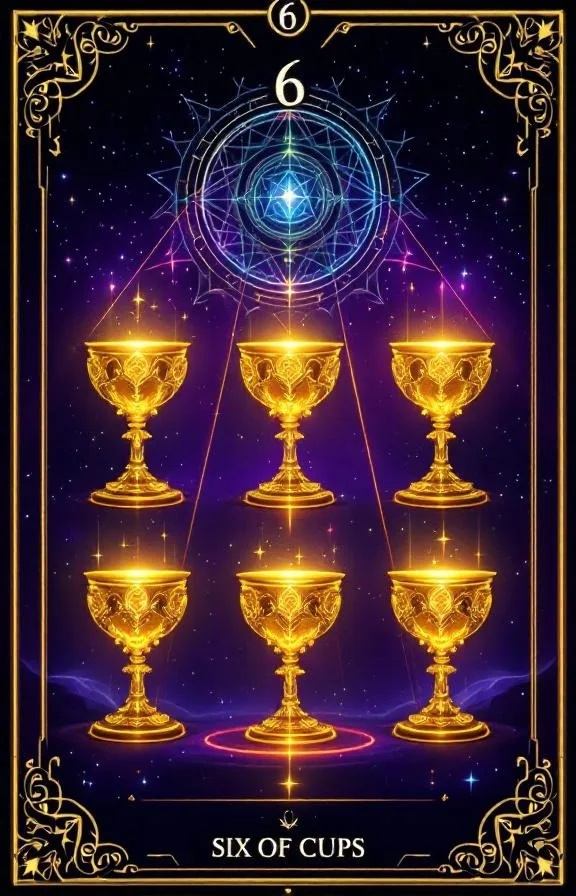
In short: The Six of Cups reversed exposes the shadow side of memory — nostalgia calcifying into a prison, childhood patterns driving adult decisions, the refusal to inhabit the present because the past feels safer. John Bowlby's attachment theory demonstrated that our earliest bonds shape every subsequent relationship. This card reversed appears when those early patterns are running the show, often without conscious awareness.
Why the Six of Cups appears reversed
Upright, the Six of Cups is tender. Two children in a garden, one offering a cup of flowers to the other. It evokes innocence, sweetness, reunion. It is the card of childhood memories, hometown visits, reconnecting with people from your past. It is nostalgia at its gentlest — the warm glow of remembering.
Reversed, the glow becomes a glare. Blinding instead of warming. The past stops being a place you visit and becomes a place you live, and the present becomes the foreign territory you merely tolerate between episodes of remembering.
Bowlby spent decades studying the bond between infants and their primary caregivers, and what he found reshaped developmental psychology permanently. Secure attachment — the pattern that develops when a caregiver is consistently responsive and attuned — creates adults who can form healthy relationships, tolerate uncertainty, and engage with the present. Insecure attachment, in its various forms, does the opposite. It creates adults who cling (anxious attachment), withdraw (avoidant attachment), or oscillate chaotically between the two (disorganized attachment).
The Six of Cups reversed does not always indicate insecure attachment. But it always indicates that the past has an outsized grip on the present. Whether that grip is tender or traumatic, the effect is the same: you are not fully here.
Six of Cups reversed in love and relationships
In love readings, this reversal operates on two levels, and they often coexist.
The first level: you are comparing your current partner to someone from your past. An ex. A first love. The idealized version of a relationship that ended before it had time to get boring. This comparison is unfair and you probably know it is unfair. But the feeling persists. The current partner makes dinner and you remember how your college boyfriend used to make that same dish. The current partner holds your hand and the grip feels wrong because your nervous system calibrated "right" twelve years ago and never updated.
The second level goes deeper. This is where Bowlby's work becomes inescapable. You are not comparing partners — you are recreating the emotional patterns of your first relationship. Your relationship with your parent. If your parent was inconsistently available, you find yourself drawn to partners who are inconsistently available. If your parent was emotionally distant, you mistake emotional distance for safety. You call this "having a type." It is not a type. It is a wound that organized itself into a compass.
Here is the thing nobody wants to hear about the Six of Cups reversed in love: you cannot love someone fully if you are using them as a stand-in for an unresolved past. It is not their job to re-parent you. It is not their job to be the corrective experience your childhood failed to provide. That is your work, and it requires going to the source rather than drafting every new partner into an old role.
For people revisiting an ex when this card appears: proceed with extreme caution. The Six of Cups reversed does not say "go back." It says your desire to go back is driven by nostalgia rather than genuine compatibility. You remember the good parts. Your nervous system has conveniently archived the bad parts.
Six of Cups reversed in career and finances
The professional version of this card reversed manifests as "things were better before." Before the merger. Before the new management. Before the industry changed. Before AI. Before remote work. Before whatever disruption rearranged the landscape you had memorized.
Nostalgia for a previous career chapter can be useful data — it might tell you what conditions you thrive in, what values matter to you, what kind of work gives you energy. But when that nostalgia prevents you from adapting to current reality, the Six of Cups reversed is warning you. Industries change. Skills expire. The way you did things in 2018 is not the way you will do things in 2028. Grieving that is human. Refusing to accept it is career suicide.
Financially, this card reversed sometimes shows up for people who cannot stop chasing the lifestyle they had during a more prosperous period. Living beyond current means because the previous income set a standard the ego will not release. Credit cards bridging the gap between who you are financially and who you were. This is the Six of Cups reversed at its most materially destructive — the past's standard of living cannibalizing the present's reality.
There is a quieter career version too. The person who peaked early. The writer whose first book sold well and whose subsequent books did not. The athlete whose body cannot do what it used to. The executive who got laid off at fifty-five and cannot accept a role at a lower level. These people are not lazy or entitled — they are grieving a version of themselves that no longer exists, and the Six of Cups reversed asks them to stop grieving it and start building a new version. That sounds simple. It is possibly the hardest thing a person can do.
Six of Cups reversed as personal growth
Bowlby's most radical contribution was not attachment theory itself — it was the implication that early patterns can be changed. He called it "earned secure attachment." People who had insecure childhoods could, through therapy, self-awareness, and corrective relationship experiences, develop the internal security they were not given. The blueprint was not permanent.
The Six of Cups reversed as a growth card is an invitation to earn your own security. This requires a particular kind of courage: the willingness to look at your childhood not through the soft-focus lens of nostalgia but through the clinical lens of pattern recognition. What did you learn about love? About conflict? About asking for what you need? About what happens when you are vulnerable? These lessons, absorbed before you had the cognitive capacity to evaluate them, are running your adult life.
Most people resist this work. The resistance sounds like: "I had a normal childhood." "My parents did their best." "I do not want to blame anyone." These statements can all be true and completely irrelevant. The Six of Cups reversed is not asking you to blame your parents. It is asking you to see the patterns clearly enough to choose differently.
The practical growth work involves identifying one specific way your past is distorting your present. Not all the ways. One. Maybe you avoid conflict because your household treated conflict as catastrophe. Maybe you people-please because approval was the currency of love in your family. Pick one thread and follow it. Where did I learn this? Is this still serving me? What would I do differently if this pattern did not exist?
How to work with Six of Cups reversed energy
Put down the photo album. Literally and metaphorically. If you spend significant time scrolling through old photos, rereading old messages, visiting old haunts — notice how you feel afterward. Nostalgia delivers a quick hit of warmth followed by a longer tail of sadness. It borrows comfort from the past at the expense of the present.
Create a new memory. Deliberately. Go somewhere you have never been. Try something with no childhood association attached. The Six of Cups reversed is healed partly by generating present-tense experiences that are powerful enough to compete with the curated past. Your brain has a highlight reel from twenty years ago. Start building a highlight reel from this year.
Write a letter to your younger self. Not the sentimental kind — the honest kind. Tell them what you know now that they did not know then. Tell them which fears turned out to be justified and which ones wasted years of their life. Tell them which relationships mattered and which ones were rehearsals. This exercise often reveals the gap between the childhood you remember and the childhood that actually happened. The idealized past does not survive honest interrogation. Neither does the catastrophized past. The truth is usually more textured and more bearable than either version.
If childhood wounds are the driver — and with this card, they often are — consider attachment-focused therapy. Not all therapy addresses attachment patterns specifically. Look for therapists trained in emotionally focused therapy (EFT), schema therapy, or internal family systems (IFS). These modalities work directly with the early relational blueprints that Bowlby identified. The goal is not to erase the past but to update the operating system so it stops mistaking 2026 for 1996.
One last practice: notice when you say "back then" versus "right now." If your sentences about the past carry more emotional weight — more color, more detail, more aliveness — than your sentences about the present, that is the Six of Cups reversed showing you where your attention lives. Your attention belongs in the present. Not because the past does not matter, but because the present is the only place where anything can actually change.
Frequently asked questions
Does the Six of Cups reversed mean I should cut off contact with my family?
No. It means your relationship with your past — including family — needs conscious examination rather than automatic re-enactment. Some people need distance from family to heal. Others need to renegotiate the relationship from an adult position rather than reverting to the childhood role every time they walk through the front door. The card does not prescribe an action. It identifies a pattern.
Can this card indicate repressed childhood memories?
It can, though that interpretation requires careful handling. Bowlby's work focused on attachment patterns rather than specific memories — the emotional residue of early experiences rather than the explicit recall of events. If the Six of Cups reversed raises questions about your childhood that feel significant, explore them with a qualified therapist rather than alone.
What if I genuinely had a wonderful childhood and still pull this card reversed?
Wonderful childhoods produce their own version of this reversal. If the past was genuinely good, the present has to compete with an idealized standard. "Nothing will ever be as good as summers at the lake house" becomes a belief that prevents you from fully enjoying what is available now. The card is not saying your childhood was a lie. It is saying your attachment to its memory is costing you something in the present.
Explore the Six of Cups' full meaning, see what it reveals as feelings, or discover the Six of Cups as a person. Ready for deeper insight? Try a free reading.