He texted her every morning. Good morning, beautiful. Without fail. He wrote poems on napkins at restaurants and left them folded under her coffee cup. He planned surprise dates — rooftop picnics, midnight stargazing in a borrowed convertible, a private cooking class at a restaurant that did not normally do private cooking classes. She told her friends he was the most romantic man she had ever met.
Six months in, she needed him to show up for something boring. A trip to IKEA. Help assembling a bookshelf. A Saturday spent doing nothing in particular. He cancelled. Or he came and was visibly miserable, checking his phone, radiating the energy of a man who would rather be anywhere else. The grand gestures kept coming, but the ordinary ones — the ones that actually build a life — were nowhere.
He was not a bad person. He was addicted to his own performance of love.
In short: The Knight of Cups reversed represents romance disconnected from reality — grand emotional gestures without substance, promises that dissolve on contact with daily life. Helen Fisher's neuroimaging research shows that early infatuation activates the brain's reward circuits in patterns nearly identical to cocaine — and the Knight of Cups reversed is someone who chases that high rather than building something real after it fades.
Why Knight of Cups appears reversed
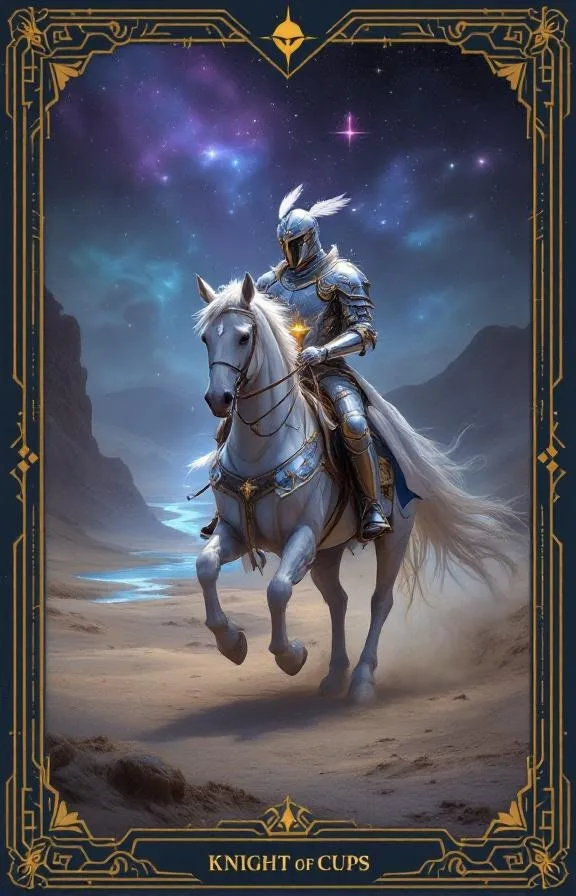
The upright Knight of Cups rides toward you on a white horse, cup raised like an offering. He is the embodiment of romantic pursuit — emotional, idealistic, moved by beauty and feeling. Reversed, the horse stops. Or worse, it keeps galloping, but the cup is empty. The pursuit continues; the substance evaporates.
Knights in tarot represent energy in motion — action, drive, sometimes excess. The Knight of Cups upright channels emotional energy into genuine romantic and creative pursuits. Reversed, that energy becomes its own purpose. The feeling of being romantic replaces the work of being a partner. The excitement of a new creative project replaces the discipline of finishing one.
Fisher's research at Rutgers documented how the dopamine system floods the brain during early romantic attraction. Her subjects' brain scans when viewing photos of their beloved showed activation patterns in the ventral tegmental area — the same region that lights up in addiction. This is not a metaphor. The Knight of Cups reversed is someone running their life on this neurochemistry, treating the dopamine hit of new attraction as the point rather than the beginning. When the high fades — and it always fades, typically between twelve and eighteen months — they do not transition into deeper attachment. They go looking for a new high.
Knight of Cups reversed in love and relationships
This is the card's primary domain, and it does not pull punches.
The Knight of Cups reversed in a love reading frequently points to someone who is emotionally unreliable. Charming, yes. Expressive, certainly. But unreliable in the ways that matter. They forget your mother's birthday. They make plans and cancel. They say all the right things and do none of them. Their love language is poetry and their follow-through language is silence.
If you are asking about a potential partner, this card is a warning. Not that the person is malicious — usually they are not. They genuinely feel what they say they feel in the moment they say it. The problem is that moments pass. The declaration of love at midnight is sincere. The inability to remember it matters at noon the next day is equally sincere. The Knight of Cups reversed does not lie. He just lives inside feelings that have no root system.
For those already in a relationship, this card can indicate your own tendency toward emotional fantasy. Are you comparing your real partner to a fictional standard? Do you consume romantic media — movies, novels, TikTok compilations — and then resent your relationship for not matching the curated intensity? That resentment is the Knight of Cups reversed turned inward. Real love does not look like a movie because movies edit out the boring parts, and the boring parts are where intimacy actually lives.
There is a darker edge too. The Knight of Cups reversed can indicate emotional manipulation — someone who uses romantic performance to control. Love-bombing followed by withdrawal. Over-the-top apologies that replace actual behavioral change. The cycle of intensity and absence that trauma bonds create.
The most revealing question to ask about the Knight of Cups reversed in a love reading: does this person's romantic behavior make you feel loved, or does it make you feel performed at? There is a difference, and your body usually knows it before your mind catches up. Genuine affection feels warm and steady. Performance feels impressive but leaves you slightly uneasy, as if you are watching a show that might end without warning.
Knight of Cups reversed in career and finances
Professionally, this reversal describes the person with twelve passion projects and zero completed ones. They are excited every Monday and bored every Wednesday. They pitch beautifully and execute poorly. Their desk is covered in first chapters, business plans, vision boards, and half-painted canvases. Starting is intoxicating. Continuing is unbearable.
The Knight of Cups reversed in a career reading can also point to workplace moodiness. Someone whose productivity depends entirely on how they feel that day. Inspired? They produce brilliant work. Uninspired? They produce nothing and rationalize it as "needing the right energy." Professionalism, at its core, is the ability to produce regardless of mood. This card signals someone who has not developed that capacity.
Financially, the pattern mirrors the romantic one. Impulsive purchases driven by feeling. Investments based on excitement rather than analysis. The stock that "felt right." The crypto that "spoke to" them. When financial decisions are governed by the same brain circuits that govern infatuation, the results tend to be similarly unstable.
The Knight of Cups reversed in a career reading is also the colleague who charms everyone in the interview and underdelivers within three months. They present brilliantly. Their resume reads like poetry. But the substance behind the presentation is thin, and once the initial impression fades, what remains is a person who needs constant novelty to function and treats consistency as a cage.
Knight of Cups reversed as personal growth
The central growth challenge here is learning to distinguish between feeling and reality. They are not the same thing, and the Knight of Cups reversed has confused them thoroughly.
Fisher's research has a hopeful dimension that is often overlooked. She identified three distinct brain systems for mating: lust (driven by testosterone and estrogen), romantic attraction (driven by dopamine and norepinephrine), and deep attachment (driven by oxytocin and vasopressin). The Knight of Cups reversed is stuck in system two. The growth work is learning to let system three activate — to let the dopamine fire quiet enough for the oxytocin bond to form.
This means tolerating boredom. Sitting with someone on a Tuesday night watching a mediocre show and not interpreting the absence of fireworks as the absence of love. It means staying when the novel feeling wears off and the real person underneath becomes visible — imperfect, complicated, sometimes annoying. Most people are not nearly as interesting as the fantasy version of them. They are more interesting, but in ways that require patience to discover.
The Knight of Cups reversed as growth also asks you to examine your relationship with creative output. Do you start things because the beginning is exciting and abandon them because the middle is hard? Finishing something — a project, a skill, a relationship — requires enduring the plateau where progress is invisible and motivation is scarce. The Knight of Cups reversed never learned to love the plateau. That is the lesson.
Fisher's three-system model offers a roadmap. Lust is biological noise. Romantic attraction is neurochemical weather — intense but temporary. Deep attachment is the climate that sustains a life. The Knight of Cups reversed keeps confusing weather for climate and then feels betrayed when the storm passes and the landscape looks ordinary. Ordinary is not the enemy. Ordinary is where real life happens. The storms are memorable, but nobody builds a house in a hurricane.
How to work with Knight of Cups reversed energy
Commit to finishing one thing. Not the biggest thing. Not the most important thing. One thing you started and abandoned. Pick it back up. Push through the part where it stops being fun and starts being work. The completed version will not match the vision you had when you started, and that gap between vision and reality is precisely what the Knight of Cups reversed needs to experience. Completion teaches something that inspiration never can.
In relationships, practice what therapists call "boring love." Cook dinner together. Run errands. Sit in the same room doing different things. If this sounds unappealing, notice that reaction. The aversion to ordinariness is the symptom, not the personality trait you have been treating it as.
Keep a log of promises you make and whether you keep them. Not to punish yourself — to build awareness. The Knight of Cups reversed often has no idea how many commitments they drop because each new one overwrites the last. Seeing the pattern in writing makes it harder to romanticize. You are not a free spirit. You are unreliable. Those are different things.
When you feel the urge to start something new — a project, a relationship, a plan — pause for seventy-two hours before acting on it. Not to suppress the impulse, but to test it. Fisher's dopamine spike peaks during novelty and declines rapidly afterward. If the desire survives three days of sitting with it, it has substance. If it evaporates, it was neurochemical weather. The Knight of Cups reversed treats every passing cloud like a revelation. Learning to wait for actual weather patterns is the practice.
One final observation: the Knight of Cups reversed is often deeply lovable. Maddening, but lovable. The charm is real. The emotional expressiveness is real. The capacity for romance is genuine — it is simply untethered from the infrastructure that would make it sustainable. This card does not ask you to kill the romantic in yourself. It asks you to give the romantic a foundation to stand on instead of letting it wander from horse to horse, cup to cup, forever arriving and never staying.
Frequently asked questions
Does Knight of Cups reversed always represent a man?
No. Court cards can represent people of any gender, or they can represent an energy or approach rather than a specific person. The Knight of Cups reversed describes a pattern of behavior — romantic idealism without follow-through — that is not gender-specific.
Can this card indicate deception?
It can, though usually not deliberate deception. The Knight of Cups reversed is more likely to describe someone who deceives themselves — who genuinely believes their own grand promises in the moment of making them. The result looks like dishonesty from the outside, but from inside, it feels like sincerity that keeps evaporating.
What is the difference between Knight of Cups reversed and Knight of Swords reversed?
The Knight of Swords reversed is about reckless action, impulsivity in thought and communication — speaking without thinking, charging into arguments, intellectual aggression without direction. The Knight of Cups reversed is about reckless emotion — feeling without grounding, promising without delivering, chasing romantic or creative highs without building anything durable. Swords reversed cuts carelessly. Cups reversed drowns beautifully.
Explore Knight of Cups's full meaning, see what it reveals as feelings, or discover Knight of Cups as a person. Ready for deeper insight? Try a free reading.