A six-year-old draws a purple horse with seven legs. She shows it to her father proudly. He says, "Horses are not purple." He says it with a smile. He thinks he is being helpful. Accurate, even. She draws another horse — brown this time, four legs — and does not bring it to show anyone.
Twenty years later she sits in front of a blank canvas in an adult painting class, unable to start. She tells her friend she just is not creative. She says this with conviction. She believes it completely.
She was creative. Once.
In short: The Page of Cups reversed represents creativity and emotional openness that have been shut down — by criticism, by conformity, by the slow accumulation of messages that said your natural responses were wrong. D.W. Winnicott's concept of the "false self" captures this precisely: a compliant persona constructed to meet others' expectations, hiding the spontaneous, playful true self underneath.
Why Page of Cups appears reversed
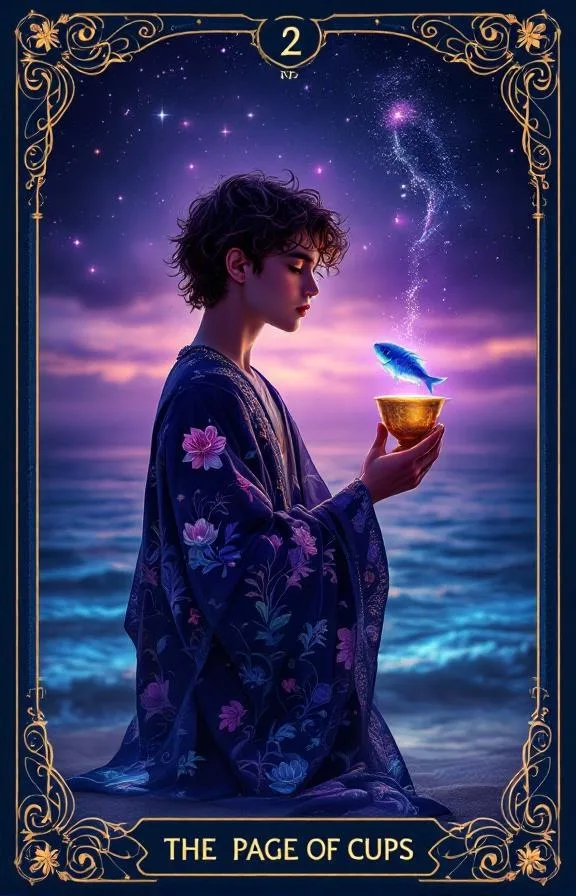
The upright Page of Cups is the most childlike card in the deck. A young figure gazes at a fish emerging from a cup with genuine wonder. No cynicism. No self-consciousness. Pure curiosity meeting pure surprise. Reversed, that openness collapses. The fish goes back in the cup. The wonder calcifies into something guarded.
This reversal happens through a process so gradual most people cannot identify when it started. A teacher who marked your creative writing as "unfocused." A parent who said art was not a real career. A partner who laughed at your poem. A colleague who called your idea impractical in a meeting where you were already nervous. Each incident, individually, is survivable. Accumulated over years, they build a wall between you and the part of yourself that used to create without permission.
Winnicott distinguished between the true self — spontaneous, creative, authentic — and the false self, which develops as a protective response to environments that do not welcome authenticity. The false self is not evil. It kept you safe. It learned what the world wanted and provided it. But it came at a cost: the true self went underground. The Page of Cups reversed is that buried true self, sending signals from beneath the rubble.
The signals are easy to miss. A pang when you see someone else creating freely. A childhood hobby you remember with disproportionate fondness. The urge to write something, paint something, build something that passes through you before the internal editor kills it. These are not random. They are the true self knocking. The false self has been answering the door and telling it to come back later for years.
Page of Cups reversed in love and relationships
Emotionally, the Page of Cups reversed shows up as immaturity that disguises itself as various things — aloofness, humor, hyperindependence. It is the person who deflects every serious conversation with a joke. The one who says "I do not do feelings" and means it as a flex rather than recognizing it as a wound.
In a romantic reading, this card often indicates someone who cannot receive love gracefully. Compliments get deflected. Vulnerability gets punished — not in the other person, but in themselves. They want intimacy but they approach it wearing armor, and then they wonder why the connection feels distant. It is hard to embrace someone through plate mail.
For new relationships, the Page of Cups reversed can signal naivety — a different flavor of the card's energy. Instead of shutting down, the person opens up too quickly, too indiscriminately. They fall in love with ideas of people. They project entire futures onto someone they met last Tuesday. This is not genuine openness. It is emotional escapism — using infatuation as a drug.
There is a quieter pattern too. Sometimes this card describes someone who used to be emotionally expressive and has become performatively detached. They post about their independence. They celebrate being "unbothered." They have convinced themselves that needing people is weakness. Winnicott would call this a false self operating at full capacity — protecting a true self that desperately wants connection but has been burned too many times to risk it.
Page of Cups reversed in career and finances
In career readings, the Page of Cups reversed almost always points to a creative block. Not the kind you solve by buying a new notebook or changing your routine. The deep kind. The kind where you have lost access to the part of yourself that generates ideas without first filtering them through a committee of internal critics.
You sit down to write and nothing comes. You start a project and abandon it after three days. You have seventeen half-finished things in folders on your desktop. The problem is not discipline. The problem is that somewhere along the way, you started requiring perfection from first drafts, and since first drafts are never perfect, you stopped drafting at all.
Financially, this card can indicate immaturity around money — not understanding where it goes, avoiding budgets because tracking expenses feels too adult, spending impulsively on things that provide a flash of childlike pleasure. New shoes, concert tickets, gadgets you use twice. The spending is not strategic. It is compensatory.
There is also the creative professional angle. The Page of Cups reversed in a career reading can describe an artist, writer, or musician who has become so focused on commercial viability that they have lost contact with the impulse that made them start creating in the first place. They know what sells. They know what the algorithm rewards. They have optimized their creative process into a production line. The work is technically competent and spiritually dead. They feel this and do not know how to fix it because going back to creating without a strategy feels irresponsible. The false self has colonized even their art.
Page of Cups reversed as personal growth
The growth work with this card is straightforward: you need to play again. Not productive play. Not "creative hobbies that might become a side hustle." Play for its own sake. Purposeless, unoptimized, financially useless play.
Winnicott argued that the capacity to play is the foundation of all creativity, and that play can only happen in a space of safety — what he called a "holding environment." When the environment is not safe, play stops. The child learns to perform instead of explore. The adult learns to produce instead of create. Output replaces process. The Page of Cups reversed asks what would happen if you created something with zero intention of showing it to anyone.
This matters more than it sounds. Because the false self is audience-dependent — it exists to manage how others perceive you. Remove the audience, and the false self has nothing to do. In that gap, the true self can surface. Badly. Awkwardly. Like a muscle that has not been used in years. The purple horse with seven legs.
Most people who pull the Page of Cups reversed repeatedly have a specific memory, whether they realize it or not, of being told their natural expression was wrong. The growth work involves finding that memory, acknowledging what it cost, and making a conscious decision to express anyway. Not because the old criticism was wrong (maybe the poem was bad, maybe the idea was impractical) but because the right to express is not conditional on the quality of the expression.
Winnicott also wrote about the relationship between play and aliveness. He argued that it is only in playing that the individual discovers the self. Not through analysis. Not through achievement. Through play. The Page of Cups reversed has forgotten this. They try to think their way back to creativity, read books about unlocking creative potential, attend workshops, buy supplies. None of it works because the path back is not through the mind. It is through the body, through the hands, through the willingness to be ridiculous and clumsy and wrong in front of no audience at all.
How to work with Page of Cups reversed energy
Make something terrible on purpose. A bad drawing. An awful poem. A song you would never play for anyone. Give yourself explicit permission to produce garbage. This is not a cute exercise. It is a direct intervention against the perfectionism that killed your creative instinct. The false self cannot tolerate intentional imperfection. It has no protocol for it. By producing bad work deliberately, you short-circuit the defense mechanism.
Spend time around children if you can. Not to learn from them in some inspirational way — to observe how they create without self-judgment. A four-year-old does not wonder if their finger painting is derivative. They do not compare it to other finger paintings on Instagram. They paint because the paint is there and their fingers are there and that is reason enough. Something in you remembers what that felt like.
Reduce your consumption of other people's creative work for a while. This sounds counterintuitive, but constant exposure to polished output raises the bar you set for your own attempts. You compare your first draft to someone's published novel. You compare your sketch to a professional illustration. The comparison kills the impulse before it can develop into anything. Create more than you consume, even if what you create is embarrassing. Especially if it is embarrassing.
Set a timer for fifteen minutes and create something — anything — without stopping to evaluate it. Do not read it back. Do not look at it critically. When the timer goes off, put it away. The product does not matter. The practice of uninterrupted expression matters. You are retraining a nervous system that has learned to clench before every act of creation. Fifteen minutes of unclenching, repeated daily, can undo years of the false self's conditioning. Not because the work improves (it will, but that is a side effect) — because the relationship to creation shifts from performance to play. Winnicott would call it recovering the capacity to be alive. The Page of Cups reversed has been surviving. The upright Page is alive. The distance between those two states is shorter than you think.
Frequently asked questions
Does Page of Cups reversed indicate a specific person?
It can. It often points to someone emotionally immature — someone who reacts to adult situations with childish defensiveness, or who uses charm and whimsy to avoid accountability. It can also indicate a creative person going through a dry spell who has lost touch with their inspiration.
Is Page of Cups reversed about blocked intuition?
Sometimes. The Page of Cups upright is one of the most intuitive cards, and its reversal can indicate that you are ignoring gut feelings or rationalizing away hunches. But in most readings, the creative blockage is more prominent than the intuitive one, and working on one tends to unblock the other.
What should I do if Page of Cups reversed keeps appearing in my readings?
Take it seriously. Recurring cards signal unresolved patterns. Specifically, look at where in your life you are performing instead of being authentic. Where are you editing yourself before you even begin? The card will keep showing up until you start making space for the unfiltered version of yourself — the one who draws purple horses because purple is more interesting than brown.
Explore Page of Cups's full meaning, see what it reveals as feelings, or discover Page of Cups as a person. Ready for deeper insight? Try a free reading.