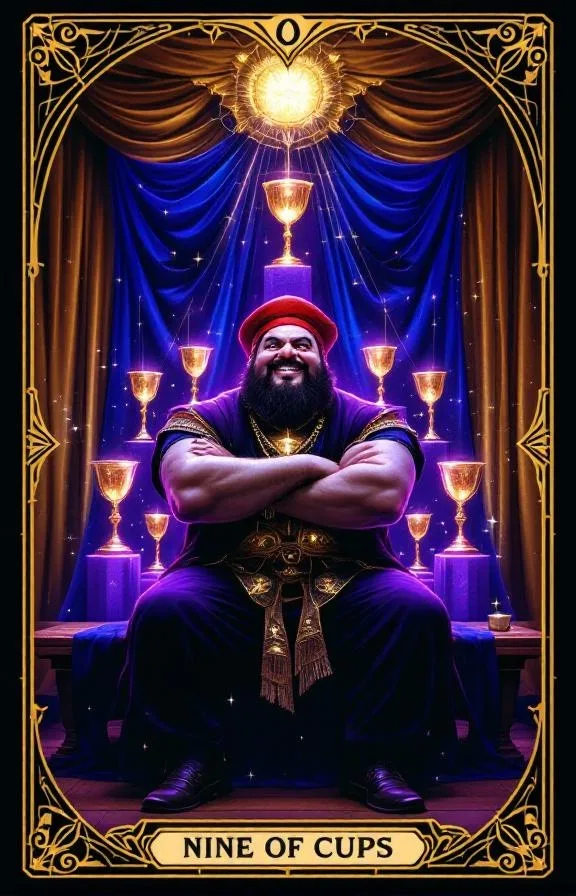
I once watched a man buy his dream car — a vintage Porsche he had been saving for since his twenties. He drove it off the lot grinning so wide his face hurt. Three weeks later, he told me he felt nothing when he looked at it in the driveway. "It is just a car," he said, bewildered. He was not performing humility. He was genuinely confused. He had expected the Porsche to fill a space inside him. It did not. The space was still there, exactly the same shape and depth, and now he had forty thousand fewer dollars.
He started looking at boats.
In short: The Nine of Cups reversed exposes the gap between acquisition and satisfaction — the moment when getting what you wished for reveals that the wish was never really about the thing itself. Sonja Lyubomirsky's research on the hedonic treadmill demonstrates that humans rapidly adapt to positive changes, returning to a baseline level of happiness regardless of what they obtain. This card is the treadmill in action.
Why Nine of Cups appears reversed
The upright Nine of Cups is called the "wish card." A figure sits before nine gleaming cups, arms crossed in satisfaction. Everything desired has arrived. Reversed, the cups are still there — but the satisfaction is hollow. The wish came true, and it was not enough.
This happens more often than people admit. Someone spends years chasing a promotion, gets it, and feels empty by the second week. A couple works toward buying their first home, closes the deal, and immediately starts fighting about renovations. A person achieves the body they wanted through months of discipline and then cannot stop finding new flaws.
Lyubomirsky's studies showed that roughly 40% of our happiness comes from intentional activities and mindset, while only 10% comes from life circumstances — the things we acquire, achieve, or accumulate. The remaining 50% is genetic set point. This means the Nine of Cups reversed is not a personal failure. It is a biological reality. We are not designed to stay satisfied with what we have. We are designed to want the next thing.
The problem is not wanting. The problem is believing that the next acquisition will be different. That this one will finally stick.
There is a reason lottery winners frequently report being no happier — and sometimes less happy — than before their windfall. Lyubomirsky documented this extensively. The initial spike of joy is real but temporary. Within months, the winner has established a new baseline that includes the mansion and the sports car, and now they need something beyond those to feel the same thrill they once felt buying a coffee. The cups keep multiplying. The satisfaction stays flat.
Nine of Cups reversed in love and relationships
In relationship readings, this reversal has a sharp and specific edge. It often indicates a partner who looks perfect on paper — attractive, successful, attentive — but leaves you feeling oddly unfulfilled. You cannot point to anything wrong. Your friends envy your relationship. Your family approves. And yet something is missing, something you cannot name, which makes you feel guilty for even noticing its absence.
The card also appears when someone has been treating relationships as collectibles. Dating someone for the ego boost. Staying in a relationship because being coupled is part of the identity they have constructed, not because this specific person enriches their life. Smugness disguised as love. The crossed arms of the Nine of Cups figure become defensive rather than satisfied — protecting an image rather than experiencing genuine connection.
There is a harsher reading too. Sometimes the Nine of Cups reversed points to someone taking their partner for granted. The initial pursuit was thrilling — the texts, the dates, the effort of courtship. Once the person was "won," the effort evaporated. They wanted the wanting more than they wanted the person.
For single people, this card frequently flags unrealistic expectations. You have a checklist. The checklist keeps growing. No human being can satisfy a list that was never really about another person — it was about filling a void that no amount of checking boxes will reach.
The Nine of Cups reversed in love is the person who says "I just want to be happy" without ever defining what happiness in a relationship actually looks like for them. It is a moving target. Every partner gets close and then falls short, not because the partners are inadequate, but because the definition of "enough" expands each time someone approaches it.
Nine of Cups reversed in career and finances
Pull this card in a career reading and the diagnosis is usually straightforward: you got what you asked for, and you are disappointed.
This is not the same as being in a bad job. The Nine of Cups reversed specifically targets achieved goals that fail to deliver. You fought for the corner office and discovered it is just a room. You hit your revenue target and the champagne tasted flat. The problem is not the achievement. The problem is the story you told yourself about what the achievement would do for you.
Financially, this card has a materialistic edge. Spending to feel something. Buying things you do not need with money you barely have because the transaction itself provides a momentary hit of satisfaction. Retail therapy is the Nine of Cups reversed expressed through a credit card. The cups arrive at your door in cardboard boxes, and you feel briefly alive opening them, and then you do not.
There is a pattern worth naming specifically: the person who keeps raising their own bar. Hit six figures and immediately set the target at two hundred thousand. Get the promotion and immediately start strategizing for the one above it. None of these milestones produce a pause long enough to feel anything. The motion itself becomes the anesthetic. If you stop striving, you have to sit with yourself, and the Nine of Cups reversed would rather do almost anything than sit with itself.
The most uncomfortable truth this card delivers in a career context: if you have achieved everything you set out to achieve and you still feel empty, the answer is not more goals. It is a fundamentally different question. Not "what do I want?" but "why do I want?"
Nine of Cups reversed as personal growth
Here is where the card gets genuinely useful, because it forces a confrontation with a pattern most people never examine.
Lyubomirsky's hedonic adaptation research suggests a practical intervention: instead of chasing new satisfactions, practice savoring existing ones. Gratitude journals, present-moment awareness, deliberate attention to what is already good. These sound like platitudes. They are not. The science behind them is robust. People who actively practice gratitude show measurable increases in life satisfaction that persist over time — precisely because gratitude interrupts the treadmill.
The Nine of Cups reversed is pointing at something you probably already suspect: you have been running on a treadmill. Getting things, achieving milestones, checking boxes, and feeling a brief flash of pleasure that fades faster each time. The card does not judge this. Everyone does it. But the card does name it, which means you can no longer pretend you do not see it.
Growth from this card means redefining what satisfaction looks like. Not the grinning, arms-crossed display of the upright Nine. Something quieter. A meal with someone you love where nobody checks their phone. An afternoon where you do not accomplish anything and feel fine about it. The recognition that contentment is not a destination you arrive at by accumulating enough cups — it is a way of relating to whatever cups you already have.
This is where the card demands genuine courage. Because admitting that external success has not made you happy feels like ingratitude. Other people would kill for what you have. You know this. The guilt compounds the dissatisfaction — now you feel empty and guilty about feeling empty, which is worse than just feeling empty. The Nine of Cups reversed grants permission to acknowledge both truths simultaneously: you are fortunate, and you are not satisfied, and those are not contradictions. They are the starting point for a deeper inquiry into what satisfaction actually requires.
How to work with Nine of Cups reversed energy
Start by listing what you thought would make you happy that did not. Be honest. The relationship, the job, the purchase, the milestone. Write down what you expected to feel and what you actually felt. The gap between those two columns is where your real work lives.
Next, examine your wish-making process. When you want something, are you wanting it for its own sake, or are you wanting it because you believe it will transform how you feel about yourself? A new job because the work genuinely excites you is different from a new job because you need the title to feel important. The Nine of Cups reversed is not anti-desire. It is anti-displacement — using external achievements as substitutes for internal work.
Try an experiment. For one week, buy nothing you do not need. No impulse purchases. No "treating yourself." Sit with the discomfort. Notice what rises. Boredom, anxiety, a low-grade restlessness that has no obvious source. That restlessness is what the Nine of Cups reversed wants you to finally feel instead of shopping it away.
One more practice that sounds strange but works: celebrate someone else's success without immediately comparing it to your own situation. The Nine of Cups reversed has a competitive relationship with satisfaction — if someone else has what you want, their having it feels like it diminishes your chances. This scarcity mindset is the engine of the treadmill. Genuine happiness for another person's good fortune is one of the most effective ways to retrain a brain that has been conditioned to see fulfillment as a zero-sum game. It is also one of the hardest things the Nine of Cups reversed will ever attempt, which is precisely why it matters.
Finally, revisit your wishes. Write down what you want right now, today. Then ask, for each wish: "If I got this tomorrow, and the excitement faded within a month — as Lyubomirsky's research predicts it will — would I still be glad I pursued it?" The wishes that survive this question are the ones worth keeping. The rest are distractions dressed as desires.
Frequently asked questions
Does Nine of Cups reversed mean my wish will not come true?
Not necessarily. It more often means the wish will come true and disappoint you — or that the wish itself needs reexamination. The card asks whether you are wishing for the right thing, not whether the universe will deliver it.
Can this card indicate overindulgence?
Yes. The Nine of Cups reversed frequently points to excess — too much food, too much alcohol, too much spending, too much of anything used to fill an emotional hole. The cups overflow, and what spills is not abundance. It is waste.
What is the difference between Nine of Cups reversed and Seven of Cups reversed?
The Seven of Cups reversed is about clarity emerging from confusion — finally seeing through illusions and making a grounded choice. The Nine of Cups reversed operates after the choice has been made and the goal achieved. You are no longer confused about what you want. You got it. The problem is that having it did not produce the feeling you expected. The Seven asks "which cup is real?" The Nine asks "why does the real cup feel empty?" They are related but address different stages of the desire cycle.
Explore Nine of Cups's full meaning, see what it reveals as feelings, or discover Nine of Cups as a person. Ready for deeper insight? Try a free reading.