A friend spent two years building business plans. Not one business plan. Twelve. A coffee shop, a SaaS startup, a podcast network, a vintage clothing resale platform, an app that matched dog owners with local walkers, a consultancy, a course on productivity, a subscription box for artisanal hot sauces. Each one got its own Notion board, its own competitive analysis, its own late-night pitch to whoever would listen. None of them got a single customer.
His wife eventually said something that cracked the whole thing open. She said: "You do not want to start a business. You want to fantasize about starting a business. Those are completely different activities."
He was furious. For about two weeks. Then he picked one idea — the consultancy, which was the boring one, the one with the least exciting Notion board — and launched it in eleven days. It made money in the first month. The hot sauce subscription did not even have a website.
Clarity is boring. Fantasy is thrilling. The Seven of Cups reversed says: pick boring. Your ego will hate this advice. Your bank account will thank you.
The hot sauce subscription still does not have a website. But the consultancy just hired its third employee.
In short: The Seven of Cups reversed represents the moment when illusion gives way to clarity — when the fog of unlimited options lifts and you can finally see which path is real and which is fantasy. Daniel Gilbert's research on affective forecasting revealed that humans are spectacularly bad at predicting what will make them happy. This card reversed is the correction — the moment when you stop imagining how each option will feel and start dealing with how things actually are.
Why the Seven of Cups appears reversed
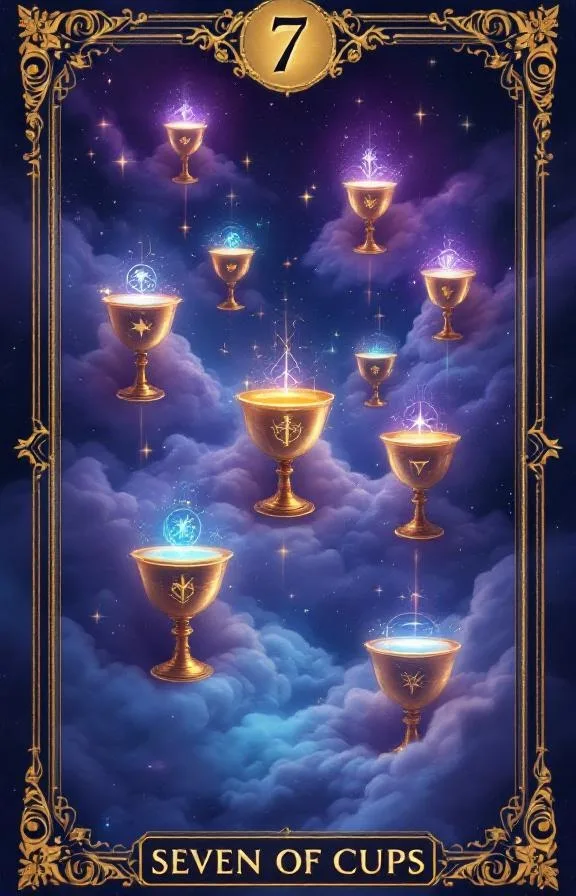
The upright Seven of Cups is the fantasy card. Seven cups floating in clouds, each containing something different — a castle, jewels, a wreath, a dragon, a figure, a snake, a veiled brightness. The figure below stares up at them, paralyzed by options, unable to choose because each choice means abandoning six others.
This is not abundance. This is overwhelm wearing abundance's clothes.
Reversed, the clouds clear. Not all at once, and not painlessly. Some of the cups turn out to be empty. Others contained things you did not actually want — you just thought you did because they looked beautiful from a distance. One or two cups remain, and they are the real ones. Less glamorous, maybe. More attainable, definitely.
Gilbert, a Harvard psychologist, built his career studying a phenomenon he called the "impact bias" — our tendency to overestimate how much future events will affect our emotional wellbeing. We think getting the promotion will make us much happier than it does. We think the breakup will destroy us more than it does. Our "psychological immune system" adapts to both good and bad outcomes faster than we predict. This means that most of the agonizing we do about decisions is based on faulty emotional forecasting.
The Seven of Cups reversed is what happens after you realize this. You stop trying to predict which choice will make you happiest — because you cannot, because nobody can — and you just choose. The power is in the choosing itself, not in the option chosen.
Seven of Cups reversed in love and relationships
In love readings, this card reversed is the end of romantic fantasy. Which sounds like bad news and is actually excellent news.
The person who has been idealizing their crush finally sees them clearly. The flaws, the incompatibilities, the practical realities that fantasy conveniently edited out. This does not always kill the attraction. Sometimes seeing someone clearly makes you love them more honestly. But it does kill the projection — the version of them that existed only in your imagination.
For people stuck in a cycle of comparing potential partners — swiping endlessly, going on first dates that feel like auditions, mentally constructing the perfect person from incompatible fragments of real people — the Seven of Cups reversed says: enough. Stop optimizing. The person in front of you is not a configuration to be perfected. They are a human being to be known. You will not know them from their profile. You will know them from the third Tuesday when the conversation gets awkward and neither of you fills the silence and it is fine.
If you are in a relationship, this reversal often marks the moment when unrealistic expectations get replaced by realistic ones. Your partner is not going to become more ambitious, less messy, more spontaneous, or less anxious because you want them to. You either love the person who is actually there or you do not. The Seven of Cups reversed strips away "they will change" and replaces it with "they will not. Now what?"
That "now what?" is where real relationships begin.
Seven of Cups reversed in career and finances
This is the card's strongest suit in readings, no pun intended.
Career paralysis caused by too many options is endemic. The modern economy presents an unprecedented number of paths — freelance, remote, hybrid, startup, corporate, creative, technical, portfolio career, side hustle, passion project. Previous generations complained about too few choices. This generation drowns in too many.
The Seven of Cups reversed cuts through it. It says: most of these options are fantasies. You know which one is real. The real one is the one you keep circling back to, the one you can start tomorrow without waiting for anything, the one that does not require perfect conditions. It is almost certainly not the most exciting option. That is how you know it is real.
Gilbert's research has a practical application here that most people miss. Since we cannot accurately predict what will make us happy, the best strategy is to talk to people who already made the choice we are considering. Not imagine their experience — ask them. "You left corporate to freelance. What is it actually like?" The answers are always less glamorous than the fantasy and more textured than the fear. Reality lives in that middle ground.
Financially, the Seven of Cups reversed warns against get-rich-quick thinking. The investment that promises extraordinary returns. The opportunity that sounds too good. The financial influencer whose portfolio conveniently started tracking at the market bottom. Clarity about money means accepting that building wealth is slow, boring, and involves a lot of spreadsheets. Nobody puts that on a vision board.
The card also speaks to the paralysis of financial comparison. Someone else made a fortune in crypto. Your college roommate sold a startup. Your neighbor drives a car that costs more than your annual salary. The Seven of Cups upright feeds this comparison — every other person's success becomes a cup you should have grabbed. Reversed, the card says: their path is not your path, their luck is not your luck, and their results tell you nothing about what will work for you. The only relevant question is what you can build with what you have, starting now, in reality rather than in imagination.
Seven of Cups reversed as personal growth
I want to make a claim: indecision is not the absence of a decision. It is the decision to keep all options theoretically open, which is itself a choice with real consequences. The opportunity cost of not choosing is at least as high as the cost of choosing wrong.
Gilbert found something counterintuitive in his research. People with reversible decisions — "you can always change your mind" — were consistently less satisfied than people with irreversible ones. When you can go back, you keep mentally revisiting the alternatives. When you cannot go back, your brain commits to the chosen path and begins finding reasons to be satisfied with it. The psychological immune system does its job. But only if you let it.
The Seven of Cups reversed as personal growth is about developing the muscle of commitment. Not reckless commitment — informed commitment. You gather reasonable information, you make a reasonable choice, and then you stop gathering information. That last part is the hard part. The internet makes it possible to research indefinitely. To read one more review, consult one more expert, watch one more video. At some point, additional information stops helping and starts paralyzing. The Seven of Cups reversed says you have reached that point.
Growth here also involves grieving the paths not taken. Every choice is a small death — the death of all the other lives you could have lived. That grief is real and legitimate. But it is also the price of having an actual life instead of a theoretical one.
How to work with Seven of Cups reversed energy
Set a decision deadline and honor it. Not a vague "I will decide soon" but a specific date. "By Friday at 5 PM I will have chosen between these three options." When Friday comes, choose. If you genuinely cannot distinguish between the options after reasonable deliberation, that means they are roughly equivalent — which means it does not matter which one you pick. Pick one. Move.
Eliminate options before evaluating them. This is backwards from how most people approach decisions, and it works dramatically better. Instead of comparing seven possibilities, immediately discard the three you would not actually pursue. Now you have four. Discard the one that requires conditions you do not control. Three. Discard the one you are only considering because someone else thinks it is a good idea. Two. Now compare two options. That is manageable.
Talk to someone who made the choice you are considering. Not someone who is also considering it — someone who made it three years ago and has lived with the consequences. Ask them what surprised them. Ask them what they wish they had known. Ask them if they would choose the same thing again. Their lived experience is worth more than a thousand hours of your speculation.
Stop consuming content about your options. Close the tabs. Unsubscribe from the newsletters. Stop watching videos about how to decide. You have enough information. You have had enough information for a while. The problem is not insufficient data. The problem is insufficient nerve.
Frequently asked questions
Is the Seven of Cups reversed a good card for making big decisions?
Yes, and specifically it is the card that says "make the decision now." The reversed position indicates that the period of exploration and fantasy is over. Continuing to deliberate will not yield new information — it will only delay action. Trust the clarity the card is offering, even if that clarity does not feel dramatic or inspired.
Does this card mean my dreams are unrealistic?
Not all of them. It means some of them are, and the card is helping you distinguish which is which. The dreams that survive the Seven of Cups reversed are the ones grounded in something real — actual skill, genuine desire, concrete first steps. The ones that dissolve were fantasies serving a psychological function (usually avoiding the risk of committing to something specific).
What if clarity feels uncomfortable?
It always does, initially. Clarity removes the comfort of possibility — the pleasant daydream of "I could do anything." Replacing that with "I am doing this one specific thing" feels like a loss, because it is one. You are trading infinite theoretical futures for one actual future. Gilbert's research confirms that this discomfort is temporary. Once the choice is made and you commit fully, satisfaction follows. Not immediately. But reliably.
Explore the Seven of Cups' full meaning, see what it reveals as feelings, or discover the Seven of Cups as a person. Ready for deeper insight? Try a free reading.