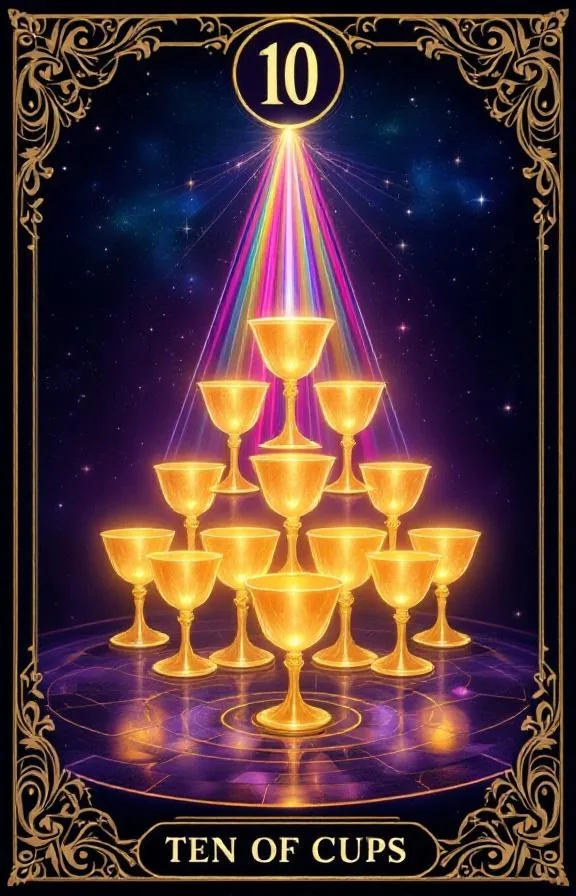
Every Thanksgiving, the Harmon family posted a group photo on Instagram. Matching sweaters. The golden retriever in frame. The caption always said something about gratitude and blessings. Everyone smiled with teeth.
What the photo never showed: the argument in the kitchen about Dad's drinking. The daughter who had not spoken to her brother since July. The mother who spent the morning crying in the bathroom before applying the makeup that would get her through the performance. The photo was real — they were all standing together, they were all smiling — but the thing it depicted did not exist.
I am not picking on the Harmons. This is most families at some point. The performance of happiness in place of actual happiness. That is the Ten of Cups reversed.
In short: The Ten of Cups reversed reveals domestic discord hiding behind a facade of harmony — the gap between how a family or relationship appears and how it actually functions. Virginia Satir, the pioneer of family therapy, identified four dysfunctional communication stances (blaming, placating, computing, distracting) that families default to when genuine connection breaks down. This card is what happens when the family portrait stays on the wall long after the family it depicts has stopped functioning.
Why Ten of Cups appears reversed
The upright Ten of Cups is the idealized family card. A couple embracing, children playing, a rainbow of cups arching overhead. Complete emotional fulfillment shared with the people you love. Reversed, the rainbow breaks. The cups scatter. The embrace tightens into something suffocating or dissolves into polite distance.
This is not a card about catastrophic family breakdown — that is more The Tower's territory. The Ten of Cups reversed describes something subtler and, in many ways, harder to address. It is the slow erosion of authentic connection within a family unit. The dinners where everyone is on their phone. The conversations that never go deeper than logistics. The sense that you are all performing roles — Parent, Child, Sibling, Partner — without actually inhabiting them.
Satir observed that families develop homeostasis just like biological systems. They find a stable state and defend it, even when that stable state is deeply unhealthy. A family where Dad yells and Mom smooths things over has found its homeostasis. Nobody likes it. But it is predictable. Disrupting it — through honest conversation, therapy, or simply refusing to play your assigned role — threatens the entire system. The Ten of Cups reversed often appears when someone is beginning to see through the family homeostasis and wondering whether the stability they have been protecting is worth the cost.
There is also the version where the ideal was never real to begin with. You married the person, bought the house, had the children, and expected to feel the way the upright card looks — complete, radiant, surrounded by love under a rainbow. Instead you feel overwhelmed, isolated, and vaguely fraudulent. The Ten of Cups reversed does not necessarily mean something went wrong. Sometimes it means the expectation was fictional from the start, imported from movies and greeting cards and your parents' carefully curated stories about their own marriage.
Ten of Cups reversed in love and relationships
In a romantic reading, this reversal strikes at the difference between a relationship that works and a relationship that looks like it works.
You know the couple. Everyone knows the couple. They host dinner parties. They finish each other's sentences. Their social media is a curated gallery of vacations and anniversary posts. Behind closed doors, they have not had a real conversation in months. They coexist efficiently. They parent effectively. They have forgotten what drew them together in the first place, or they remember but cannot find the bridge back to it.
The Ten of Cups reversed does not necessarily mean the love is gone. It means the expression of love has been replaced by the performance of love. Date nights become obligations. "I love you" becomes a reflex. Physical intimacy happens on schedule rather than from desire. The structure of the relationship is intact; the soul of it has gone quiet.
For someone asking about a potential partner or new relationship, this card warns about idealization. You are projecting a fantasy of domestic bliss onto someone you do not actually know well enough to evaluate. You are in love with the idea of a life together, not the messy reality of the specific human in front of you.
If you grew up in a family where dysfunction was hidden behind performance, this card has an additional layer. You may be unconsciously recreating your family of origin's patterns in your romantic relationships — choosing partners who help you maintain the facade, avoiding conflict because your childhood taught you that harmony must be preserved at any cost, even the cost of your own needs.
Ten of Cups reversed in career and finances
In a career context, the Ten of Cups reversed typically points to a workplace culture problem. The company says "we are like family here" — and means it in the worst possible way. Boundaries are nonexistent. Dissent is treated as disloyalty. Dysfunction is repackaged as culture.
It can also indicate a disconnect between professional success and personal happiness. You have built the career. The house. The savings account. The retirement plan. All the markers of a successful life are in place. And the life itself feels hollow. Not because the achievements are meaningless, but because they were pursued at the expense of the relationships that give achievement its context. What good is the corner office if nobody you care about knows what you actually do all day?
Financially, the Ten of Cups reversed sometimes signals family money conflicts — inheritances that divide siblings, disagreements about spending between partners, the unspoken resentments that accumulate when one person earns significantly more than the other and both pretend it does not matter.
Money in families is never just money. It is power, love, obligation, and resentment compressed into a dollar sign. The family that "does not talk about money" is not being polite. They are maintaining the homeostasis at the expense of honesty. The Ten of Cups reversed in a financial context asks you to look at which family dynamics are being transacted through money rather than through actual conversation.
Ten of Cups reversed as personal growth
This is the most challenging arena for the Ten of Cups reversed because it asks you to examine something most people consider sacred: your narrative about your family.
Satir believed that healing family dysfunction requires what she called "congruence" — the alignment between what you feel, what you say, and what you do. In congruent communication, anger is expressed as anger, not as passive aggression. Love is expressed through action, not performance. Vulnerability is allowed, not punished. Most families operate far from congruence, and the Ten of Cups reversed names that gap.
Growth from this card often involves grief. Grieving the family you thought you had. Grieving the childhood that looks fine in photographs but felt wrong in ways you could not articulate. Grieving the partner you imagined your partner would be. This grief is not dramatic. It is a quiet recalibration — adjusting your expectations from fantasy to reality and discovering that reality, while less picturesque, allows for something the fantasy never could: genuine intimacy born from seeing each other clearly.
The boldest thing you can do with the Ten of Cups reversed is stop defending the myth. Stop telling yourself your family is fine when it is not. Stop performing happiness for audiences who do not live inside your house. The performance consumes enormous energy. Dropping it frees that energy for the actual work of repair.
One particular trap deserves attention: the belief that acknowledging dysfunction means destroying the family. It does not. Satir spent her career demonstrating that naming problems is the beginning of healing, not the beginning of destruction. Families that survive honest reckoning come out stronger. Families that demand silence come out hollow. The Ten of Cups reversed is hollow. The upright version — the genuine article — requires passing through a period of discomfort that the reversed version is determined to avoid.
How to work with Ten of Cups reversed energy
Have the conversation you have been avoiding. The one about how you actually feel, not how you are supposed to feel. This does not require a dramatic confrontation. It can be as simple as "I miss how we used to talk" or "Something is off between us and I want to understand what."
If family therapy is accessible, consider it. Not because your family is broken — because the communication patterns Satir identified are invisible from inside the system. A skilled therapist can see what you cannot: the roles you play, the dances you perform, the ways you protect the homeostasis at your own expense.
For personal reflection, write the uncensored version of your family story. Not the Instagram version. The real one. Include the parts you normally skip. Not to assign blame — blame is just another way of maintaining the old pattern — but to see the full picture. You cannot repair what you refuse to look at.
One practical exercise: at the next family gathering, notice your role. Are you the peacemaker? The entertainer? The invisible one? The problem child? These roles were assigned decades ago, and you are probably still performing them on autopilot. Noticing the role is the first step toward choosing whether to keep playing it. You do not have to confront anyone. You do not have to make a scene. Just observe. "I am doing the thing again." That observation alone begins to loosen the grip of the pattern.
If your family is genuinely toxic — not imperfect, not annoying, but actively harmful — the Ten of Cups reversed can also be granting permission to redefine what family means. Chosen family. Friends who show up. A partner who sees you clearly. The card is about the ideal of emotional belonging, and that ideal does not require a blood connection. Sometimes the most loving thing you can do for yourself is accept that the family you were born into cannot provide what you need, and build one that can.
Frequently asked questions
Does Ten of Cups reversed mean my family is dysfunctional?
It means some aspect of your family or domestic life is not functioning as harmoniously as it appears — or as you wish it would. Every family has dysfunction. This card is not a diagnosis. It is an invitation to look honestly at the gap between your ideal and your reality.
Can this card predict divorce?
On its own, no. The Ten of Cups reversed is about disharmony and broken ideals, not necessarily separation. Many relationships that produce this card can be repaired through honest communication and mutual effort. The card warns you that repair is needed, not that it is too late.
What if I pulled Ten of Cups reversed but my home life genuinely feels good right now?
Check whether "feels good" means "genuinely fulfilling" or "stable and conflict-free." Those are not the same thing. Stability without depth is comfortable but empty — and that comfortable emptiness is exactly what the Ten of Cups reversed describes. If after honest reflection you still feel the card does not apply, consider that it may be addressing an inner experience: your relationship with the concept of family, your expectations about what domestic happiness should look like, or unresolved feelings about your family of origin that have nothing to do with your current household. Cards sometimes speak to internal landscapes rather than external circumstances.
Explore Ten of Cups's full meaning, see what it reveals as feelings, or discover Ten of Cups as a person. Ready for deeper insight? Try a free reading.