Every January, roughly 40 percent of Americans make New Year's resolutions. By February, most of those resolutions are already ghosts. A frequently cited study by John Norcross and Dominic Vangarelli, published in the Journal of Clinical Psychology (1989), found that only 19 percent of resolution-makers maintained their goals over two years. More recent data from the University of Scranton confirms the pattern: approximately 80 percent of resolutions fail by the second week of February.
This is not because people are weak. It is because the entire resolution framework is built on a flawed premise. Resolutions assume you know what you want. They assume the problem is willpower. They assume that the best time to set a direction is the moment when the calendar changes, regardless of whether you have actually examined where you are standing right now.
Tarot offers an alternative. Not prediction. Not magical goal-setting. Something simpler and more useful: a structured way to ask yourself honest questions at the turn of the year, when the temptation to fantasize about transformation is at its peak and the capacity for genuine self-assessment is at its lowest.
In short: New Year tarot readings replace the failing resolution framework with honest self-assessment. Three spreads — a four-card Year Behind, a five-card Year Ahead, and a three-card Resolution Replacement — help you examine what last year actually taught you, identify recurring patterns your resolutions keep ignoring, and find one genuine starting point grounded in self-knowledge rather than fantasy.
The Problem With Resolutions
The resolution ritual goes like this: you sit down on December 31 or January 1, think about the person you wish you were, and write down a list of things that person would do. Exercise five days a week. Read fifty books. Stop checking your phone before bed. Meditate. Drink more water. Be more present. Be less anxious. Be, essentially, someone else.
The problem is not that these are bad goals. The problem is that they are disconnected from any honest examination of why you are not already doing them. Resolutions treat symptoms. They almost never address the underlying patterns, fears, habits of avoidance, or unexamined beliefs that created the gap between who you are and who you want to be.
The psychologist Gabriele Oettingen spent over twenty years studying motivation and goal pursuit at New York University and the University of Hamburg. Her research, published in Rethinking Positive Thinking (2014), produced a finding that surprised almost everyone in the self-help world: fantasizing about desired outcomes actually reduces the motivation to achieve them. When people vividly imagine a positive future, their brains respond as if the outcome has already occurred. Blood pressure drops. Energy decreases. The psychological urgency to act dissolves because the reward circuit has already fired.
Oettingen did not conclude that optimism is useless. She concluded that optimism must be paired with what she calls "mental contrasting," which she formalized in the WOOP method (Wish, Outcome, Obstacle, Plan). The process works like this: imagine the desired outcome, then immediately and deliberately confront the internal obstacles standing in the way. Not external obstacles like time or money. Internal ones, like the fear of failure that makes you quit the gym after three sessions, or the perfectionism that turns "read more" into "feel guilty about not reading enough."
This is precisely what tarot does well. A card reading does not ask "what do you want?" It asks "what is actually going on?" The difference matters enormously at the start of a new year, when the cultural pressure to dream big actively works against the psychological work of seeing clearly.
Why the Turn of the Year Still Matters
If resolutions are flawed, why bother with the new year at all?
Because the timing itself has real psychological power, even if the usual ritual squanders it. Katherine Milkman, a behavioral scientist at the Wharton School, coined the term "fresh start effect" in a 2014 paper published in Management Science. Her research found that temporal landmarks, such as the start of a new year, the beginning of a new week, or a birthday, genuinely increase people's motivation to pursue goals. They create a psychological separation between the "old self" and the "new self," making people feel less burdened by past failures.
The fresh start effect is real. The question is what you do with it.
Most people use their fresh start energy to write better resolutions. Milkman's own research suggests a different approach: use the motivational boost to establish systems rather than goals. Do not resolve to run a marathon. Set up a schedule, a route, a pair of shoes by the door. Do not resolve to be more mindful. Create a daily practice with a specific time, place, and structure.
A New Year tarot reading is exactly this kind of structured practice. It does not ask you to fantasize about the year ahead. It asks you to examine the year behind, identify what you are carrying forward, confront the obstacles that actually blocked you, and establish one honest starting point. The fresh start energy gets channeled into self-knowledge rather than aspiration. And self-knowledge, unlike aspiration, does not expire in February.
Three New Year Spreads
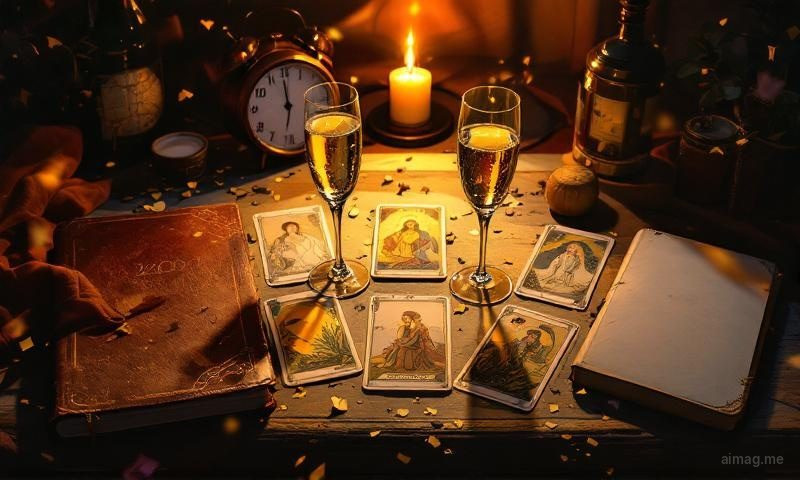
The following three spreads are designed to be used together as a single New Year reading, or separately depending on how much time and depth you want. Start with "The Year Behind" if you only have fifteen minutes. Add the others if the process pulls you in.
Spread 1: The Year Behind (4 Cards)
This spread looks backward before you look forward. Most New Year rituals skip this step entirely, which is why the same resolutions appear year after year.
| Position | Question |
|---|---|
| 1 | The theme of this past year, the energy that defined it |
| 2 | What this year taught me, the lesson that is now mine |
| 3 | What I am ready to leave behind, what has run its course |
| 4 | What I am carrying forward, what still has life in it |
How to read it: Position 1 is the headline, the single word or concept that captures what the past twelve months were actually about (which may be very different from what you planned). Position 2 is the gift of the year, however unwelcome it may have felt while you were living through it. Position 3 is permission to let go. And Position 4 is the thread that connects the old year to the new one, the thing that is not finished yet and should not be abandoned.
If The World appears in Position 1, the past year was about completion, about bringing something full circle. If it appears in Position 3, you are ready to close a chapter you have been keeping open out of habit or fear.
Tip: Journal your answers before consulting any card reference. Your first instinct about what the card means for you in this context is often more accurate than a textbook definition.
Spread 2: The Year Ahead (5 Cards)
This spread replaces the resolution list with a map. It does not tell you what will happen. It shows you the energies, opportunities, and challenges that are available to work with.
| Position | Question |
|---|---|
| 1 | What energy is available to me this year |
| 2 | The opportunity that is opening |
| 3 | The challenge that will test me |
| 4 | What I need to develop in myself |
| 5 | The underlying theme of this year |
How to read it: Position 1 is the raw material. Not what you should do, but what kind of energy you have to work with. The Ace of Wands means creative fire. The Two of Pentacles means the ability to balance and juggle. Position 2 is not a promise. It is a door that you still have to walk through. Position 3 is the honest part, the obstacle that Oettingen's research says you must confront. Position 4 is what you need to grow within yourself to meet that challenge. Position 5 is the throughline, the word you will write at the top of your journal for the year.
If The Fool appears in Position 1, the year's energy is about beginning something without guarantees. That is very different from a resolution. A resolution says "I will achieve X." The Fool says "I will step into the unknown and see what happens." One is a contract. The other is an attitude.
Tip: Pay special attention to the relationship between Positions 3 and 4. The challenge and the quality you need to develop are almost always connected. The card in Position 4 is frequently the antidote to the card in Position 3.

Spread 3: The Resolution Replacement (3 Cards)
This is the shortest and most direct of the three. It is designed for the moment when you catch yourself writing a resolution and want to do something more useful instead.
| Position | Question |
|---|---|
| 1 | What I actually need (vs. what I think I want) |
| 2 | The obstacle I keep encountering, the pattern I keep repeating |
| 3 | One honest step I can take, not a fantasy, but a real beginning |
How to read it: Position 1 is often the most surprising. The resolution you were about to write ("lose weight," "be more productive," "find a partner") is usually a surface-level translation of a deeper need. The card in Position 1 points to what that deeper need actually is. The Nine of Cups suggests the need is for genuine contentment, not achievement. The Hermit suggests the need is for solitude and self-understanding, not for another social goal.
Position 2 is the pattern. Not this year's specific obstacle, but the recurring one. The one that shows up in different costumes across multiple years. If you find yourself drawing the same card in this position year after year, that is significant. That is the card telling you that this pattern has not been addressed, only renamed.
Position 3 is deliberately small. One step. Not a plan, not a system, not a year-long commitment. One honest action that moves you closer to what Position 1 revealed and away from the pattern in Position 2. The power of this position is its modesty. Resolutions fail because they are too large. This card gives you something you can actually do tomorrow.
Cards That Speak to the New Year
Certain cards carry particular weight in New Year readings because their themes align naturally with the psychology of transitions and fresh starts.
The World signals completion. When it appears in a year-end reading, it confirms that something has genuinely come full circle. This is the card of earned endings, not abrupt ones. If The World shows up, the appropriate response is not to immediately plan what is next. It is to pause and acknowledge what was accomplished, even if what was accomplished was simply surviving.
The Fool signals a true beginning, the kind that cannot be planned in advance because it requires stepping off the edge of the known. The Fool in a New Year reading does not mean recklessness. It means that the year ahead calls for the willingness to begin without a guaranteed outcome. No resolution can capture this energy because resolutions are, by definition, attempts to control the future. The Fool is about releasing that control.
The Wheel of Fortune speaks directly to the cyclical nature of the new year itself. What goes up comes down. What ended will begin again in a new form. This card in a New Year reading reminds you that some of what you are planning is genuinely within your control, and some of it is not. The question is not how to control the wheel. It is how to stay centered while it turns.
Judgement is the card of honest assessment, of looking at your life with clear eyes and deciding what to resurrect, what to release, and what to transform. In many ways, Judgement is the anti-resolution card. It does not ask what you want to become. It asks what you already are, beneath the habits and performances and accumulated compromises, and whether you are ready to live from that place instead.
What to Do After the Reading
A New Year tarot reading is not complete when you put the cards away. The reading is the beginning of a conversation with yourself that should extend through at least the first week of January.
Write it down. Record the cards, your initial interpretations, and especially the parts that surprised you or that you resisted. Resistance is information. The card you do not want to look at is almost always the one with the most to tell you.
Choose one word. From the entire reading, distill a single word that captures the theme of your year. Not a goal. Not a resolution. A word. "Patience." "Honesty." "Rest." "Risk." Write it somewhere you will see it. This word will serve you better than any list of resolutions because it is a compass direction, not a destination.
Revisit quarterly. Pull the same spreads at the end of March, June, and September. Not to check whether your predictions came true, but to see how your relationship with the themes has changed. The cards you draw will be different, and the way you read them will be different too, because you will be different.
Replace the resolution reflex. Every time you catch yourself thinking "I should..." or "starting Monday I will...," pause. Pull a single card. Ask: "What do I actually need right now?" The answer is usually simpler, smaller, and more honest than the resolution you were about to make. And because it is honest, it is more likely to stick.
If you want to go deeper into the practice of asking better questions, the guide on best questions to ask tarot cards covers the distinction between closed questions that seek validation and open questions that generate genuine insight. The difference between "Will I get the promotion?" and "What is my relationship with ambition right now?" is the difference between fortune-telling and self-knowledge.
Frequently Asked Questions
When is the best time to do a New Year tarot reading?
Any time between December 28 and January 7 works well. The fresh start effect identified by Milkman's research is strongest around the actual date change, but it persists for about a week afterward. Some readers prefer New Year's Eve for the symbolic weight. Others prefer January 2 or 3, after the celebrations have ended and the mind is quieter. The worst time is when you are rushed, distracted, or treating it as an obligation. Wait until you have at least thirty uninterrupted minutes.
Can I do a New Year reading if I have never used tarot before?
Yes. The spreads above are designed to be accessible to beginners. You do not need prior experience with tarot to pull cards and respond to the images and themes they present. If you are entirely new, the guide to your first tarot reading covers the basics of shuffling, drawing, and interpreting. The most important skill for a New Year reading is not tarot expertise. It is honesty with yourself.
What if I draw mostly negative or difficult cards?
There are no negative cards. There are uncomfortable ones. The Ten of Swords, The Tower, and the Five of Cups look alarming but carry essential information. A New Year reading heavy with challenging cards is telling you that the year ahead requires growth, and that growth will involve confronting things you would prefer to avoid. That is not a curse. That is a diagnosis. And like any diagnosis, it is far more useful than the comforting fiction that everything will be fine if you just try harder.
Should I share my New Year reading with others?
That is entirely personal. Some people find that sharing their reading creates accountability and deepens the insight through conversation. Others find that sharing dilutes the reading's power by turning a private reckoning into a social performance. A useful guideline: share if the other person is genuinely interested in your process, not just curious about what cards you drew. The value of a New Year reading is in the self-examination it prompts, not in the spectacle of the cards themselves.
The new year does not need your resolutions. It does not need your willpower, your discipline plans, your morning routines, or your carefully curated list of things that the improved version of you will finally start doing. What the new year needs from you is something quieter and more difficult: an honest look at where you actually are. Not where you wish you were. Not where you think you should be. Where you are.
A tarot reading at the turn of the year is not a replacement for action. It is a replacement for the kind of magical thinking that pretends action starts with ambition rather than with seeing clearly. Pull the cards. Look at what they show you. Write it down. And then, instead of resolving to become someone you are not, take one honest step from where you already stand. That step, small and unglamorous as it may be, is worth more than a hundred resolutions. Because it starts from the truth.