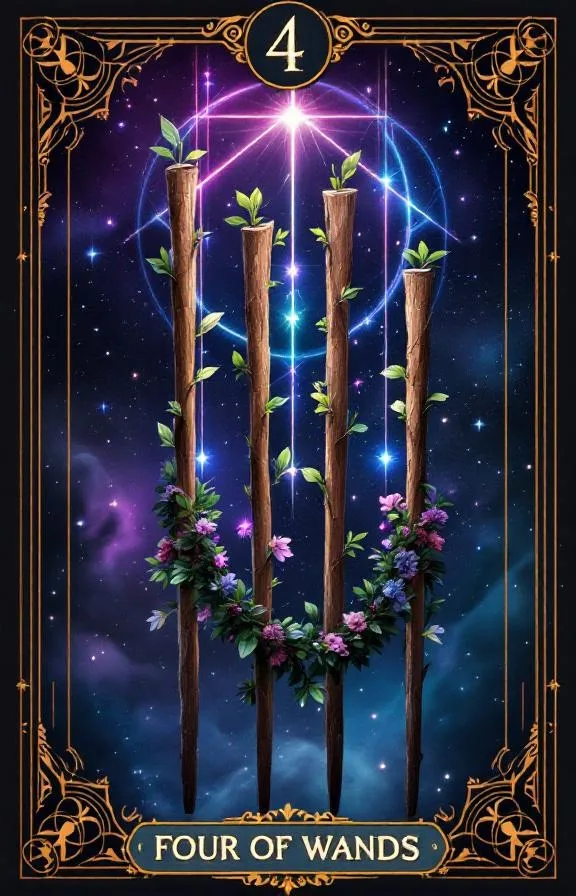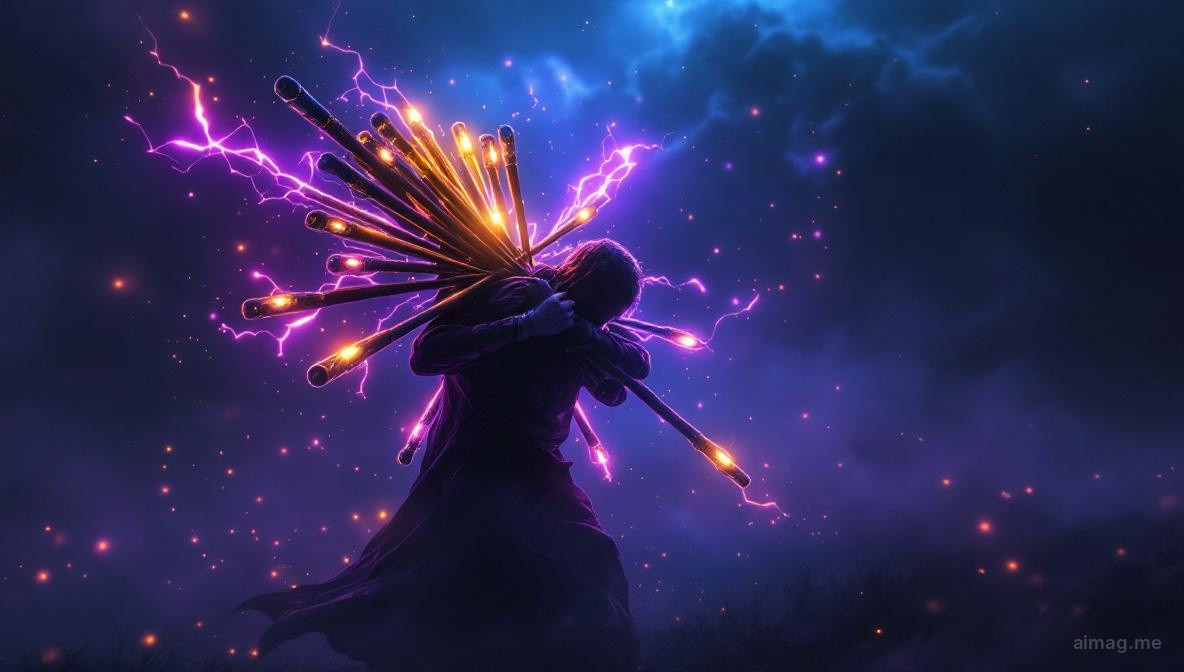
When the Ten of Wands appears as feelings, someone is experiencing the emotional weight of carrying too much. This is not sadness or grief. It is the specific exhaustion of responsibility — the feeling of having taken on more than any single person can hold, and continuing to hold it because putting anything down feels like failure. Every obligation is a wand, and they are all pressing down at once.
In short: The Ten of Wands as feelings represents emotional overload — the crushing weight of too many responsibilities, commitments, or expectations carried alone. Upright, it signals hard work, determination pushed to its limit, and the burden of being the one who holds everything together. Reversed, it points to the moment of release or collapse. Christina Maslach and Michael Leiter's burnout research identifies this pattern precisely: when demands consistently exceed resources, the result is not just tiredness but a fundamental shift in how a person relates to their own capacity.
The emotional core of the Ten of Wands
The Ten of Wands occupies the final numbered position in its suit — the point where fire's passion and drive have been pushed to their maximum. As a feeling, it represents what happens when enthusiasm becomes obligation, when the projects you started with excitement now feel like sentences you are serving. The original spark is buried under layers of commitment.
Tómate un momento para reflexionar sobre lo que has leído. ¿Qué resuena con tu situación actual?
Christina Maslach, professor of psychology at UC Berkeley, developed the most widely used framework for understanding burnout. Her research, conducted with Michael Leiter, identifies three components: emotional exhaustion, depersonalization, and reduced personal accomplishment. The Ten of Wands maps directly to the first: the feeling of being emotionally drained by the demands of work, relationships, or self-imposed expectations. Critically, Maslach found that burnout is not a character flaw — it is a structural problem. The person is not weak. The load is too heavy.
Martin Seligman, whose early research at the University of Pennsylvania defined learned helplessness, identified a related pattern. When people repeatedly experience situations where their efforts fail to change outcomes, they stop trying — not from laziness but from a conditioned belief that effort is futile. The Ten of Wands captures the stage just before learned helplessness sets in: the person is still trying, still carrying, still pushing forward. But the question of "why am I doing this?" has begun to echo louder than any answer.
This is a feeling that anyone who has been the reliable one — the parent who manages everything, the employee who never says no, the partner who absorbs all the emotional labor — will recognize at a visceral level.
Ten of Wands upright as feelings
When the Ten of Wands appears upright as someone's feelings, the dominant experience is being crushed by the weight of their own commitments. This person is not lazy. They are not disengaged. They are doing too much, and they know it, but they cannot figure out what to put down because everything feels essential.
In relationships, this card often signals that someone feels emotionally overburdened — not necessarily by you, but by the totality of their circumstances. They may love you deeply while simultaneously feeling that love is one more thing they have to maintain on a list that is already impossible. This is not about their feelings toward you being negative. It is about their capacity being maxed out.
Imagine someone who works ten-hour days, comes home to manage household logistics, maintains relationships with extended family, handles financial planning, and then hears their partner say "we need to talk." The content of that conversation might be perfectly reasonable. But the feeling it triggers is not proportional to the request — it is proportional to everything else they are already carrying. That disproportionate emotional response to one more demand is the Ten of Wands feeling.
Maslach and Leiter's research shows that burnout does not emerge from any single demand. It emerges from the chronic imbalance between what is asked and what is available to give. The Ten of Wands person may appear functional — they are still showing up, still performing, still holding things together. But internally, every task costs more energy than it should because the reserves are empty.
In self-reflection, drawing this card is a clear signal: you are carrying too much, and the weight is distorting your emotional responses. Things that should feel manageable feel catastrophic. Things that should feel joyful feel like obligations.
Ten of Wands reversed as feelings
Reversed, the Ten of Wands represents one of two emotional states: the relief of finally putting something down, or the collapse that comes when you carry too long without rest.
The first pattern is liberation through delegation. The person has reached the point where they recognize, honestly and without self-judgment, that they cannot do everything alone. Seligman's later work on learned optimism — the counterpoint to his helplessness research — describes the cognitive shift that makes recovery possible: the realization that circumstances are specific, not global; temporary, not permanent; and changeable, not fixed. The reversed Ten of Wands person has made this shift. They are actively choosing to release some of their burden, not because they have given up but because they have grown wiser.
The second pattern is less voluntary. This is the emotional crash that follows prolonged overextension. The body or psyche simply stops cooperating. Projects get dropped. Relationships suffer from neglect. The person feels not just tired but hollow — emptied of the motivation that once drove them to take on so much. Maslach identified this as the endpoint of unchecked burnout: a state of detachment that can look like apathy but is actually the nervous system's emergency brake.
In relationships, the reversed Ten of Wands can signal someone pulling back — not from lack of caring but from genuine inability to give any more. They may seem distant, disengaged, or irritable. These are not personality traits. They are symptoms of a system that has been running on empty for too long.
The key distinction is whether the reversal is conscious or involuntary. One is growth. The other is a warning.
In love and relationships
In romantic readings, the Ten of Wands upright as feelings carries a specific message: this person's emotional bandwidth is consumed. When they seem distant or overwhelmed, it is likely not about you. It is about everything. The feeling they carry is not indifference — it is the guilt of knowing they cannot give you what you deserve right now because there is nothing left to give.
For established relationships, this card frequently appears during periods of external stress — career demands, family obligations, financial pressure. One partner feels like they are carrying the relationship along with everything else, and resentment is beginning to build under the surface of their exhaustion.
The work of John Gottman at the University of Washington on relationship dynamics is relevant here. Gottman's research shows that successful relationships require a ratio of roughly five positive interactions to every negative one. When one partner is in a Ten of Wands state, their capacity for positive interactions drops sharply — not because the love has diminished but because the energy has. Understanding this distinction can prevent misinterpretation of emotional withdrawal as emotional abandonment.
When reversed in love, the card asks: what would happen if you asked for help? What would change if you admitted you cannot carry this alone? The answer is rarely as catastrophic as the exhausted mind imagines.
When you draw the Ten of Wands as feelings in a reading
If the Ten of Wands appears as feelings in your reading, the card is not asking you to try harder. It is asking you to examine what you are carrying and whether all of it is actually yours.
Consider: Which of these burdens did I choose, and which were placed on me by assumption? What am I afraid will happen if I put one thing down? Who have I failed to ask for help, and why?
The Ten of Wands does not romanticize suffering. It does not treat exhaustion as a badge of honor. It presents the honest picture of someone who started with passion and has been ground down by the weight of their own dedication. The way forward is not more effort. It is strategic release.
Explore what the Ten of Wands reflects in your emotional landscape with a free reading.
Frequently asked questions
What does the Ten of Wands mean as feelings for someone?
The Ten of Wands as someone's feelings indicates they are emotionally overloaded. They care about you but are carrying so many responsibilities that their emotional capacity is stretched beyond its limits. Distance is not rejection — it is exhaustion.
Is the Ten of Wands a positive card for feelings?
Not in the traditional sense. It acknowledges hard work and dedication but warns that the current pace is unsustainable. The positive aspect is that it makes the problem visible — you cannot fix what you refuse to see.
How does the Ten of Wands reversed differ as feelings?
Reversed, the burden is being released — either through conscious delegation and boundary-setting, or through involuntary collapse. The emotional tone shifts from "I must keep going" to "I cannot keep going," which can be either liberating or alarming depending on how it happens.
Explore the full guide to all 78 cards as feelings or discover the Ten of Wands' complete meaning. Ready to explore what the cards reflect about your emotions? Try a free reading.