Easter is one of the oldest rebirth festivals that humanity knows. Before it became Christian, before it layered onto itself the theology of resurrection, it was a spring celebration — a recognition that what looked dead had not actually died. Earth that lay frozen for months suddenly produces green shoots. An egg — sealed, still, showing no sign of life — cracks open from within and releases something alive. Easter, stripped of any specific tradition, is a celebration of the fact that death is not always final.
In short: Easter's core symbols — the egg, the fast, the tomb, the resurrection — map directly onto the psychology of genuine change. James Prochaska's stages of change, Joseph Campbell's death-rebirth motif, and Jung's concept of individuation all describe the same arc: something must die before something new can be born. A four-card "Rebirth" spread — What Died, The Tomb, The Stone, Resurrection — helps you identify where you are in that cycle.
Joseph Campbell spent his life cataloging one pattern that recurs across every culture's mythology: the death-rebirth motif. The hero descends to the underworld, dies symbolically, and returns transformed. Isis reassembles the body of Osiris. Persephone returns from Hades. Jesus emerges from the tomb. Campbell did not claim these myths describe the same event. He claimed they describe the same psychological experience — the moment when something in us must die so that something else can be born.
Tómate un momento para reflexionar sobre lo que has leído. ¿Qué resuena con tu situación actual?
Tarot encodes this same pattern. The Death card (XIII) is not an ending. It is a transition. And what follows Death in the Major Arcana sequence — Temperance, the Devil, the Tower, the Star — is a psychological map of what new beginnings actually look like when you live through them: painful, chaotic, slow, and marked by a quiet that comes only after the old has fully fallen apart.
The Egg, the Fast, and the Psychology of Voluntary Restriction
Easter's symbolism contains two images that the psychology of change takes with deadly seriousness.
The first is the egg. A closed system that appears static but inside which invisible transformation is taking place. James Prochaska, creator of the transtheoretical model of change, describes the "contemplation" stage — knowing change is needed but not yet ready to act. From outside, nothing is happening. Inside, everything is preparing. The Easter egg is a perfect metaphor for contemplation: nothing appears changed, and then suddenly — a crack.

The second image is Lent — forty days of voluntary restriction before Easter. Whether someone fasts for religious reasons or secular ones, the psychological mechanism is the same. Roy Baumeister's research on self-control demonstrated that voluntary restriction — giving up something pleasurable — strengthens the capacity for self-regulation. Fasting is not punishment. It is training. It tells the psyche: you can relinquish what is familiar and comfortable, and survive. That is precisely the competency you need to navigate genuine change.
Jung described individuation as psychological resurrection — not a one-time event but a recurring cycle: old identity dies, disorientation follows, something more integrated emerges. Easter tells the same story in a single weekend.
The Death Card and the Sun Card — Easter's Arc in Tarot
If you want to see Easter in tarot, look at the sequence from card XIII to XIX:
Death (XIII) — Good Friday. Something ends irreversibly. Not because it is bad, but because it has run its course. Paradoxically the card of liberation — holding onto what has died costs more energy than letting go.
Temperance (XIV) — Holy Saturday. Silence. The old no longer exists, the new has not yet formed. Prochaska calls this the "preparation" stage — you know change is coming but cannot yet see it.
The Star (XVII) — First hope. Quiet, patient, fragile. The Star does not shout about rebirth. It whispers. After a period of destruction, this is the first moment you believe something new is possible.
The Sun (XIX) — Easter Sunday. Clarity, vitality, a new beginning that is no longer fragile. The Sun in tarot is not naive optimism. It is clarity that comes after passing through darkness — and is therefore real.
This arc — from Death to Sun — is an exact map of what genuine new beginnings look like. They do not start with enthusiasm. They start with loss.
The "Rebirth" Spread — 4 Cards
A spread designed for Easter but useful at any moment when you sense something ending and something new trying to emerge. Four positions mirror Easter's arc: death, tomb, stone, resurrection.
| Position | Question |
|---|---|
| 1 — What died | What old pattern, belief, or identity has run its course? |
| 2 — The tomb | What transitional period are you living through? What is happening in the silence? |
| 3 — The stone | What is blocking your rebirth? What stands between the old and the new? |
| 4 — Resurrection | What new possibility is trying to emerge? |
How to read it: Position 1 asks what has ended — or what should end but you are still holding onto. Death here is the obvious confirmation. But more often, less dramatic cards appear: the Four of Cups (apathy, emotional disconnection), the Ten of Swords (a painful ending hard to believe), the Eight of Cups (a quiet departure from something that once mattered). Whatever appears, take it seriously. Easter says: you cannot resurrect from something you have not buried.
Position 2 is hardest because it describes a place where nothing seems to happen. This is Easter Saturday: the tomb is sealed, nobody knows what is inside. Psychologically, disorientation is normal here. Prochaska emphasized that people who skip the preparation stage revert to old patterns faster than those who allow the discomfort of "I do not know what comes next." If the Hermit appears, the tomb is voluntary solitude. If the Hanged Man appears, the transition requires suspension — stopping action and allowing a different kind of knowing.
Position 3 names what blocks. In the Easter narrative, the stone had to be rolled away before anything could emerge. In your life, that stone might be fear (the Nine of Swords), attachment to an old identity (the Four of Pentacles), someone else's expectations (the Hierophant reversed), or the habit of comfortable suffering you know better than the uncomfortable freedom you do not. This position is the most valuable because it names a specific obstacle — and a named obstacle is one you can work with.
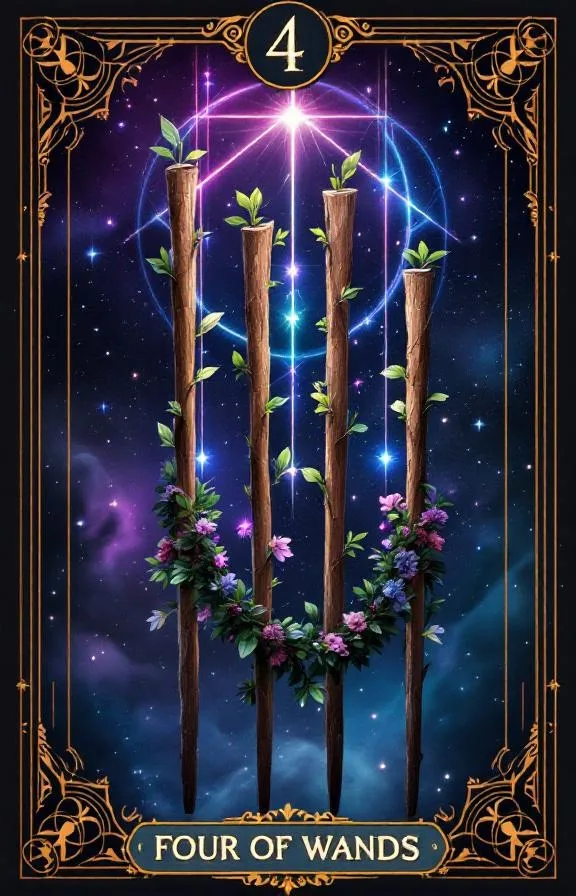
Position 4 is not a promise. It is a possibility. The Ace of Cups suggests a new emotional beginning. The Ace of Wands suggests a creative impulse waiting to be activated. The Star suggests hope returning after drought. Whatever appears, treat it as invitation, not prophecy.
Change Is Not Linear — and Easter Knows It
Prochaska discovered something self-help culture is reluctant to admit: most people cycle through the stages of change multiple times before the change sticks. On average, it takes five attempts to quit smoking permanently. Relapses are not failure — they are part of the process. Easter, read psychologically, says the same. Resurrection is not a one-time event. It is a pattern that repeats — each time in deeper form.
Campbell called this the "hero's journey" — a spiral, not a line. The hero returns to a higher orbit of the same spiral, with experience that changes perspective. The Fool's Journey in tarot maps this dynamic: card 0 (the Fool) and card XXI (the World) are not beginning and end. They are two points on a spiral that keeps turning.
Easter does not ask for belief in literal resurrection. It asks for recognition of a pattern that every psyche knows firsthand: something ends, chaos follows, and then — if you do not flee the tomb too early — something emerges that you could not have planned, because you did not yet exist in the form that is capable of thinking it.
The egg does not crack from outside. It cracks from within. Everything needed for rebirth is already inside you — but it requires time, silence, and willingness to accept that the new beginning will not look the way you imagined. The "Rebirth" spread will show you where you are in the cycle: what has died, what is maturing in silence, what blocks the transition, and what waits on the other side of the stone.
Try a free AI-powered reading at aimag.me/reading
Related Reading
- Spring equinox tarot spread — three layouts for the spring transition and planting intentions
- Archetypes you live by: Major Arcana as a map of the psyche — the Fool's Journey as individuation
- Shadow work: what your discomfort with a card reveals — why the cards that unsettle you point toward shadow material
- Tarot and the hero's journey: the Fool's path through the archetypes — a deeper exploration of Campbell's monomyth in tarot