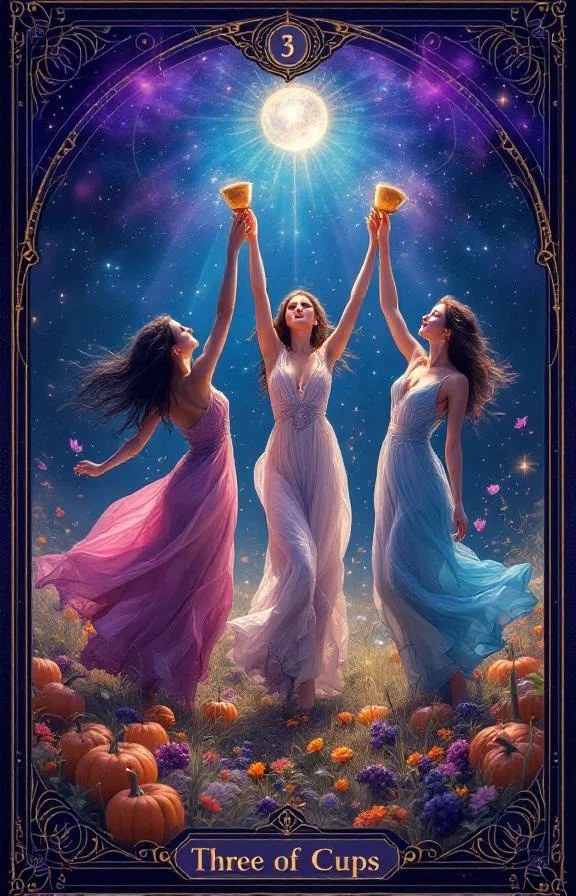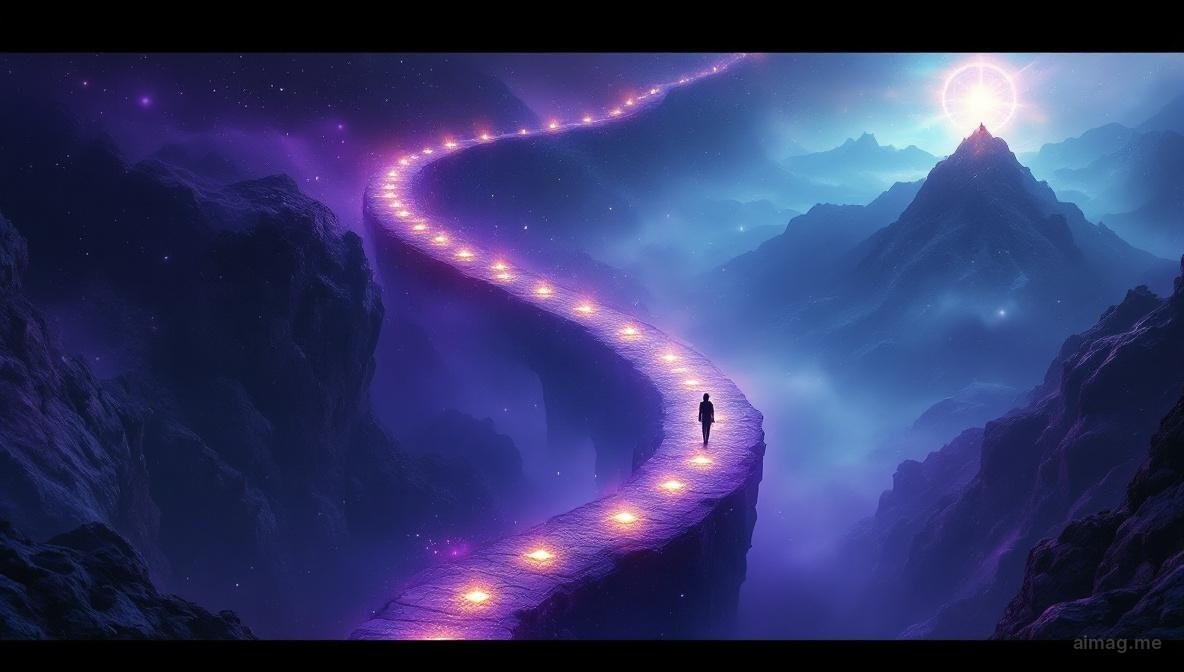
The 22 Major Arcana map onto Joseph Campbell's hero's journey with a precision that is either a remarkable coincidence or evidence that both systems describe the same fundamental pattern of human psychological growth. The Fool starts where the hero starts — at the threshold of the unknown. The World arrives where the hero returns — transformed, integrated, carrying the gift of experience back to ordinary life.
In short: The tarot's 22 Major Arcana parallel Joseph Campbell's monomyth — the universal story pattern of departure, initiation, and return. This mapping is grounded in Carl Jung's individuation theory and Dan McAdams's narrative identity research, suggesting that both tarot and the hero's journey describe the same deep structure of psychological growth.
Why the hero's journey matters psychologically
Campbell published The Hero with a Thousand Faces in 1949. His argument: the myths of every culture share a common narrative structure. A hero departs from the ordinary world, faces trials and transformation in a supernatural realm, and returns with a boon that benefits the community. He called this the monomyth.
Campbell was deeply influenced by Jung, whose concept of individuation — the lifelong process of integrating conscious and unconscious into a unified self — provides the psychological engine beneath the hero's journey. The hero's trials are not external adventures. They are symbolic representations of inner work: confronting the shadow, integrating the anima/animus, encountering the Self.
Dan McAdams, the personality psychologist at Northwestern, extended this into contemporary science with his narrative identity theory. His research — spanning decades and thousands of life stories — shows that psychological health correlates strongly with the ability to construct a coherent, meaningful story of your own life. One that integrates suffering and triumph into something that makes sense.
The critical link: people who can locate themselves within a meaningful story arc — who can say "I am in the trials phase" or "I am crossing the return threshold" — handle adversity better than those who experience events as random or pointless.
The hero's journey is not just a myth template. It is a psychological technology for meaning-making. And tarot, mapped onto its stages, provides a concrete visual vocabulary for doing that work.
The complete mapping: Major Arcana as hero's journey stages
Campbell's journey has three major movements — Departure, Initiation, Return — subdivided into seventeen stages. The 22 Major Arcana map across these with some cards covering a full stage, others marking transitions.

Part I: Departure (Cards 0-VII)
The departure covers the hero's movement from ordinary life into the adventure. Awakening, calling, and crossing the first threshold.
| Campbell Stage | Major Arcana | Connection |
|---|---|---|
| The Ordinary World | — | The pre-story state before The Fool steps forward |
| The Call to Adventure | 0 — The Fool | The leap into the unknown, backpack on shoulder, cliff ahead |
| Refusal of the Call | (internal tension within The Fool) | The moment of hesitation before the step |
| Supernatural Aid | I — The Magician | The mentor figure who provides tools and knowledge |
| Crossing the First Threshold | II — The High Priestess | Passage between known and unknown, conscious and unconscious |
| Belly of the Whale | III — The Empress, IV — The Emperor | Immersion in the new world — its nurturing (Empress) and structural (Emperor) dimensions |
| V — The Hierophant | Encounter with established wisdom, tradition, institutional knowledge | |
| VI — The Lovers | First major choice — the fork that defines the hero's path | |
| VII — The Chariot | Willful forward movement through obstacles, initial mastery |
The Fool is the purest Call to Adventure. A figure about to step off a cliff into empty space, a small dog barking at their heels (instinct warning), a white rose of innocence in hand. The Fool does not know what lies below. That is the point. Campbell: "The adventure is always and everywhere a passage beyond the veil of the known into the unknown." The Fool is the moment before the passage becomes irrevocable.
The Magician serves as supernatural aid — the mentor, the Gandalf. In the tarot, all four elemental tools are on the table. One hand pointing to heaven, the other to earth. The message: you have everything you need. The connection between vision and reality is the skill the mentor teaches. Every hero's journey includes a figure who provides what the hero cannot yet provide alone.
The High Priestess is the threshold itself — the veil between conscious, structured reality and the unconscious, mysterious depths. She sits between two pillars with a veil behind her. Not an obstacle. A gateway. The understanding that what lies beyond rational knowing is real and must be entered.
The Lovers represent what Campbell calls the defining choice. Not simply romantic (though it can include that), but the fundamental fork where the hero commits. Before The Lovers, the hero could still turn back. After, the chosen path shapes everything that follows. Irreversible commitment — not because return is impossible, but because returning would mean becoming someone different from the person who chose.
The Chariot closes the departure with the hero's initial triumph — first victory, confidence boost, proof of capability. A warrior steering opposing forces through sheer will. Not the final victory. The first mastery. The deeper trials will test and ultimately transcend it.
Part II: Initiation (Cards VIII-XVI)
The initiation is the journey's core — trials, revelations, atonement, and transformation. The hero's real education.
| Campbell Stage | Major Arcana | Connection |
|---|---|---|
| The Road of Trials | VIII — Strength | Inner trials requiring courage, patience, self-mastery |
| IX — The Hermit | Solitary seeking, withdrawal for wisdom, the mentor becomes internal | |
| X — Wheel of Fortune | Encountering fate, cycles, forces beyond personal control | |
| Meeting with the Goddess | XI — Justice | Encounter with cosmic truth, the weighing of the soul |
| Temptation | XII — The Hanged Man | Surrendering old perspective, sacrificing comfort for truth |
| Atonement with the Father | XIII — Death | The great transformation, ego death, the old self dies |
| Apotheosis | XIV — Temperance | Integration of opposites, alchemical transformation, grace |
| The Ultimate Boon | XV — The Devil, XVI — The Tower | Confronting bondage and liberation, the destruction that precedes renewal |
Strength opens the initiation with a woman gently holding open a lion's mouth. Not physical force but the inner fortitude Campbell's Road of Trials demands. The lion — the animal self, the shadow, the fears — is not an enemy to destroy but an energy to befriend.
The Hermit hits the deepest point of the inner journey — alone in darkness, guided by nothing but their own lantern. Campbell described this as the hero consumed by the unknown, and from that consumption, finding inner guidance. The Hermit stands on a mountain peak, cloaked, the lantern revealing only the next step. Every external guide has been left behind.
Death is the central axis. The point where the old identity must die for the new one to emerge. Campbell called it "Atonement with the Father" — confrontation with the ultimate power and dissolution of the ego that separated the hero from it. In tarot, the Death card almost never means physical death. It is transformation so complete that the person who emerges is not the person who entered.
The Devil and The Tower form the final, most severe trial. The Devil names what chains you — addictions, illusions, self-imposed bondage. The Tower shatters it. Campbell's hero acquires the Ultimate Boon through a trial that strips away everything false. The Tower is violent, disorienting, and absolutely necessary. No hero returns unchanged. The change is never comfortable.
Part III: Return (Cards XVII-XXI)
The return is often the most psychologically complex phase: bringing the boon back to ordinary life, integrating extraordinary experience into the everyday.
| Campbell Stage | Major Arcana | Connection |
|---|---|---|
| Refusal of the Return | (internal tension after The Tower) | The reluctance to leave the transformed state |
| The Magic Flight | XVII — The Star | Renewed hope, guidance from above, the first calm after the storm |
| Rescue from Without | XVIII — The Moon | Navigating illusion and fear on the return path |
| Crossing the Return Threshold | XIX — The Sun | Re-emergence into clarity, joy, and illuminated understanding |
| Master of Two Worlds | XX — Judgement | Full integration of ordinary and extraordinary, the call to authentic life |
| Freedom to Live | XXI — The World | The completed cycle, the dance of integration, the hero's gift to the community |
The Star follows The Tower in both systems. After catastrophic transformation: a moment of pure, vulnerable hope. A naked figure pouring water onto earth and into a pool under eight-pointed stars. No armor, no pretense. Campbell describes the hero after the ultimate trial as stripped bare and renewed. The Star is that liminal moment — the trial is over, the transformation is real, and quiet awareness of what has been gained is just beginning.
The Moon represents the dangers on the way back. The return is never simple — the ordinary world may reject the hero, or the hero may struggle to translate the experience into ordinary language. The Moon is illusion, fear, the unconscious. On the return path, the hero must navigate deceptions both external (the world changed while they were gone) and internal (the temptation to distort the experience into something more comfortable than truth).
The Sun is triumphant re-emergence. Where The Moon obscured, The Sun illuminates. The child on the white horse in The Sun represents not naivety but second innocence — simplicity on the other side of complexity, joy possible only after suffering has been processed. Not The Fool's ignorant enthusiasm. Earned radiance.
Judgement is "Master of Two Worlds" — the hero who moves freely between ordinary and extraordinary, conscious and unconscious. The dead rising at a trumpet's sound is not literal resurrection but awakened life — the refusal to sleepwalk after seeing what lies beneath the surface. The hero who completed the journey cannot unknow what they know. Judgement calls them to live accordingly.
The World closes both systems. A dancer within a wreath, four zodiac signs at the corners (lion, bull, eagle, human). Campbell's "Freedom to Live" — someone who completed the cycle, integrated the experience, and can now live fully in the present. The dancer moves freely because nothing is left to prove, nothing unfinished, nothing avoided.
And then The Fool appears again. Because the journey is a cycle, not a line. The World's completion becomes The Fool's next departure. Every ending is a beginning. This is the monomyth's deepest teaching and tarot's deepest structural truth.
Why this mapping changes your reading practice
Understanding the hero's journey in the Major Arcana transforms how you read these cards. Drawing The Hermit is no longer just "solitude" or "introspection." It is a specific stage — the one where external guidance has been exhausted and only inner light remains. Both more specific and more resonant than a keyword.
McAdams's narrative identity research shows that people who can locate themselves in a story arc handle adversity better than those who see events as random. The hero's journey mapped onto tarot gives you exactly that framework.
When difficult cards show up — Death, The Tower, The Devil — the hero's journey context reframes them. You are not being punished. You are being initiated. The psychological difference is enormous.
This does not mean suffering is good or that you should seek hardship. It means that when hardship arrives — and it will — a narrative framework that positions it as a stage in a larger journey produces measurably different outcomes than experiencing it as random misfortune.
Jung, Campbell, and tarot: the deeper thread
The connection is not an accident of clever mapping. All three systems draw from the same source: Jung's archetypes and the collective unconscious.
Jung proposed that the psyche contains inherited patterns — archetypes — shaping how we respond to universal situations: the mother, the shadow, the trickster, the wise elder, death and rebirth. Not cultural inventions. In Jung's framework, biological inheritances expressed through culture.
Campbell built the monomyth directly on these archetypes. The hero's journey is the narrative expression of individuation — the psyche's movement toward wholeness through integrating its archetypal elements.
Tarot independently encoded many of the same archetypes into a visual system centuries before Jung articulated them. The Magician is the Self-as-creator. The High Priestess is the anima. Emperor and Empress are the archetypal parents. The Devil is the shadow. Death is transformation. The World is the Self fully integrated.
This convergence says something: all three systems — Jung's psychology, Campbell's mythology, tarot's symbolic vocabulary — describe the same territory from different angles. Understanding any one deepens your grasp of the others.
Using the hero's journey in a reading
A practical approach for your own practice.
When a Major Arcana card appears, ask: what stage does this represent? Does that stage feel accurate for where I am right now?
Drawing The Hermit during a period when external supports have fallen away and you rely on inner guidance — the framework confirms this is not abandonment. It is a necessary stage. The Hermit stage ends. The Wheel turns.
Drawing The Tower while life feels like it is collapsing — the framework says something specific: this stage immediately precedes The Star. The destruction is not the end of the story. It is the clearing that makes renewal possible.
For a full hero's journey reading, draw three Major Arcana cards:
- Where you have been — which stage are you emerging from?
- Where you are — which stage are you navigating now?
- Where you are heading — which stage is approaching?
Read these as a chapter in your personal myth. You are not a passive character in random events. You are a hero mid-journey. The question is not whether the journey is happening — it is. The question is whether you are navigating it consciously.
The mirror within that tarot provides is, at its deepest level, the mirror of your own mythic narrative — the story your life is telling, whether or not you are paying attention.
FAQ
Is the hero's journey really universal, or is it a Western cultural framework? Campbell's universality claim has been debated. Critics like Marta Weigle and folklorist Alan Dundes argue the monomyth privileges masculine, Western patterns. But McAdams's cross-cultural research on narrative identity supports departure-initiation-return as a widespread (if not strictly universal) pattern of meaning-making. The tarot mapping works because both systems describe psychological transformation in broadly human terms, even if cultural expressions vary.
Do I need to know the hero's journey to read tarot well? No. Tarot works perfectly without this framework. But understanding the hero's journey adds depth to Major Arcana readings by placing each card within a developmental narrative. It turns isolated meanings into a coherent growth story — which McAdams's research shows is inherently beneficial for how we make meaning.
What if I keep drawing the same stage repeatedly? Recurring cards or stages usually mean you haven't finished the work of that stage. The Hermit keeps appearing? You may still be developing internal guidance and aren't ready for the Wheel of Fortune (forces beyond your control). Repetition is information, not failure. The journey moves at its own pace.
Can the stages happen out of order in real life? Absolutely. Campbell's stages are structural, not rigid. Real development is messier than any model. You might face Tower moments before Hermit wisdom, or experience Star renewal before the Death transformation feels complete. The model is a map. Maps simplify terrain. Use it as an orienting tool, not a prescriptive timeline. Tarot readings reflect where you actually are, not where the model says you should be.
Every life is a journey. The cards can show you where you are on yours. Try a free AI tarot reading and discover which chapter of your story you are writing right now.