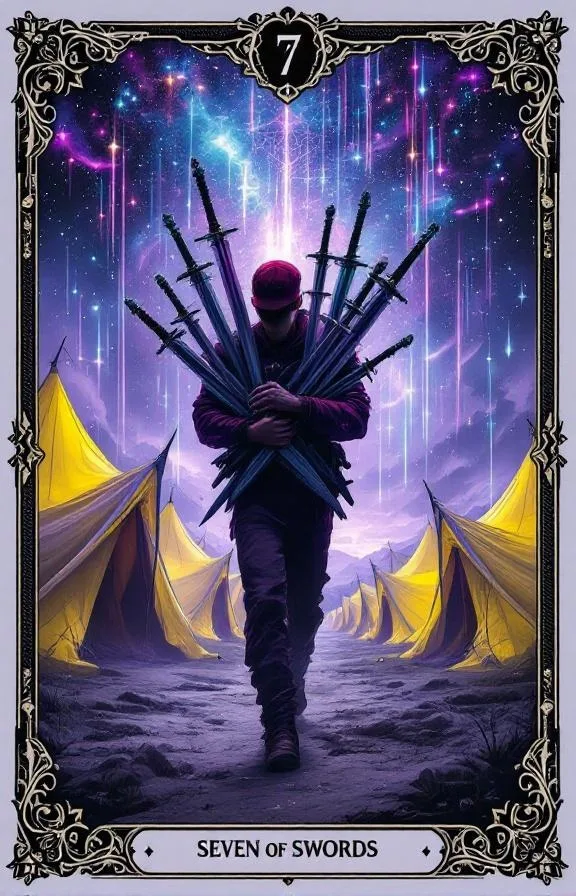
Estamos probando diferentes estilos artísticos — las cartas pueden variar. ¡Tu opinión nos ayuda!
Siete de Espadas — Significado de la carta del tarot
(Seven of Swords)
Siete de Espadas — Significado al derecho
El Siete de Espadas muestra a una figura escabulléndose de un campamento con cinco espadas, mientras dos quedan atrás. Hay algo de hurto o engaño aquí, aunque no siempre malintencionado: puede ser escapar de una situación de manera encubierta o un movimiento estratégico que prefiere la astucia a la confrontación directa. Pregúntate si tu estrategia está alineada con tus valores.
Siete de Espadas — Significado invertido
The Seven of Swords reversed often signals the moment when deception is exposed — when the figure who was tiptoeing away drops the swords with a clatter and everyone turns to look. Secrets come to light. Plans unravel. The strategy that seemed so clever in planning falls apart in execution. If you have been withholding truth from someone, this card warns that the window for voluntary honesty is closing; soon the truth will emerge on its own terms, which are rarely gentle. In a more internal reading, the reversed Seven can represent imposter syndrome — the persistent, anxious feeling that you are getting away with something you do not deserve. You may be genuinely qualified and still feel like a fraud, constantly looking over your shoulder waiting for someone to realize you do not belong. The card asks: what would change if you stopped performing competence and simply trusted that you earned your place? Alternatively, this reversal can signal a conscious decision to come clean — to stop the scheme, return what was taken, confess what was hidden. This is the moment of moral course-correction, and while it is uncomfortable, it is vastly preferable to the alternative of being caught. Voluntary honesty preserves dignity; forced disclosure destroys it.
Palabras clave
Significado al derecho
- engaño
- sigilo
- estrategia astuta
Significado invertido
- confesar
- ser descubierto
- reconocer el engaño
Simbolismo visual
Figura escabulléndose con cinco espadas, campamento al fondo, expresión furtiva; sigilo, engaño, estrategia.
Simbolismo clásico Rider-Waite — cada elemento visual lleva un significado psicológico más profundo.
Amor y Relaciones
The Seven of Swords in a love reading is the card that makes your stomach drop — because it speaks directly to deception, hidden agendas, and the particular brand of emotional dishonesty that corrodes trust from the inside. Someone in this dynamic is not being fully transparent, and that someone might be you. At its most direct, the Seven of Swords can indicate infidelity — physical or emotional. Secret conversations, deleted messages, a second life maintained behind a partner's back. But the card's scope extends beyond obvious betrayal to the subtler forms of romantic dishonesty: presenting a carefully curated version of yourself to avoid vulnerability, withholding important information that would change the relationship dynamic if shared, maintaining backup options while claiming exclusivity, or strategically revealing only the parts of your past that support the narrative you want your partner to believe. For singles, the Seven of Swords warns against pursuing connections through manipulation rather than authenticity. If you find yourself calculating how to present yourself rather than simply being yourself, this card asks why genuine connection frightens you more than the performance of connection. The figure sneaking away from camp is carrying stolen swords, not earned ones — and relationships built on stolen trust have foundations made of sand. In existing relationships, this card calls for a courageous reckoning. What are you hiding, and why? What do you suspect your partner is hiding? The Seven of Swords does not automatically end relationships, but it demands that the hidden become visible. Secrets maintained to protect your partner are usually actually maintained to protect yourself from your partner's justified reaction. The two swords left behind represent what truth would cost — and also what continuing the deception will eventually cost, which is almost always more. The redemptive reading of this card is the decision to stop sneaking. Put down the swords. Walk back into the camp. The vulnerability of honesty terrifies more than the risk of being caught — but it is the only foundation on which lasting love can be built.
Carrera y Finanzas
The Seven of Swords in a career reading is the card of strategic maneuvering in the professional arena — and it carries both a warning and, in certain contexts, a validation. At its most cautionary, it represents the colleague who takes credit for your ideas, the competitor who uses inside information against you, or your own temptation to cut corners, fudge numbers, or take shortcuts that would not survive scrutiny. The figure sneaking away from camp is hoping nobody notices, but the backward glance reveals the truth: they already know this will not end well. If you recognize yourself in the sneaking figure, the Seven of Swords asks you to calculate the full cost of the shortcut. Professional reputations are built over years and destroyed in moments. The clever workaround that saves you a week of work may cost you a decade of trust. The data you massaged to look better will eventually meet reality, and reality always wins. Whatever you are tempted to take — credit, resources, proprietary information — ask yourself whether you would be comfortable if every detail of how you obtained it were made public. If you suspect someone else is the figure with the swords — if you sense that a colleague is undermining you, a partner is diverting resources, or a competitor is using unfair tactics — this card validates your instinct and advises documentation over confrontation, at least initially. Build your paper trail. Protect your intellectual property. Share sensitive information on a need-to-know basis until you understand who in your professional circle is trustworthy and who is operating with hidden agendas. The constructive reading of this card in career contexts involves strategic independence — the ability to think differently from the group, to develop plans that do not require consensus, or to make moves that prioritize your own professional interests in environments that do not reward loyalty. Sometimes the smartest career move is the one nobody sees coming, executed with precision and without apology. The difference between the shadow and the light reading of this card is transparency: cunning in service of legitimate goals is strategy; cunning in service of deception is sabotage. The two swords left behind in career readings often represent opportunities or resources you had to leave on the table. You cannot optimize for everything simultaneously. The Seven asks: did you take the right swords?
Siete de Espadas — ¿Sí o No?
No — The Seven of Swords warns of deception, hidden motives, and shortcuts that backfire. Something in this situation is not what it appears to be. Proceed with extreme caution or reconsider entirely.
Sí o No — Análisis detallado
Siete de Espadas sí o no — respuesta del tarot
Como sentimientos — Análisis profundo
Siete de Espadas como sentimientos — qué significa en una lectura
Como persona — análisis profundo
El Siete de Espadas como persona — cómo es realmente
Consejo — análisis profundo
Siete de Espadas como consejo — qué te dice esta carta
Preguntas frecuentes
- What does the Seven of Swords mean in a love reading?
- The Seven of Swords in love warns of dishonesty — hidden feelings, secret contacts, or someone not being fully transparent. It calls for examining what is being concealed in the relationship and addressing it directly.
- Is the Seven of Swords a yes or no card?
- The Seven of Swords is a No card. It signals deception, hidden agendas, and strategies that will ultimately fail. Something is not as it seems, and proceeding without full information is risky.
- What does the Seven of Swords reversed mean?
- The Seven of Swords reversed can mean secrets coming to light, a guilty conscience leading to confession, or the failure of a deceptive plan. It can also signal a decision to finally come clean and choose honesty over strategy.
Más de este palo


Revisado por Tomasz Fiedoruk
Tomasz Fiedoruk es el fundador de aimag.me y autor del blog The Modern Mirror. Investigador independiente en psicología junguiana y sistemas simbólicos, explora cómo la tecnología de IA puede servir como herramienta de reflexión estructurada a través de la imaginería arquetípica.
Más sobre el autorLo que revelan 1.370 lecturas
Entre 1370 lecturas en aimag.me, Seven of Swords aparece cerca de la base estadística del 1.28% por carta. El motor aleatorio trata cada carta por igual; el significado lo encuentras tú.
En nuestro conjunto de datos, el 78,5% de todas las lecturas usa la simple tirada Pasado-Presente-Futuro. Tres cartas. Nada más. La gente quiere claridad, no complejidad.
El martes es el día pico del tarot en nuestros datos — +37% sobre la media semanal. No es la ansiedad del lunes, ni la reflexión del domingo. Martes: cuando la realidad de la semana ya se ha instalado.
Datos actualizados: mayo 2026 · Methodology
¿Listo para mirarte al espejo?
Comienza una lectura gratuita y descubre lo que las cartas reflejan sobre ti.
Comenzar una lectura