Jung proposed that the human psyche processes experience through four primary functions: Feeling, Intuition, Thinking, and Sensation. Everyone has a dominant function — the mode of perception and judgment they lean on hardest — and one or more inferior functions that stay underdeveloped and occasionally cause trouble.
What catches your attention, once you look closely, is that tarot's four suits encode these same four dimensions with striking coherence.
This is not coincidence in a mystical sense. It reflects the consistent way human cultures have carved up the fundamental domains of experience. Once you see the mapping, the minor arcana stop being 56 individual cards to memorize and become a four-dimensional map of inner and outer life.
In short: Tarot's four suits map directly onto Jung's four psychological functions: Cups correspond to Feeling (emotion, relationships, values), Wands to Intuition (vision, creative fire, possibility), Swords to Thinking (analysis, truth, mental clarity), and Pentacles to Sensation (material reality, the body, practical resources). The suit that dominates your readings reveals where your life energy concentrates, and the suit that is absent points to what you are leaving unattended.
The framework: Jung's four functions
Before the suits, a brief grounding in the Jungian functions.
 Jung laid out his theory of psychological types in 1921: four fundamental modes through which the psyche processes experience. These were not personality traits in the modern sense — they were cognitive functions that determine how a person perceives reality and reaches judgments about it.
Feeling — Not emotion, but value judgment. Feeling assesses "what matters" and "what is meaningful." It works through personal values, relational attunement, and the weighing of significance. Feeling-dominant people orient themselves by asking "does this align with what I care about?"
Intuition — The perception of possibilities, patterns, and potential. It works through images, hunches, and the recognition of what might be rather than what is. Intuition-dominant people see the future possibility inside every present situation. Cognitive psychology now calls this pattern recognition — rapid processing of cues without deliberate analysis.
Thinking — Logical analysis, cause-and-effect reasoning, and organizing experience into coherent frameworks. Thinking-dominant people work through "how does this function?" and "what follows from what?"
Sensation — Sensory perception of what is actually, concretely present. Sensation grounds experience in physical reality — what can be seen, touched, measured, and managed. Sensation-dominant people trust what is directly in front of them.
Jung observed that your dominant function tends to double as your identity, while the inferior function — the least developed one — tends to produce blind spots, unconscious reactions, and occasional destabilization. His concept of the psychological shadow applies here: the parts of yourself you have not integrated act out in unpredictable ways.
The axes: Thinking-Feeling and Sensation-Intuition
Jung organized the four functions into two pairs of opposites. Thinking and Feeling are both judging functions — they both reach conclusions, but through different methods. You cannot fully engage both at the same time. Sensation and Intuition are both perceiving functions — they both absorb information, but through opposite channels.
This means that when your Thinking function runs at full capacity, your Feeling function gets suppressed, and the reverse. When you are immersed in concrete sensory detail (Sensation), your intuitive pattern-recognition (Intuition) takes a back seat.
This is not a design flaw. It is how the psyche works efficiently. But it has direct consequences for how you engage with tarot: the suits you gravitate toward, the suits that unsettle you, and the suits that rarely appear in your readings all become meaningful data about where your psychic energy naturally flows — and where it does not.
The historical and Hermetic roots of the suit system
The four suits did not appear out of nowhere. Before exploring each suit-function match, it is worth noting that the elemental framework underneath the suits has deep roots in Hermetic philosophy and classical Western thought.
 The four classical elements — Fire, Water, Air, Earth — were understood not just as physical substances but as fundamental principles of nature and psyche. This framework entered medieval and Renaissance thought through Aristotelian philosophy and Neoplatonic synthesis, and was picked up by the Hermetic and Rosicrucian traditions that shaped the design of esoteric tarot decks in the 18th and 19th centuries.
Fire (Wands) was the principle of will, transformation, and ascending energy. Water (Cups) was reception, feeling, and the dissolving of boundaries. Air (Swords) was distinction, movement, and the separating power of the mind. Earth (Pentacles) was stability, manifestation, and sustained form.
When Jung was building his theory of functions, he was not drawing directly from this tradition — but the convergence is hard to ignore. The consistent mapping across widely separated cultural systems suggests these four categories reflect something structurally real about how humans organize experience.
The four suits and their correspondence
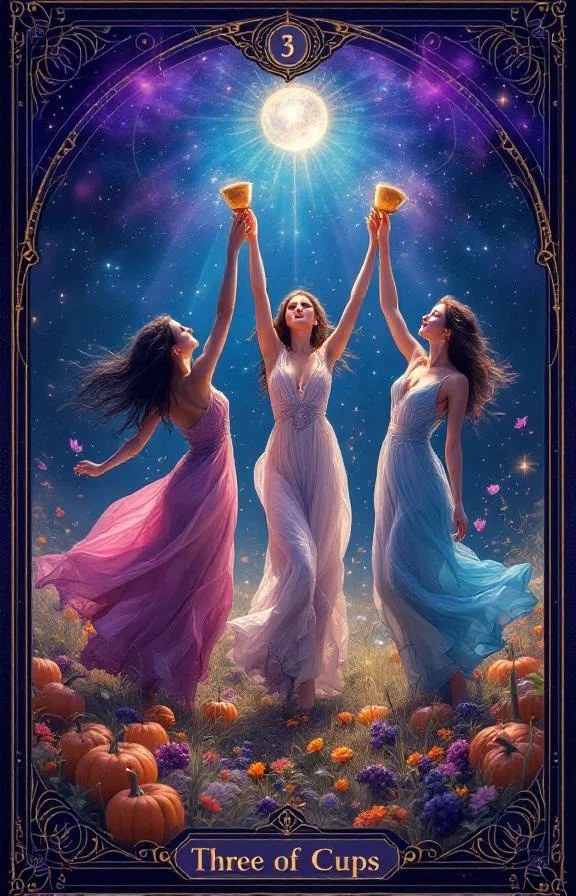
Cups — Feeling
 The suit of Cups governs emotion, relationship, intimacy, and the interior life. Water is its traditional element: fluid, receptive, capable of reflecting and of concealing.
Cups correspond directly to Jung's Feeling function. Where Feeling assesses value and meaning through emotional resonance, Cups cards ask: What do I feel? What do I love? What matters to me? How am I connecting — or failing to connect — with others and with myself?
Cups cards span the full emotional range — the ecstasy of the Ace of Cups, the grief of the Five of Cups, the wishful fantasy of the Seven of Cups, the integrative wisdom of the King and Queen.
In attachment theory terms, the Cups suit covers the full spectrum of bonding patterns — secure connection, anxious clinging, avoidant withdrawal, and the messy oscillations of disorganized attachment. Which Cups cards show up and which stay absent can illuminate the quality of your current relational life.
The Cups progression
The arc of the Cups tells a developmental story. The Ace of Cups is pure emotional potential — the capacity for deep feeling before experience conditions it. The Two of Cups (partnership, mutual recognition) introduces the encounter with another person. By the Five of Cups (grief, loss), the suit confronts the cost of caring. The Ten of Cups (fulfillment, community) represents emotional experience integrated into a rich relational life.
This arc tracks what developmental psychologists describe as emotional maturity: moving from raw feeling through relational complexity toward hard-earned wisdom.
If Cups are consistently absent from your readings: Jungian analysis would suggest the Feeling function is underrepresented — that you are navigating mainly through other modes and leaving emotional content unattended. Worth asking whether emotional life is getting bypassed in how you frame your questions.
If Cups consistently dominate: You may be engaging most readily with the emotional and relational dimensions of your situations. That can be a strength when it means high relational intelligence — and a pattern worth examining when it means difficulty shifting from feeling into analysis or action.
Wands — Intuition
The suit of Wands governs passion, creative fire, vision, and the energy of possibility in motion. Fire is its element: dynamic, consuming, capable of illumination and destruction.
Wands map to Jung's Intuition function. Where Intuition perceives possibilities and patterns, Wands cards ask: What am I drawn toward? What vision is driving me? What creative energy is available? Where is my passion pulling me, and is it directed or scattered?
The Wands suit has a particular restlessness — its characters are often in motion, in conflict, in pursuit. The Knight of Wands is the archetype of the passionate, headlong charge toward the horizon. The King of Wands has learned to channel that fire with intention instead of impulse.
In psychological terms, Wands energy connects to what Csikszentmihalyi described as flow — fully absorbed, intrinsically motivated engagement with challenging activity. When Wands energy is present and channeled, creative fire does its best work. When Wands energy scatters or gets blocked, the result is the frustrated restlessness visible in the suit's harder cards.
The shadow of Wands
The Intuition function has a well-known dark side: a tendency toward inflation — the feeling that possibilities are limitless, that the next project will be the one, that the grass is always greener in some field you have not reached yet. Jung noted that underdeveloped Sensation (Intuition's opposite) creates problems with follow-through, material constraint, and the patience required to cultivate concrete results.
This tension shows up clearly in the Wands suit: the contrast between the King of Wands (intuition mastered) and the scattered energy of the Seven of Wands (defensive and exhausted) maps the developmental journey the function requires.
If Wands frequently appear in your readings: You may be in a particularly generative or activating period. Or Intuition is your default mode — which serves you in creative and entrepreneurial work and challenges you when persistence or concrete follow-through is what the situation needs.
If Wands are consistently absent: There may be a dimming of creative fire or vision — a stretch where possibility feels shut down. Worth asking directly: "What would reignite my energy or interest right now?"
Swords — Thinking
The suit of Swords governs intellect, analysis, conflict, and the domain of thought and communication. Air is its element: invisible, pervasive, capable of gentle breeze and devastating force.
Swords map to Jung's Thinking function. Where Thinking analyzes, distinguishes, and organizes, Swords cards ask: What is true here? What decision needs to be made without flinching? Where am I in conflict — with circumstances, with others, or with myself? What story am I telling myself, and is it accurate?
Swords is the suit that makes people uncomfortable. It holds many of the deck's hardest cards — the Ten of Swords (defeat), the Three of Swords (heartbreak), the Nine of Swords (anxiety and rumination). But the suit also holds cards of piercing clarity: the Ace of Swords slices through confusion, and the Justice card (often associated with this suit's energy) demands honest accounting.
The discomfort is a Jungian clue: clear-eyed analysis of reality is the function people avoid most when its conclusions hurt. The Swords suit asks you to see what is, not what you wish were true.
Cognitive distortions and the Swords suit
The Swords suit is the tarot's most direct exploration of what cognitive behavioral psychology calls cognitive distortions — the habitual patterns of inaccurate thinking that generate unnecessary suffering.
The Nine of Swords (anxiety, rumination, catastrophizing) shows the paralysis of thought turned against itself — what CBT identifies as catastrophizing and threat overestimation. The Three of Swords (heartbreak, piercing truth) shows the cost of a thought that cannot be unfelt once fully faced. The Eight of Swords (restriction, self-imposed limitation) maps onto what Aaron Beck called cognitive traps — mental patterns that constrain you not through external circumstance but through how you interpret it.
When the Thinking function operates cleanly, it cuts through these distortions. The Ace of Swords represents that capacity at its sharpest: the sudden, clarifying insight that reorganizes everything. But when Thinking turns on itself — in rumination, self-attack, or obsessive analysis of the unanswerable — it generates the suffering depicted in the suit's darker cards.
If Swords frequently appear: You may be in a period that demands honest analysis and hard decisions. Or you are Thinking-dominant by nature — you default to clarity and logic. Either way, the question is whether that intellectual sharpness is balanced by the emotional intelligence of Cups.
If Swords are consistently absent: There may be a pattern of ducking difficult truths or avoiding the analytical confrontation of complicated situations. Worth asking: "What am I refusing to think clearly about?"
Pentacles — Sensation
The suit of Pentacles governs material life, the body, resources, work, and the physical world. Earth is its element: solid, sustaining, slow-moving, enduring.
Pentacles map to Jung's Sensation function. Where Sensation perceives what is actually present in concrete reality, Pentacles cards ask: What are my real resources? What is the state of my physical and material world? What needs practical, sustained attention? What is being built slowly, and what is that building costing or providing?
Pentacles is the suit most connected to time — not the time of Wands's vision or Swords's decision, but the long time of steady cultivation. The Ace of Pentacles is a seed. The Ten of Pentacles is a multigenerational legacy. The work between those two cards is the suit's subject matter.
The body as ground
One dimension of the Pentacles suit that gets underemphasized is its connection to embodiment — not just material resources in the financial sense, but the body as the primary ground of experience. The Sensation function, in Jung's framework, is the one most directly linked to somatic awareness.
Research in somatic psychology and interoception — the brain's perception of internal body states — has established that emotional and cognitive processing is deeply intertwined with bodily signals. When we ignore the Pentacles dimension (the material, the somatic, the physical), we tend to lose contact with the body's signals — often the earliest indicators of how we are actually doing.
The Pentacles suit, at its most fundamental, asks: are you inhabiting your body? Are you in contact with your physical reality, or are you living mainly in the abstract registers of emotion (Cups), vision (Wands), or analysis (Swords)?
If Pentacles frequently appear: Attention is being drawn to the material and practical dimensions of your situation — a resource question, a health concern, an issue about sustainable work, or an invitation to attend to something concrete that has been neglected while you focused on more abstract concerns.
If Pentacles are consistently absent: The physical and material may be running on autopilot while attention flows to emotional, creative, or analytical territory. Worth asking: what is happening in my body and in my material circumstances that deserves more direct attention?
Which suit dominates your readings? A self-assessment
Before applying this framework, pause for a structured self-check. This is not a diagnostic — it is an invitation to notice.
Reflection exercise:
Think back over the last month or season. Where has most of your mental and emotional energy gone?
- Relationships, feelings, and the question of what matters? (Cups/Feeling)
- Ideas, possibilities, projects, and what might become? (Wands/Intuition)
- Decisions, analysis, conflict, and the need to see clearly? (Swords/Thinking)
- Practical management, health, resources, and steady work? (Pentacles/Sensation)
Notice which of those felt immediately recognizable and which felt foreign. The familiar one is likely your current dominant register. The foreign one is likely where your attention has been thinnest — and potentially where there is something worth looking at.
This is not about labeling yourself a "Cups person" or a "Swords person." It is about noticing where your current life energy is concentrated — a question that shifts with seasons, circumstances, and the natural rhythms of growth.
The inferior function and what it reveals
Jung's concept of the inferior function deserves particular attention for tarot work.
The inferior function is not simply underdeveloped — it is the function most distant from conscious identity, and therefore most tied to the unconscious. When activated, it tends to erupt with disproportionate emotional force: the Thinking-dominant person who dissolves into irrational feeling under stress. The Intuition-dominant person who becomes obsessively fixated on concrete details when anxiety spikes. The Feeling-dominant person who turns unexpectedly cold and surgical in conflict.
In tarot terms, the suit tied to your inferior function is likely the one you find most uncomfortable, hardest to interpret, or most eager to explain away when it shows up in readings.
Common inferior function patterns:
- Thinking-dominant people often have inferior Feeling — the Cups suit may feel evasive or embarrassing
- Feeling-dominant people often have inferior Thinking — the Swords suit may feel harsh, threatening, or "negative"
- Intuition-dominant people often have inferior Sensation — the Pentacles suit may feel boring, mundane, or irrelevant
- Sensation-dominant people often have inferior Intuition — the Wands suit may feel impractical, unrealistic, or anxiety-producing
When a suit consistently makes you uncomfortable, that discomfort is not noise — it is a signal pointing toward underdeveloped psychic territory. One of the most productive uses of tarot is to deliberately seek out that uncomfortable suit and sit with it long enough to hear what it is actually saying.
Using this framework in your own readings
The most useful application of the four-function model is not to label yourself but to track which suits are most and least present in your readings over time.
A month of readings heavy on Swords and empty of Cups might signal an extended stretch of analytical engagement with insufficient emotional attention. A spread loaded with Pentacles might reflect a period of practical reckoning after long phases of vision (Wands) or emotional processing (Cups).
Practical application — the Four-Suit Monthly Review:
At the end of a month, review your readings. Count which suits appeared most and which least.
- The dominant suit reflects where your life energy has been concentrated.
- The absent suit reflects what has been left unattended.
- Ask: does this pattern match how you have actually been living? What would a more balanced distribution suggest about what deserves attention?
The full card library at aimag.me/cards gives detailed interpretations for each suit's arc, including how individual cards within a suit relate to each other and to the suit's thematic territory.
When you begin a reading at aimag.me/reading, you can experiment with suit-specific questions: "What does the Cups energy of my current situation look like?" or "Where is Pentacles energy asking for my attention?" This gives you a four-dimensional view of any situation rather than a single symbolic snapshot.
The functions in relationship: balance and integration
Jung's framework is not just a typology of strengths and gaps. Its deeper purpose is developmental: the goal of what Jung called individuation — the lifelong process of becoming more fully yourself — involves gradually integrating all four functions, including the inferior and auxiliary ones.
This does not mean becoming uniformly mediocre at everything. It means developing enough conscious relationship with each function that it stops acting out unconsciously and becomes something you can access on purpose when the situation demands it.
The tarot suits offer a practical map for this work. Over years of reflective practice, someone who starts as clearly Feeling-dominant may develop enough relationship with Swords (Thinking) to see clearly through their emotional valuing. A Thinking-dominant person may learn to honor the Cups register without dismissing it as sentimentality.
The cards that appear in your readings are never arbitrary. They reflect the psychic territory your life is crossing right now. The suits that stay absent are often the ones you have not yet developed the language to hear.
You move through all four functions, all four suits, all four dimensions of experience. The question is not which one you are — it is which one is overdeveloped, which is underdeveloped, and what balance you need right now.
Explore your own suit patterns. Start a reading at aimag.me/reading and see which suits come up most consistently — the answer often reveals where your current life energy is concentrated.
Related Reading
- The complete suit of Cups: meaning, psychology, and progression — a deep dive into the Feeling function's 14 cards and their emotional arc
- The complete suit of Wands: meaning, passion, and creative fire — the Intuition function in full: from Ace spark to King's mastery
- The complete suit of Swords: meaning, clarity, and mental life — how the Thinking function plays out across conflict, clarity, and cognitive distortion
- The complete suit of Pentacles: meaning, material life, and the body — the Sensation function's relationship to resources, work, and embodiment
- Major Arcana vs Minor Arcana: what's the difference? — when the deep archetypal currents of the Major Arcana speak versus everyday suit dynamics