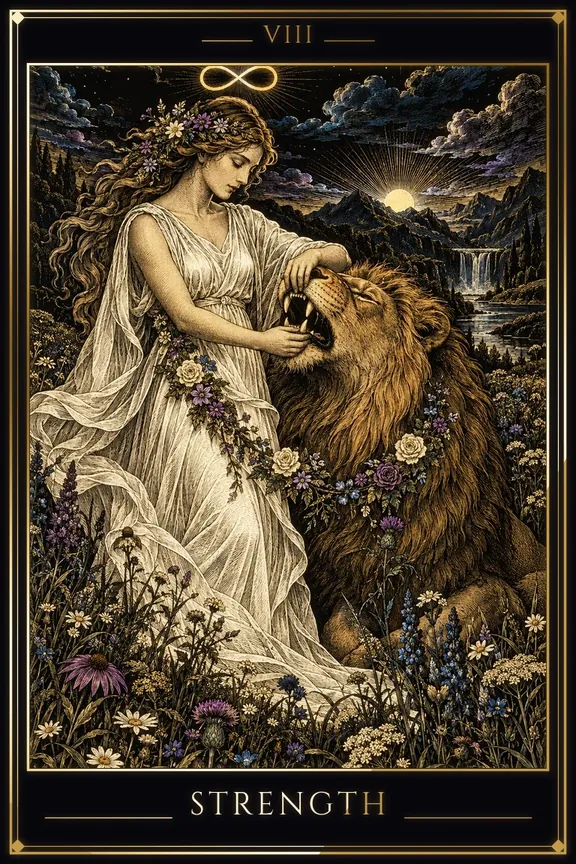
Pick up a tarot deck and you are holding seventy-eight cards that split into two groups — twenty-two that feel heavy and fifty-six that feel specific. That split is not random. It reflects something fundamental about how people experience life: some things are capital-letter Events, and some things are Tuesday. Both matter. Getting clear on the difference between Major and Minor Arcana is not just vocabulary — it is the key to reading any spread with depth instead of confusion.
In short: The 22 Major Arcana cards represent deep archetypal life themes like identity, transformation, and freedom, mapping onto Jung's universal psychological patterns. The 56 Minor Arcana cards cover everyday situations across four domains: emotions (Cups), material life (Pentacles), thinking (Swords), and energy (Wands). In a reading, Major cards signal something significant is shifting; Minor cards tell you specifically where and how.
What "arcana" actually means
The word arcana comes from the Latin arcanum, meaning secret or mystery. Not secret in the gossip sense, but in the older sense — something that requires lived experience to understand. You cannot truly grasp grief until you have grieved. You cannot understand parenthood until a small human who will not sleep is your responsibility.
This etymology matters because it sets the tone. Tarot cards are not predicting your future. They are pointing at things you already know but have not consciously organized. The "secrets" are your own. The cards are the filing system.
The distinction between Major and Minor Arcana is really a distinction between two kinds of inner knowledge: the deep archetypal patterns shaping who you are becoming, and the everyday situations where those patterns show up in practical form.
The 22 Major Arcana: archetypal life themes
The Major Arcana contains twenty-two cards, numbered from 0 (The Fool) to 21 (The World). Each represents a fundamental human experience — not a specific event, but a psychological territory that every person moves through at some point.
Jung spent much of his career developing the concept of archetypes — universal patterns that appear across cultures, myths, and individual psyches. The Shadow (the parts of yourself you reject), the Anima/Animus (the inner counterpart to your conscious gender identity), the Self (the integrated totality you are working toward). The Major Arcana maps directly onto this framework. The Empress is the archetype of nurturing abundance. The Hermit is deliberate solitude and inner seeking. Death is the necessary ending that precedes transformation.
This overlap is not a coincidence. The tarot's Major Arcana evolved over centuries of European esoteric tradition, drawing on the same mythological and psychological substrates Jung was studying. They are parallel maps of the same territory.
When a Major Arcana card appears in a reading, it signals something significant — not necessarily dramatic, but psychologically weighty. You are not dealing with "what happened at work today." You are dealing with a fundamental pattern: how you relate to authority (The Emperor), how you handle the tension between freedom and commitment (The Lovers), what happens when the structures you built stop serving you (The Tower).
The Fool's progression: a map of becoming
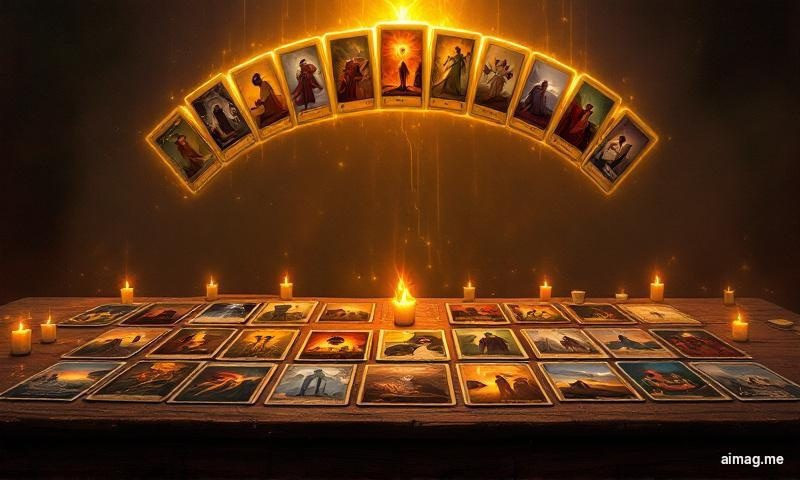
One of the most useful ways to understand the Major Arcana is as a sequence — what tarot practitioners call The Fool's progression. Card 0, The Fool, begins in open, unformed potential. Card 21, The World, arrives at integration and wholeness. Everything between is the process of becoming.
This mirrors what Jung called individuation — the lifelong process of integrating the various parts of your psyche into a coherent, authentic whole. The Fool starts unconscious. The Magician discovers personal will. The High Priestess encounters the unconscious. The Wheel of Fortune teaches that not everything can be controlled. The Tower shows that some structures must fall. The Star reveals how to hope after devastation.
You do not move through this sequence once. You cycle through it repeatedly, at different levels of depth, across different areas of your life. You might be at The Hermit stage in your career (needing solitude and reflection) while simultaneously at The Lovers stage in your relationship (facing a genuine choice about commitment). The Major Arcana is not a line. It is a spiral.
Developmental psychology has proposed something similar — that humans pass through distinct stages, each with its own central conflict to resolve before genuine growth can continue. Trust versus mistrust. Autonomy versus shame. Identity versus role confusion. The Major Arcana offers a parallel map rendered in symbolic images rather than clinical language, with the added benefit of being non-linear — you can revisit any stage when life demands it.
The 56 Minor Arcana: the texture of daily life
If the Major Arcana is about who you are becoming, the Minor Arcana is about what you are doing on any given Wednesday. These fifty-six cards split into four suits — Cups, Pentacles, Swords, and Wands — each covering a different domain of everyday experience.
Cups deal with emotions, relationships, love, intuition, and your inner emotional world. When Cups dominate a reading, the situation is fundamentally about how you feel — even if you think it is about something else.
Pentacles deal with material reality — money, career, health, physical environment, practical concerns. Pentacles ground the reading in tangible outcomes and real-world logistics.
Swords deal with the mind — thoughts, beliefs, communication, conflict, decision-making. Swords reveal your mental patterns, including the ones that are cutting you rather than cutting through confusion.
Wands deal with energy, passion, creativity, ambition, and drive. Wands point to what motivates you, what inspires you, and what is draining your fire.
Each suit runs from Ace (pure potential in that domain) through Ten (the fullest expression of that energy), plus four court cards — Page, Knight, Queen, and King — representing different levels of maturity or personality aspects within each domain.
The Minor Arcana is where readings get specific. A Major Arcana card might tell you that you are in a period of fundamental transformation. The Minor cards around it tell you how — through an emotional reckoning (Cups), a financial shift (Pentacles), a change in thinking (Swords), or a new creative direction (Wands).
How they work together in a reading
Here is where the distinction turns practical. When you lay out a spread and look at the cards, the ratio of Major to Minor tells you something important about the nature of your situation before you even read individual meanings.
A reading that is mostly Major Arcana means you are dealing with big, archetypal forces. This is not a minor adjustment. Something fundamental is shifting — your identity, your core values, your relationship to power or freedom or death or love. These readings tend to feel heavy, and they should. They point at the deep structure of your life, not the surface details.
A reading that is mostly Minor Arcana means the situation is practical, manageable, and about daily choices rather than existential shifts. This is not less important — it is different. The Minor Arcana tells you that you have agency here, that the tools you need are ordinary ones: a conversation, a budget adjustment, a boundary, a creative project. You are not being swept along by archetypal currents. You are navigating regular life with regular resources.
A reading that mixes both — the most common result — shows how the big themes are manifesting in specific situations. You might draw Death (Major) alongside the Three of Pentacles (Minor), which tells you a fundamental ending or transformation (Death) is playing out through your working relationships or collaborative projects (Three of Pentacles). The Major card gives you the theme. The Minor cards give you the setting.
What it means when Major Arcana cards keep appearing
If you do regular readings and notice Major Arcana cards showing up disproportionately, pay attention. This pattern tells you that you are in a period of significant psychological development — that the events in your life right now are not just events, but connect to deeper patterns of growth, crisis, or transformation.
Nothing to be alarmed about. Individuation — becoming more fully yourself — is the central task of the second half of life, and it naturally involves encounters with archetypal forces. But it does mean the usual advice ("just do X") might not cut it. When Major cards dominate, the situation is asking you to grow, not just to cope.
Conversely, readings that stay consistently Minor Arcana are not a sign your life is "boring" or spiritually shallow. They mean you are in a practical phase — implementing, building, relating, managing. These phases are necessary. Not every month needs to be a Major Arcana drama. Sometimes the most important work is showing up to the routine and handling it well.
Common misconceptions
"Major Arcana cards are good, Minor Arcana cards are bad." No. Both groups contain the full spectrum. The Sun (Major) is radiant, but The Tower (Major) is devastating. The Ace of Cups (Minor) is beautiful, but the Ten of Swords (Minor) is brutal. Major does not mean positive. It means significant.
"Minor Arcana cards do not matter as much." They matter differently. If the Major Arcana says you are going through a death-and-rebirth process, the Minor Arcana tells you whether that process is happening through your finances (Pentacles), your emotions (Cups), your beliefs (Swords), or your creative life (Wands). Without Minor cards, you would know something big is happening but have no idea where to look.
"You can skip the Minor Arcana and just read with the Major." Technically, yes. Some readers do this for quick thematic readings. But you lose all specificity. It is like looking at a map that shows countries but not cities. You know you are in France, but not whether you are in Paris or a vineyard in Provence.
Practical exercise: sorting and seeing
If you own a deck, try this. Separate all seventy-eight cards into two piles: Major and Minor. Spread the Major Arcana in order from 0 to 21. Look at the progression. Notice how The Fool's open-eyed innocence gives way to The Magician's focused will, then The High Priestess's receptive wisdom, and so on through to The World's integration. This is the story of a life — or of a single transformation within a life.
Now look at the Minor Arcana. Sort them by suit. Each suit tells its own mini-story from Ace to Ten. The Cups move from the overflowing potential of the Ace through the emotional complications of the Five and Six, to the deep satisfaction of the Nine and the shared joy of the Ten. The Swords move from the mental clarity of the Ace through the agonizing choices of the Two and Three, to the collapse of the Ten. Each suit is a complete arc.
For a comprehensive guide to reading all these cards together in practice, see our beginner's guide to reading tarot cards.
Why both matter equally
Maslow's hierarchy of needs (1943) offers a useful parallel. The base — food, shelter, safety — corresponds roughly to the Minor Arcana: practical, essential, daily. The peak — self-actualization — corresponds to the Major Arcana: the drive toward becoming fully who you are. But Maslow himself eventually revised his model to show these levels are not strictly sequential. You do not finish eating before you start seeking meaning. Both operate simultaneously.
Tarot works the same way. The Minor Arcana is not a lower form of the Major. They are two lenses on the same life. A solid reading uses both. A solid life lives in both. The question is never "which arcana matters more?" but "what is this particular moment asking of me — a deep reckoning, or a practical adjustment?" Usually, the answer is some of each.
Frequently asked questions
What does it mean if I only pull Major Arcana cards?
It tells you that you are in a period of intense psychological or life-stage development. Major Arcana cards point to archetypal themes rather than everyday logistics. If every card in your spread is Major, the reading is saying the situation involves fundamental aspects of who you are — not just what you should do. Not inherently good or bad, but the situation carries significant weight.
Can I do a reading with only the Major Arcana?
Yes, and some readers prefer this for quick thematic readings. A Major-only reading gives you broad strokes — the core psychological dynamics at play. But you lose the specificity Minor Arcana provides. Think of it as getting a diagnosis without a treatment plan. For most questions, a full seventy-eight card deck gives richer, more actionable insight.
Are court cards (Page, Knight, Queen, King) part of the Minor Arcana?
Yes. Each of the four suits has four court cards, making sixteen total within the fifty-six Minor Arcana. Court cards often represent people in your life, aspects of your own personality, or levels of maturity in handling a particular domain. A Page of Cups might be someone new to emotional openness; a King of Pentacles might be someone who has mastered practical, material stability.
Why are there exactly 22 Major Arcana cards?
The number 22 has significance in several esoteric traditions — it corresponds to the twenty-two letters of the Hebrew alphabet, which Kabbalistic tradition associates with pathways on the Tree of Life. But from a psychological perspective, the number matters less than the coverage: the twenty-two cards span the full range of fundamental human experiences, from innocent beginning (The Fool) to integrated completion (The World), with every major psychological challenge represented between them.