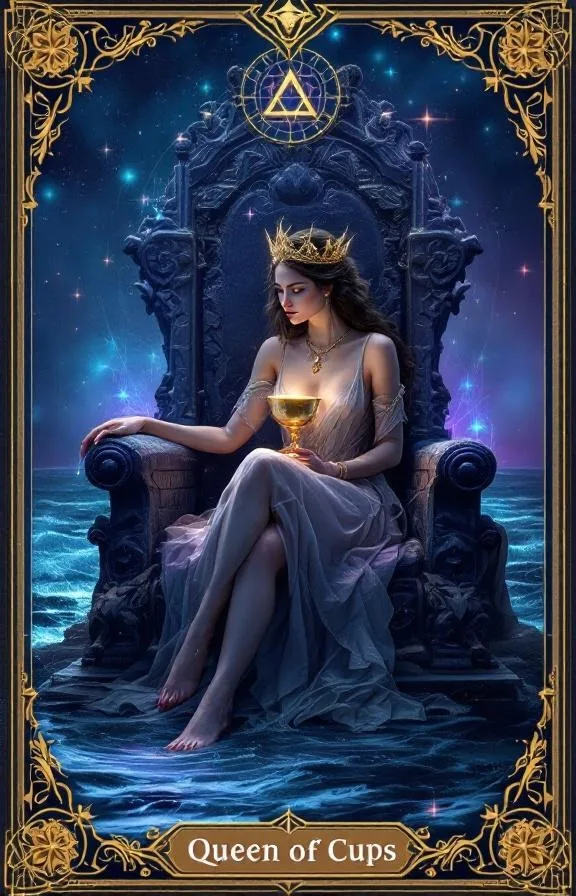
The major arcana is a sequence of 22 cards numbered 0 through 21. That much is simple. What makes these cards extraordinary is what they actually depict: a complete map of human psychological development compressed into images that have survived five centuries of cultural change. Not because they predict the future. Because they describe the interior architecture of a life — the crises, awakenings, destructions, and integrations that every person navigates between the first reckless step into the unknown and whatever wisdom waits on the other side.
In short: The 22 major arcana cards represent life's defining psychological passages — from innocence (The Fool) through crisis, transformation, and integration (The World). Unlike the minor arcana, which tracks daily events, these cards signal turning points that reshape who you are. Understanding their sequence as a developmental journey changes how you read every spread.
The Fool's Journey as developmental psychology
The traditional name for the major arcana's narrative arc is "The Fool's Journey" — the story of card 0, The Fool, moving through each subsequent archetype on the way to wholeness. It sounds mystical. It is actually developmental psychology wearing older clothes.
Erik Erikson mapped eight psychosocial stages from infancy to old age, each defined by a central crisis: trust versus mistrust, identity versus role confusion, integrity versus despair. The major arcana traces a remarkably similar trajectory. The Fool begins in undifferentiated potential. The Magician and High Priestess establish the first polarity of conscious and unconscious. The Empress and Emperor build parental structures. The sequence continues through identity formation, moral crisis, withdrawal, transformation, and eventual integration.
Joseph Campbell's hero's journey — departure, initiation, return — maps onto the same arc even more directly. Cards 0-7 roughly correspond to departure: leaving the known world, encountering mentors and challenges. Cards 8-14 are initiation: confronting inner forces, reversals, sacrifice, the slow work of integration. Cards 15-21 are the return: destruction of false structures, revelation, and the completion of the cycle.
None of this is coincidence. These patterns recur because they describe something real about how human beings develop. The major arcana did not invent these stages. It illustrated them.
All 22 major arcana cards
Each card below is a station on the developmental journey. Some descriptions are brief because the card's meaning is focused. Others require more space because the psychology is layered. That unevenness is the point — not every transformation takes the same amount of time or explanation.
0. The Fool
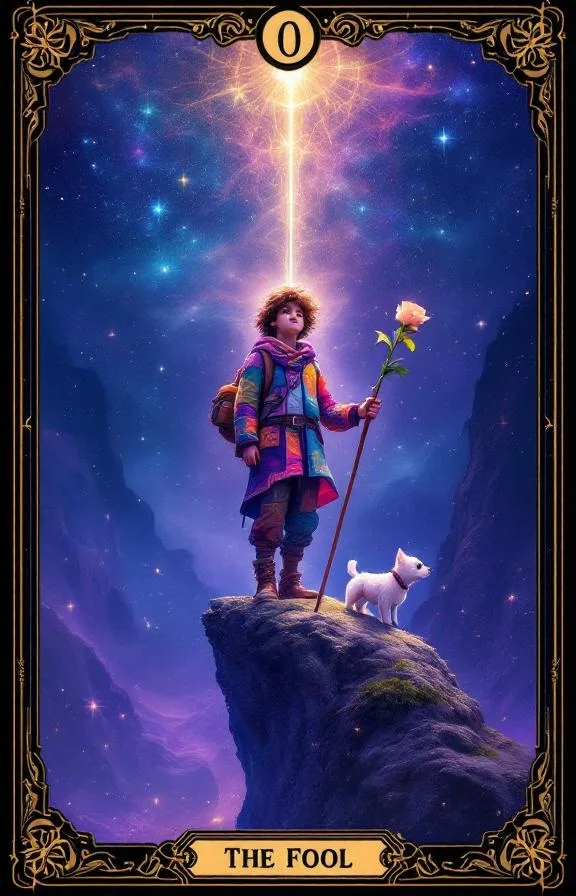
A figure steps off a cliff carrying a small pack, a white rose in one hand, a small dog at their heels. Zero. The number before numbers. The Fool represents pure potential unconditioned by experience — the psychological state before identity has solidified, before failure has taught caution, before the world has said "you can't." Every genuine beginning in life requires a return to this state: the willingness to not know what you are doing.
I. The Magician
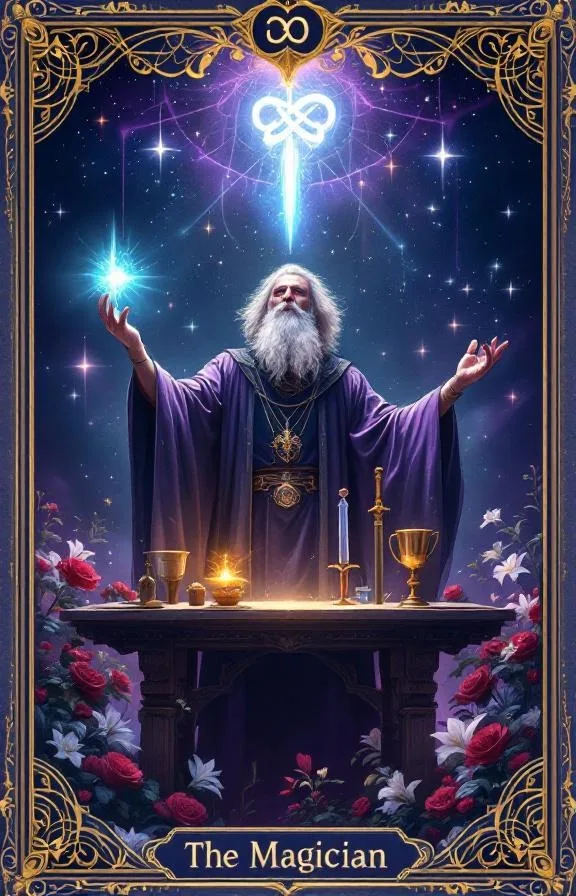
One hand points to the sky, the other to the earth. On the table before him: a cup, a sword, a wand, a pentacle — the four elements, the raw materials of reality. The Magician is the first act of conscious will. "I have resources and I will use them." This is agency in its purest form, the discovery that you can shape your circumstances rather than merely react to them. The danger here is equally clear: skill without wisdom becomes manipulation.
Full meaning of The Magician →
II. The High Priestess
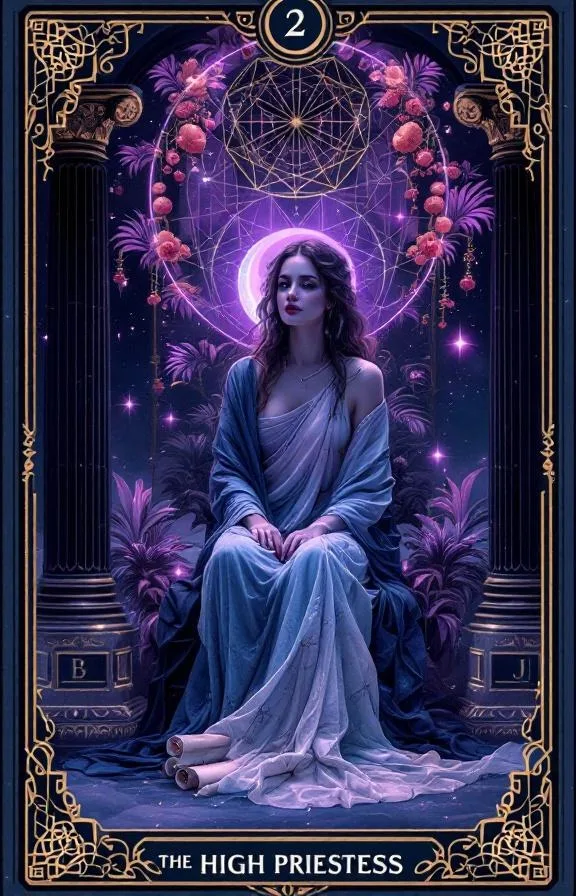
She sits between two pillars — one black, one white — a scroll partially concealed in her lap. Where the Magician acts, the High Priestess knows without acting. She represents the unconscious mind, intuition, and the knowledge that arrives before rational explanation catches up. In developmental terms, this is the recognition that not everything important can be grasped through effort. Some things must be received.
Full meaning of The High Priestess →
III. The Empress
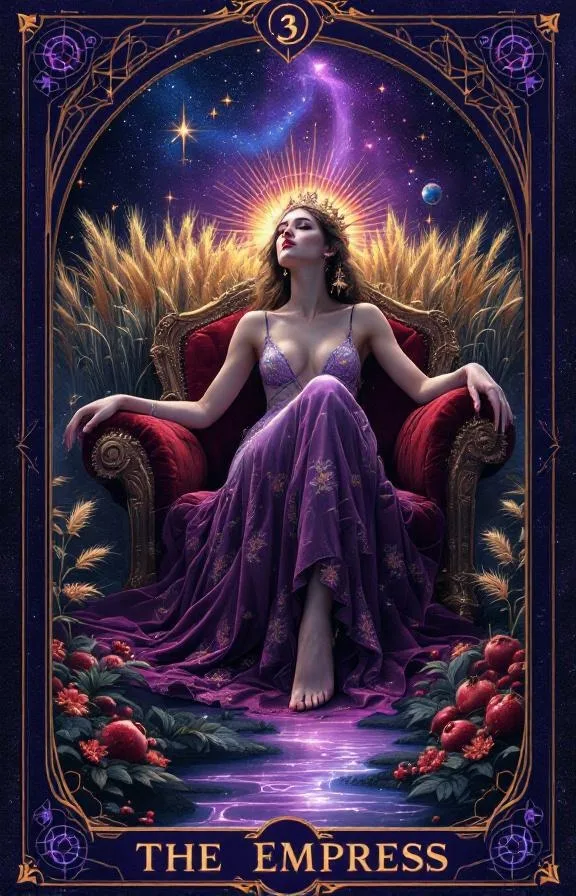
Abundance. Fertility. The sensory world in full bloom. The Empress is the archetype of nurturing creation — life that grows because conditions support it. Psychologically, she represents the capacity to create environments where things can thrive: relationships, projects, children, ideas. She does not force growth. She makes growth possible.
IV. The Emperor
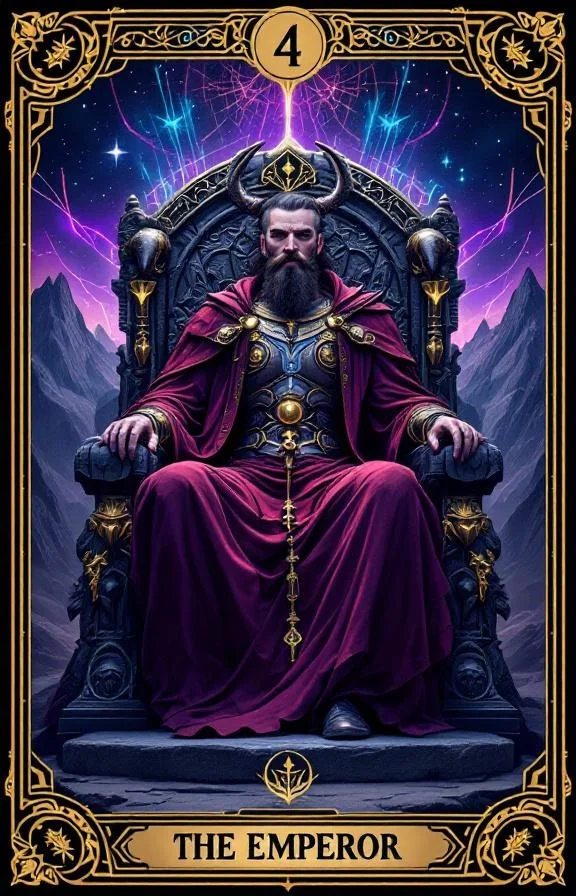
Structure, authority, order. Where the Empress creates through nourishment, the Emperor creates through organization. Boundaries, rules, hierarchies — the frameworks that give shape to what would otherwise remain formless potential. The Emperor is not the opposite of the Empress. He is her necessary complement. Growth without structure becomes chaos. Structure without growth becomes rigidity.
V. The Hierophant
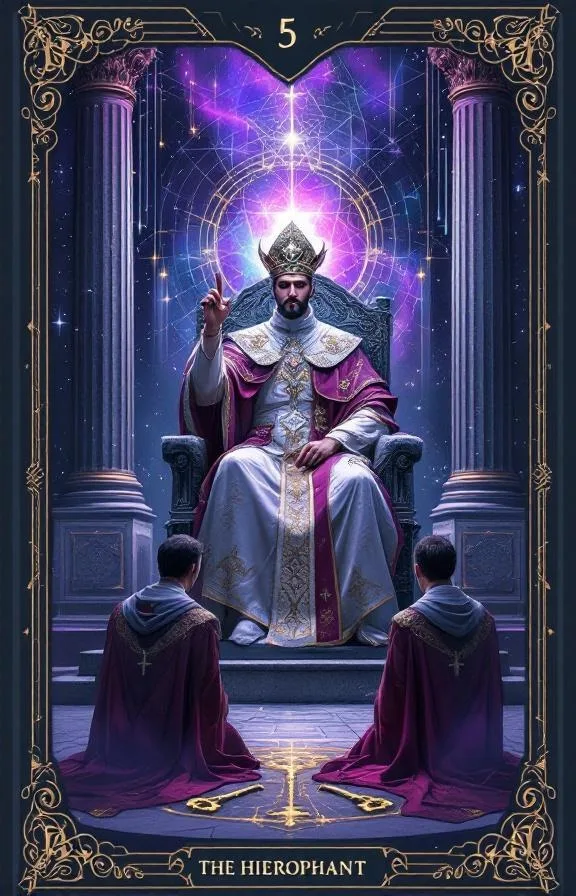
A religious figure sits between two pillars, two acolytes kneeling before him. The Hierophant represents inherited wisdom — the traditions, institutions, and systems of meaning that existed before you arrived. He is the teacher who passes down what previous generations learned. The developmental question he poses is essential: which inherited structures will you accept, which will you modify, and which will you reject?
Full meaning of The Hierophant →
VI. The Lovers
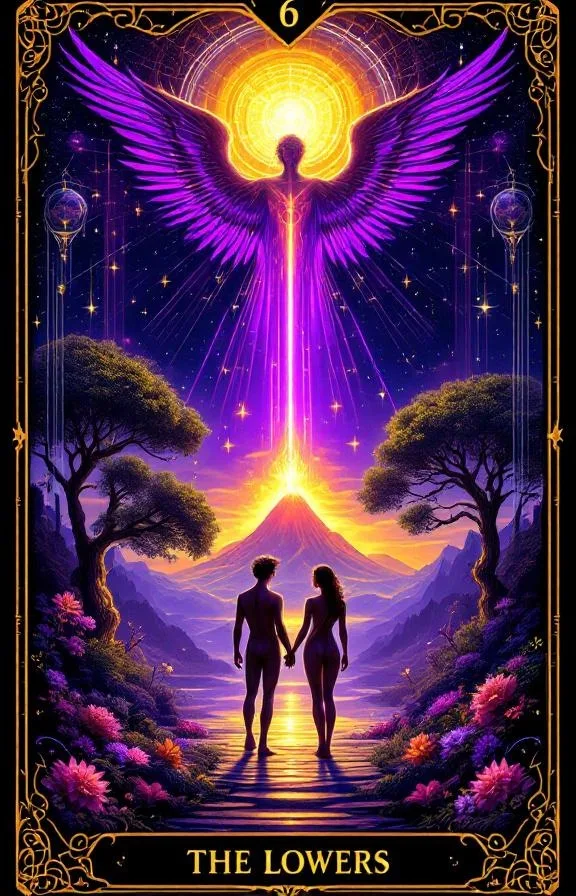
Two figures stand beneath an angel. This card is about choice more than romance. The Lovers represents the moment when you must choose between paths — and in choosing, define what you value. Every significant relationship is a values choice. Every commitment eliminates alternatives. The card does not promise that the choice will be easy or that you will choose correctly. It says only that the choice must be made.
VII. The Chariot
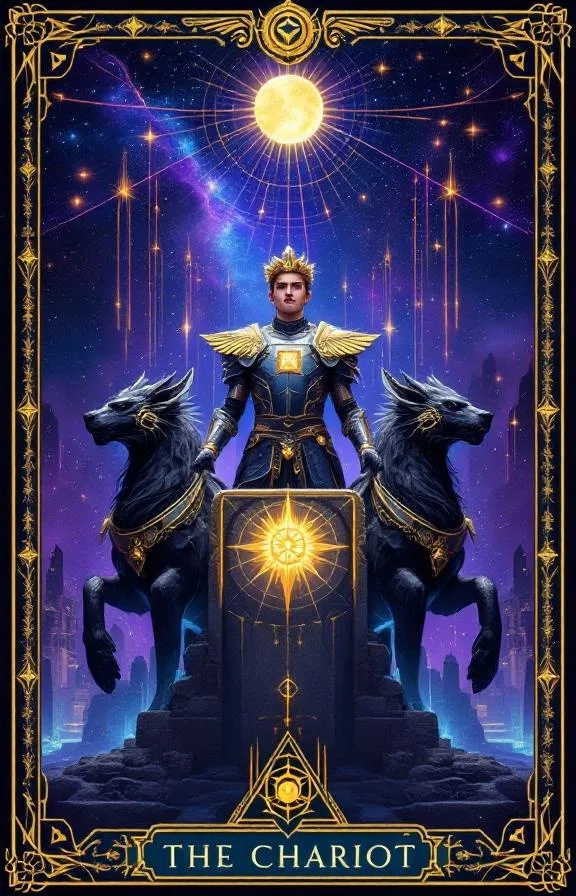
A figure drives a chariot pulled by two sphinxes — one black, one white — moving forward through sheer force of will. The Chariot is victory through discipline and determination. Opposing forces held in harness. Contradictions managed through forward motion rather than resolution.
But here is what most interpretations miss: the Chariot is not sustainable. Willpower alone exhausts itself. This card marks the peak of the ego's outward journey — the last moment when raw determination is enough. Everything that follows requires a different kind of strength.
VIII. Strength
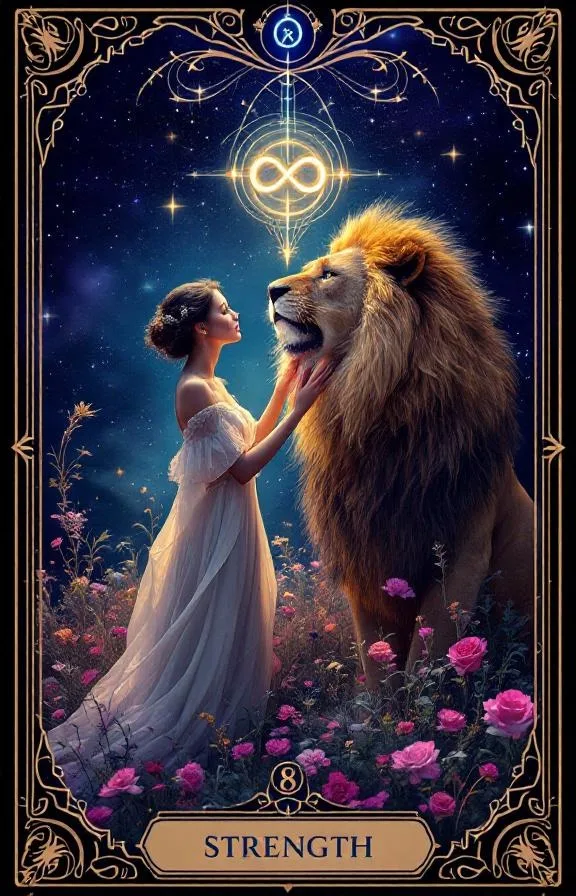
A woman gently opens a lion's mouth. No force. No restraint. The infinity symbol floats above her head. Strength in the major arcana is not about domination — it is about the quiet power that comes from befriending what is wild in you rather than caging it. The lion is not tamed. The lion is met. This is the psychological shift from controlling impulses to integrating them.
IX. The Hermit
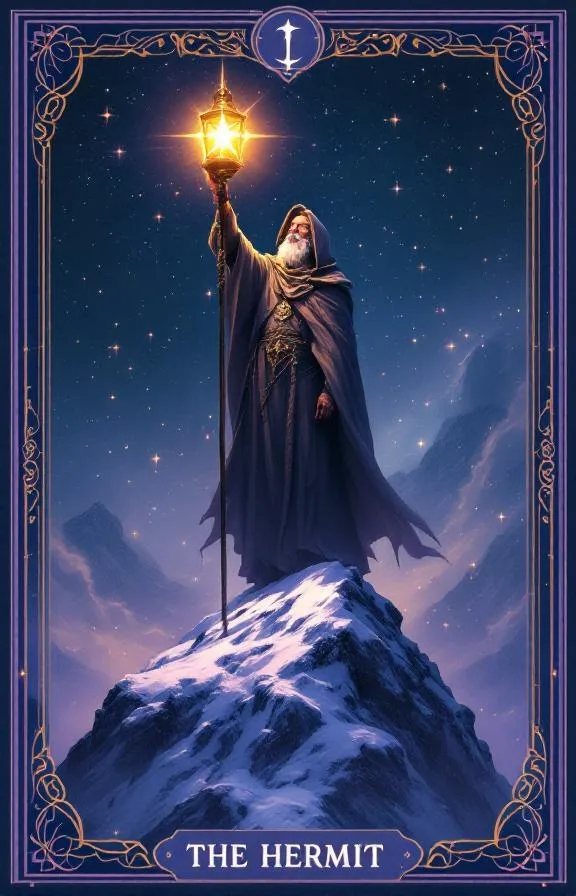
An old figure stands alone on a mountaintop, lantern in hand. Withdrawal from the world. Not escapism — purposeful solitude. The Hermit has seen enough of external life to know that the next answers are internal. This is the midlife turn inward that Jung considered essential to individuation: the point where external achievement stops being enough and the question becomes "who am I when no one is watching?"
X. Wheel of Fortune
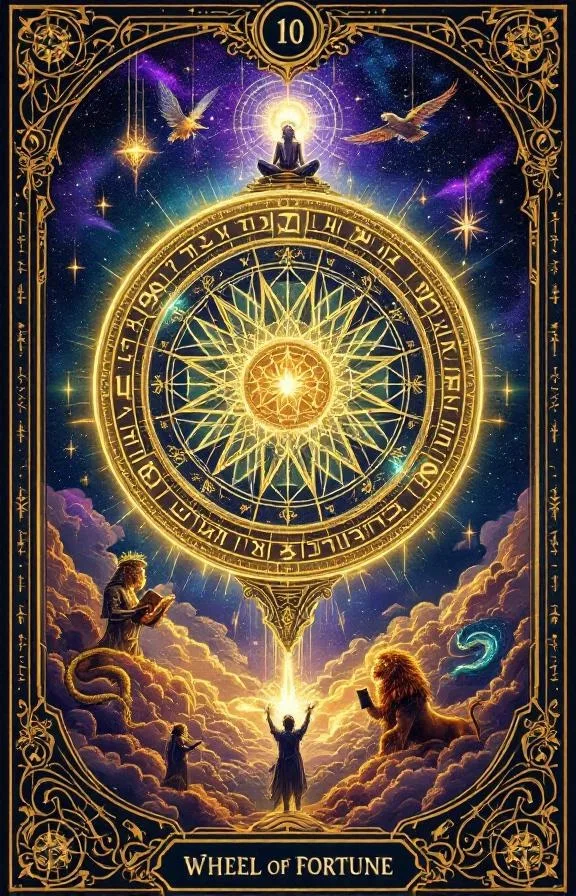
The wheel turns. Figures rise and fall on its rim. At the center, stillness. The Wheel of Fortune is the recognition that change is not random but cyclical — and that your position on the wheel is temporary. Up becomes down. Success becomes challenge. The card does not ask whether you can stop the wheel. You cannot. It asks whether you can find the center.
Full meaning of Wheel of Fortune →
XI. Justice
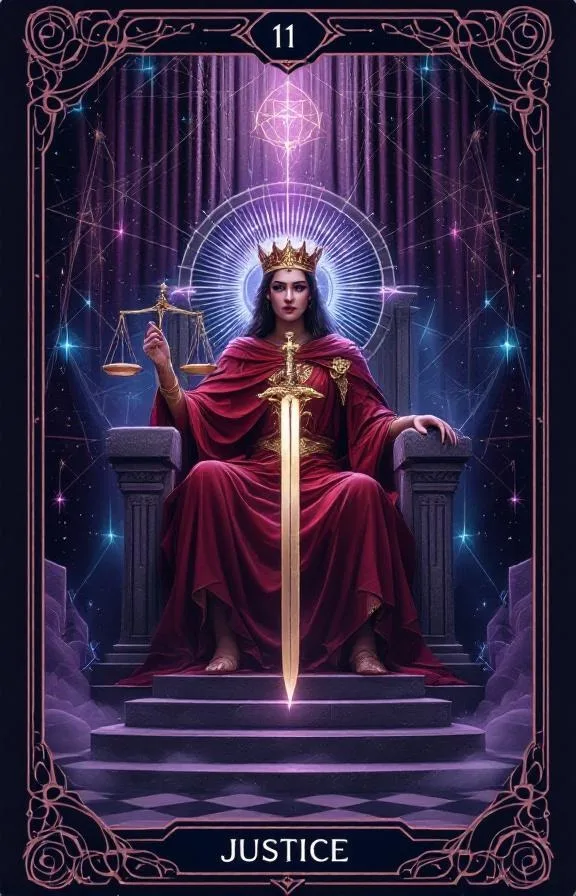
A figure holds a sword in one hand and scales in the other. Clear-eyed evaluation. Cause and effect. Justice in the major arcana is not about punishment — it is about truth. The willingness to see a situation as it actually is, weigh it honestly, and accept the consequences of what you find. Most people do not want justice. They want validation. This card is not interested in what you want.
XII. The Hanged Man
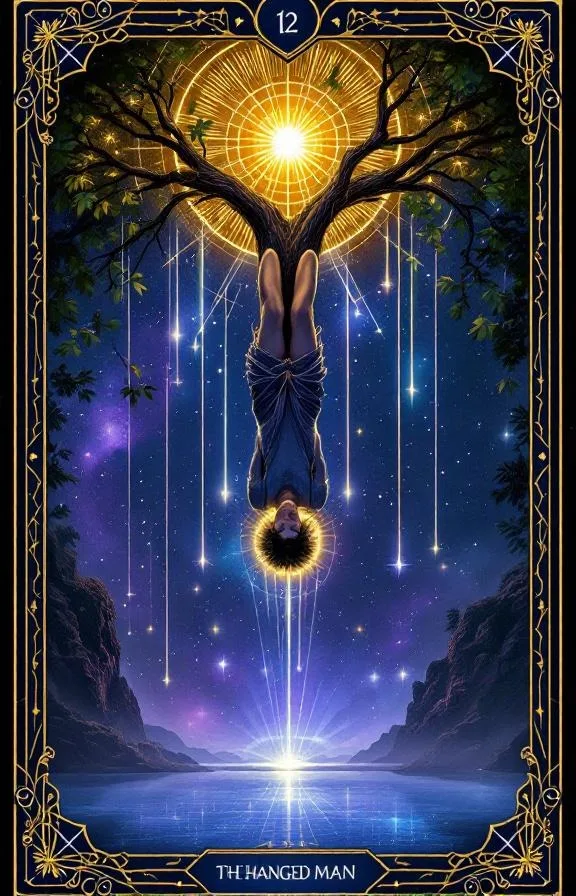
A figure hangs upside down from a tree by one foot, face serene. Surrender. Suspended action. The world inverted so you can see it from an angle that right-side-up living never provides.
The Hanged Man is one of the most misunderstood cards in the deck. It is not about suffering. It is about the voluntary suspension of control — the willingness to stop pushing, stop fixing, stop doing, and let a different kind of understanding arrive. Sometimes the most powerful thing you can do is nothing. For a while.
Full meaning of The Hanged Man →
XIII. Death
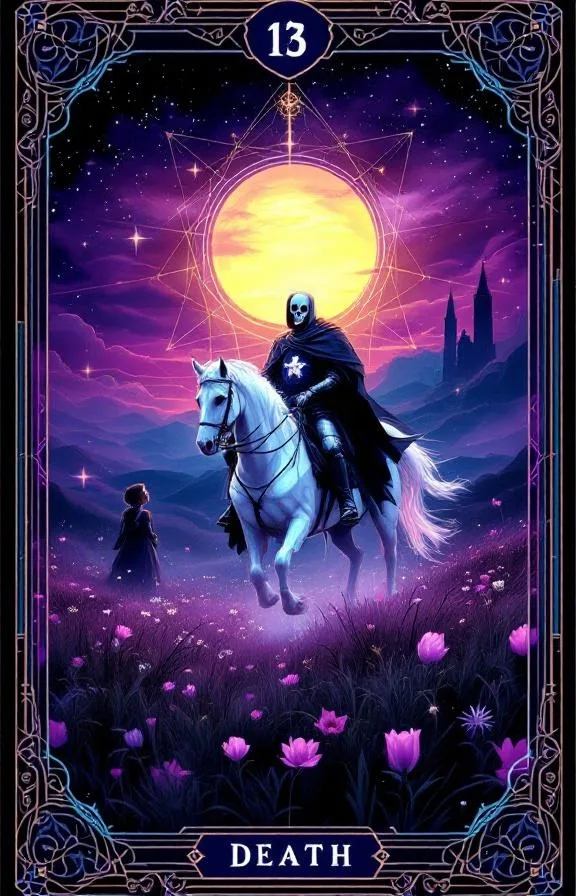
A skeleton in armor rides a white horse. A king has fallen. A child and a maiden stand in the path. A bishop waits. No one is exempt.
Death is transformation — the ending that makes the next beginning possible. Not physical death. The death of an identity, a relationship, a belief system, a way of being that has served its purpose. The card is feared because what it describes is genuinely painful: the destruction of something you built, loved, or defined yourself through. But the major arcana's sequence is clear. Without Death, there is no Temperance. Without endings, there is no integration. The refusal to let things die is not loyalty. It is stagnation.
XIV. Temperance
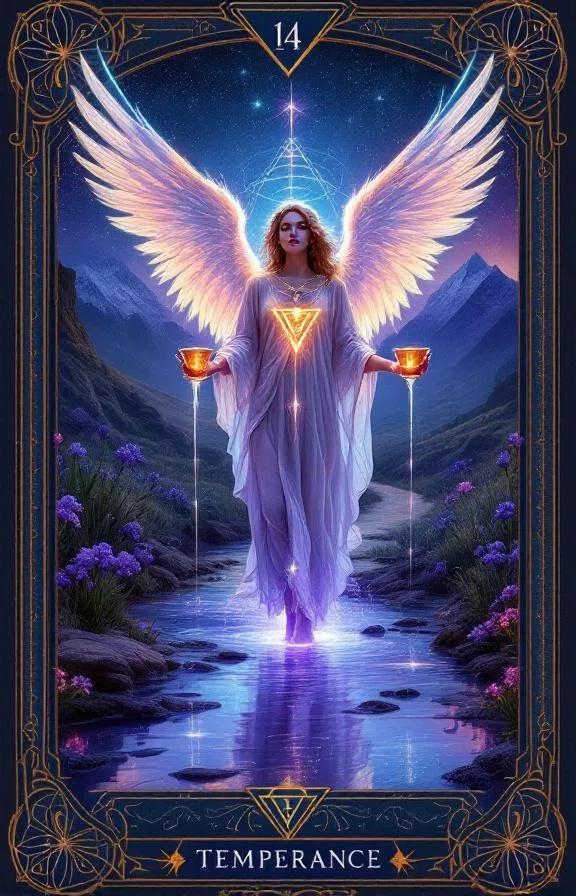
An angel pours water between two cups, one foot on land, one in a stream. Temperance is integration — the slow, patient work of combining what seemed incompatible. After Death clears the ground, Temperance builds something new from what survived. This is not compromise. It is synthesis. The angel stands between elements — water and earth, conscious and unconscious — and finds the flow that connects them.
XV. The Devil
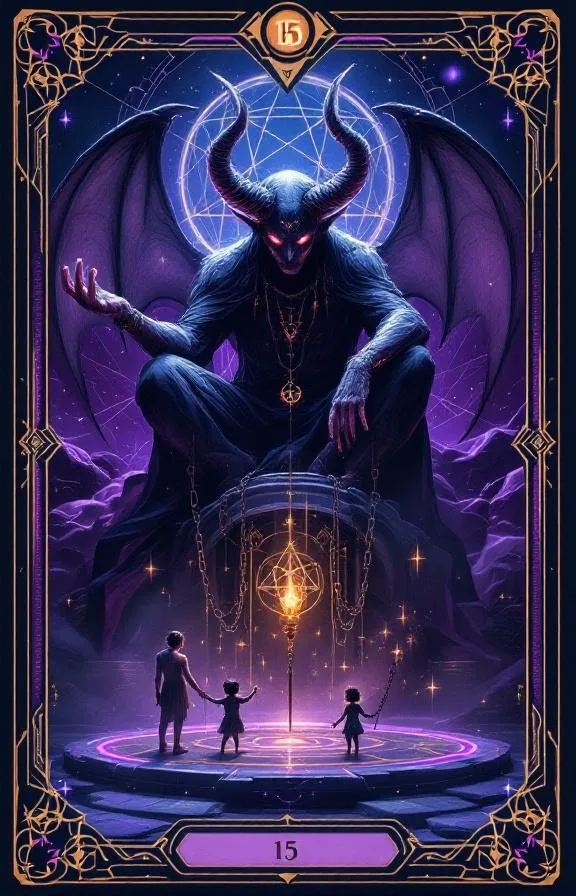
A horned figure crouches above two chained humans. But look at the chains — they are loose. The figures could remove them at any time. The Devil represents bondage that is chosen, patterns that are maintained by consent rather than force. Addiction, toxic relationships, materialism so consuming it replaces meaning. The card's power lies in its honesty: most of what imprisons you, you are cooperating with.
XVI. The Tower
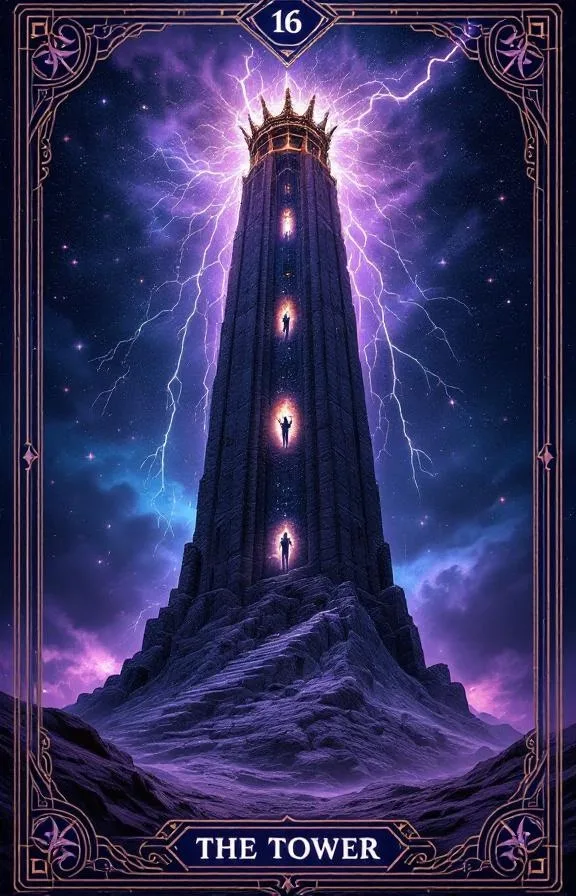
Lightning strikes a tower. Two figures fall. Flames. Destruction. The Tower is the most dramatic card in the deck and the most necessary. It represents the sudden collapse of structures built on false foundations — beliefs, relationships, identities, institutions that looked solid until the lightning revealed they were not.
The Tower does not negotiate. It does not warn. It does what Death does, but faster and less gently. And here is the uncomfortable truth: what the Tower destroys was already failing. The lightning did not create the structural weakness. It exposed it.
XVII. The Star
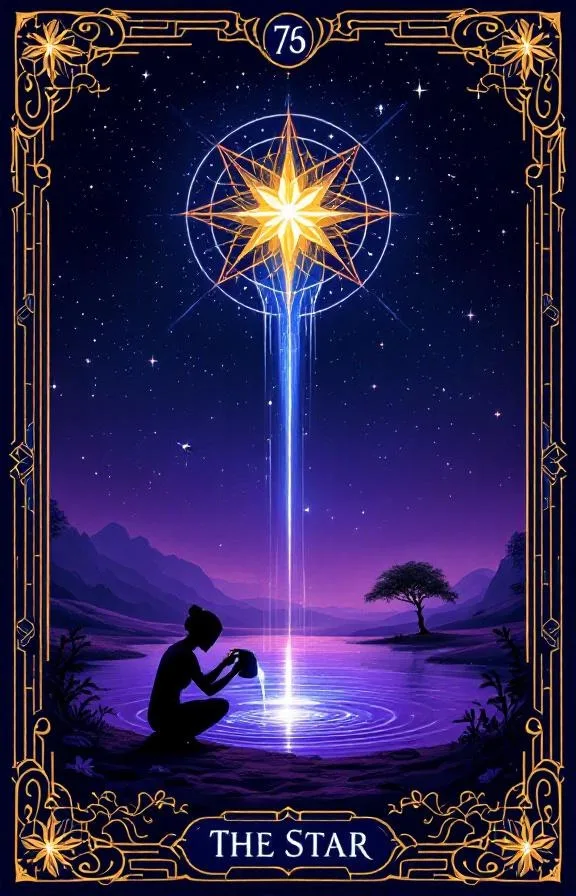
A naked figure kneels by a pool, pouring water onto the earth and back into the pool. Stars shine overhead. After the Tower's destruction, the Star is what remains when everything false has been stripped away. Hope. Not optimistic fantasy — genuine hope, the kind that exists only after you have survived something that should have destroyed you. Quiet. Vulnerable. Real.
XVIII. The Moon
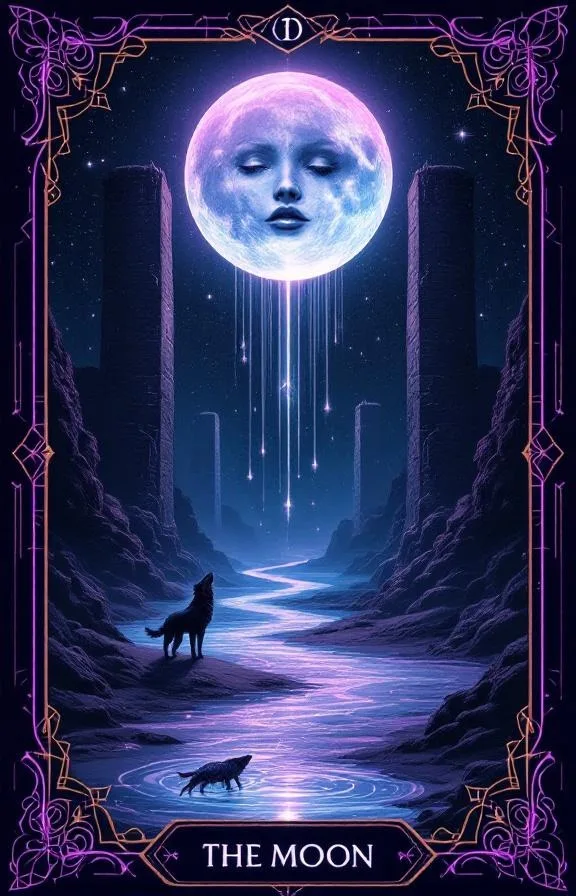
A path winds between two towers into the distance. A dog and a wolf howl at the moon. A crayfish emerges from a pool. The Moon is confusion, illusion, the dark territory of the unconscious where nothing is what it appears to be.
This is the card of the night journey — the passage through fear, doubt, and disorientation that cannot be skipped on the way to clarity. The Moon says: you will be lost for a while. Your instincts will conflict. What you see will deceive you. Keep walking anyway.
XIX. The Sun
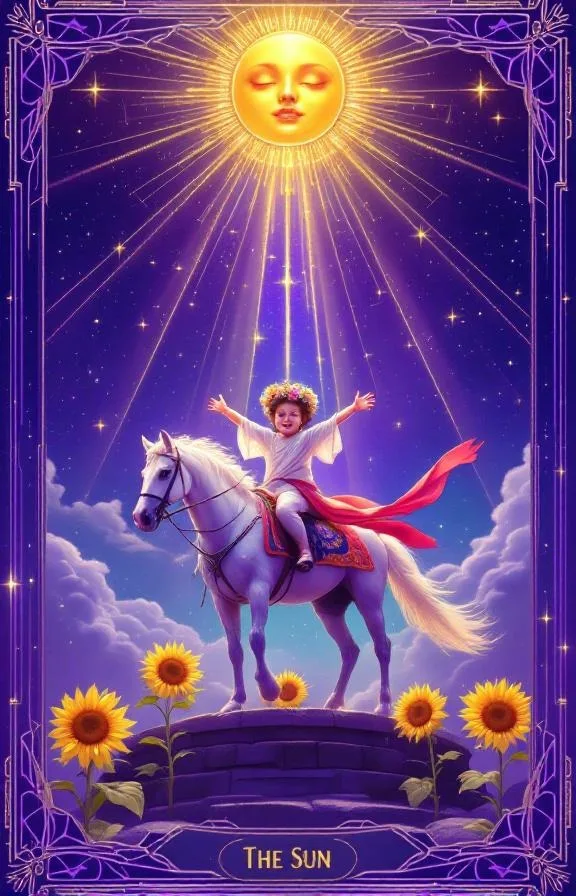
A child rides a white horse beneath a blazing sun, arms open, sunflowers behind. Joy. Clarity. Vitality. The Sun is the simplest card in the major arcana and the most direct: after the Moon's confusion, things become clear. You see yourself and the world without distortion. The child's nakedness echoes the Star's vulnerability — but here it is joyful rather than tender. Nothing to hide. Nothing to fear.
XX. Judgement
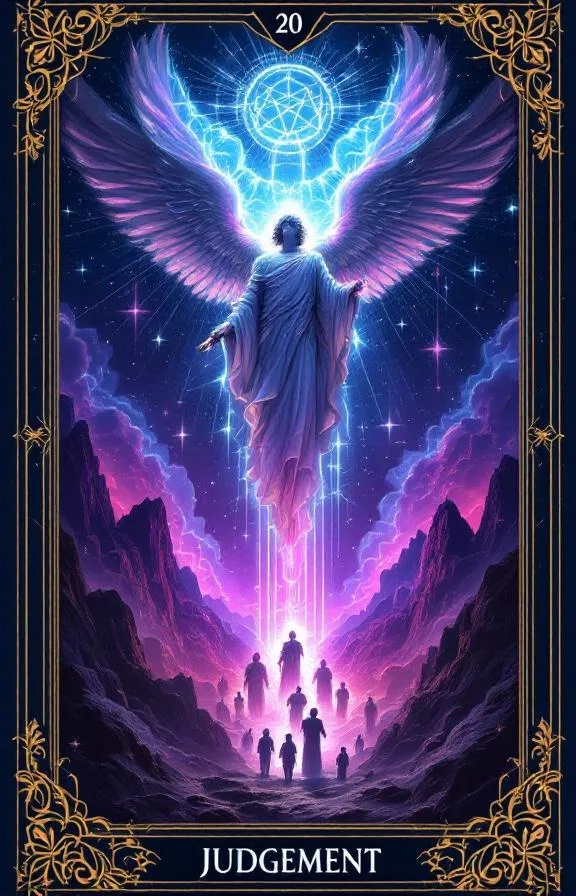
An angel blows a trumpet. Figures rise from coffins, arms raised. Judgement is the call to account — the moment when you evaluate your entire journey, acknowledge what you have been and done, and answer the question: given everything I now know, who will I choose to become? This is not external judgment. No one is grading you. The call comes from inside, and it demands the kind of honesty that most people spend their lives avoiding.
XXI. The World
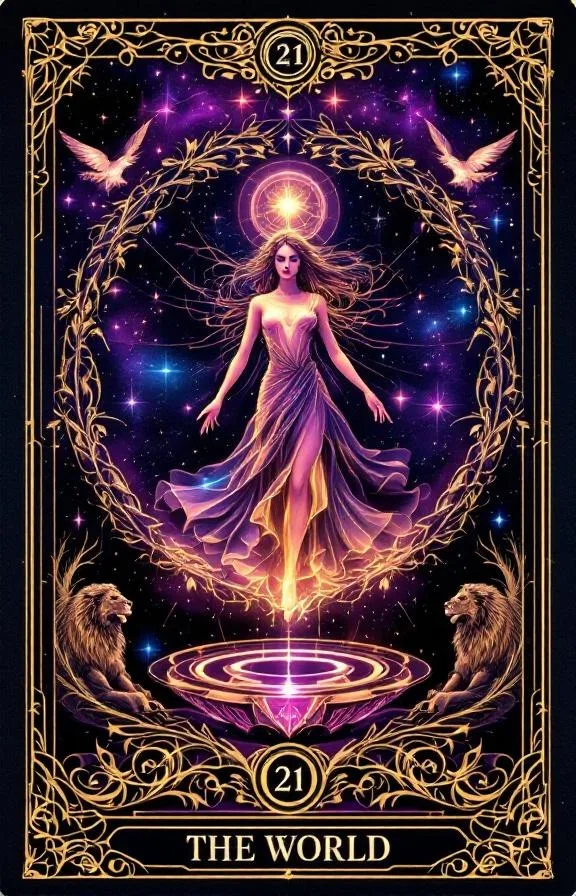
A figure dances within a laurel wreath, the four elemental creatures at the corners. Completion. Integration. The end of one cycle and the threshold of the next. The World does not mean "you have arrived." It means you have completed a full revolution of experience — innocence through crisis through destruction through renewal — and you are whole enough to begin again. Because the next Fool's Journey starts here. It always does.
Major arcana vs minor arcana
The distinction matters for reading, not just categorization.
The minor arcana — 56 cards divided into four suits — deals with the texture of daily life: emotions, thoughts, actions, material circumstances. These are the situations you navigate every week. A conflict at work. A new relationship. A financial decision. Manageable, familiar, human-scaled.
Major arcana cards operate at a different level. They signal the psychological turning points that restructure who you are. Not "you will have a difficult conversation with your partner" but "your understanding of what partnership means is being fundamentally transformed." The Cups tell you what you are feeling. The Tower tells you that the container holding all your feelings just shattered.
When a major arcana card appears in a spread, it demands more attention than the minor cards around it. Not because it is "more important" in some abstract hierarchy, but because it signals that the situation involves forces larger than the daily circumstances that surround it. A reading full of minor arcana with one major arcana card is a daily situation with one transformative element running through it. A reading dominated by major arcana is a life in transition.
How to read major arcana in a spread
A few principles that actually help:
Position matters. The same card means different things depending on where it falls. The Tower in a "past" position describes a disruption you have already survived. In a "future" position, it points to a coming upheaval. In an "advice" position — and this is where most readers flinch — it may be telling you to tear something down on purpose.
Reversed major arcana cards signal internalized or resisted energy. The Hermit upright is purposeful solitude. Reversed, it may indicate isolation without purpose, or the refusal to do the inner work that the current moment requires. Reversals do not negate the card. They complicate it.
Count them. Three or more major arcana cards in a five-card spread is significant. The reading is pointing at something larger than a situational question — a life passage, a developmental crisis, a transformation in progress. If all the cards are major arcana, the question you asked may be too small for what is actually happening.
Read the sequence. Major arcana cards appearing in order (or near-order) within a spread often tell a compressed version of the developmental journey. Death followed by Temperance in adjacent positions describes an ending that is already producing integration. The Devil followed by The Tower describes a bondage about to be broken — whether you want it broken or not.
Pair them with the minors. The major arcana tells you what archetypal energy is in play. The minor arcana tells you how it is manifesting in your actual life. The Star (hope, renewal) next to the Three of Swords (heartbreak) does not cancel the pain — it says that the pain is part of a larger healing. Context is everything.
For a practical experience with major arcana cards, try a free tarot reading or explore all 78 cards.
Reversed major arcana — deep dives
Every major arcana card carries a reversed meaning that goes far deeper than "the opposite." Reversed cards signal energy that is internalized, blocked, excessive, or not yet integrated. Each guide below explores the full psychological landscape of that card in its reversed position:
The Fool Reversed → | The Magician Reversed → | The High Priestess Reversed → | The Empress Reversed → | The Emperor Reversed → | The Hierophant Reversed → | The Lovers Reversed → | The Chariot Reversed → | Strength Reversed → | The Hermit Reversed → | Wheel of Fortune Reversed → | Justice Reversed → | The Hanged Man Reversed → | Death Reversed → | Temperance Reversed → | The Devil Reversed → | The Tower Reversed → | The Star Reversed → | The Moon Reversed → | The Sun Reversed → | Judgement Reversed → | The World Reversed →
For the general approach to reading reversed cards, see the complete guide to reversed tarot cards. To understand how numbers connect cards across suits, explore the tarot numerology guide.
FAQ
How many major arcana cards are there?
Twenty-two, numbered 0 (The Fool) through 21 (The World). This count has been consistent across virtually all tarot traditions since the 15th century, though the ordering of a few cards (particularly Strength and Justice, numbered VIII and XI or reversed depending on the deck) varies between the Rider-Waite-Smith and Marseille traditions.
What does it mean when you pull all major arcana in a reading?
It is rare and it is loud. A spread composed entirely of major arcana cards indicates that every aspect of the situation involves archetypal, life-defining energy. You are not dealing with a daily problem — you are inside a transformative passage that is touching every part of your life simultaneously. Read slowly. This is not a situation that responds to quick fixes or surface-level solutions. The entire structure of something is shifting.
Are major arcana cards more powerful than minor arcana?
Not more powerful. Different in scope. Major arcana cards describe the turning points and deep patterns of a life. Minor arcana cards describe the specific situations, emotions, and actions within that life. A doctor might say the major arcana is the diagnosis and the minor arcana is the symptom. You need both. A reading with only major arcana gives you the big picture but no practical detail. A reading with only minor arcana gives you granular information about a situation without showing you the larger forces shaping it.
Can you do a reading with only the major arcana?
Yes, and many readers do — particularly for questions about life direction, spiritual development, or major decisions. Removing the 56 minor arcana cards narrows the deck to its most archetypal elements, which can produce readings that are more focused on the "big why" behind a situation. The trade-off is that you lose the nuance and specificity that the suits provide.
What is the most important major arcana card?
The Fool. Not because card 0 is "better" than the others, but because it is the one that makes the entire journey possible. Without the willingness to begin without knowing what you are doing — without that first uncalculated step into the unknown — none of the other 21 stations can be reached. Every card in the sequence is essential. But The Fool is the precondition for all of them.
Ready to see which of these 22 archetypes is speaking to your life right now? Start a free tarot reading — the major arcana has a way of showing up exactly when the question matters most.