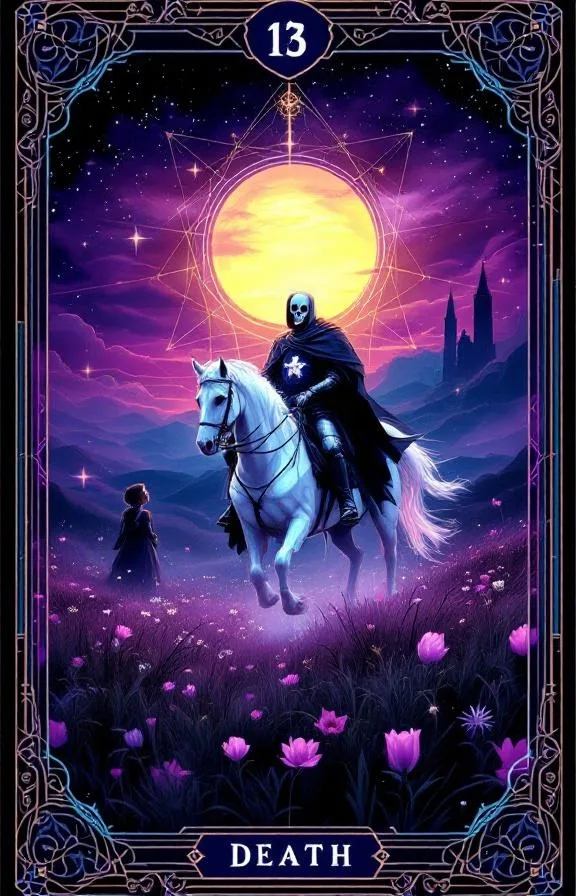
There is a plant on my kitchen windowsill that died three months ago. The leaves are brown and crisp. The soil is powdery dry. I keep watering it anyway. Once a week, I pour water into dead dirt around dead roots, and I cannot tell you why except that throwing it away would mean admitting it is gone.
Death reversed is that plant. And the watering. And the refusal to see what is already obvious.
The upright Death card terrifies people who do not know tarot and bores people who do — everyone learns early that it means transformation, not literal death, and moves on. But Death reversed? That is the card readers should actually fear. Because while upright Death sweeps through and clears the ground for something new, the reversal means the sweeping stopped. The old thing is still here. Rotting. Taking up space where new growth should be.
In short: Death upright is transformation — painful, necessary, ultimately renewing. Death reversed is transformation refused. You know something needs to end but you will not let it. Elisabeth Kubler-Ross identified five stages of grief, and this card lives permanently in stage three: bargaining. "Maybe if I just try harder, hold on longer, ignore the signs more completely, the thing that is dying will somehow live." It will not. The reversal is the universe's way of saying the negotiation period has expired.
Why Death appears reversed
The mechanism behind this reversal is almost always fear. Not vague, ambient anxiety — specific, pointed terror about what comes after the ending.
People can tolerate enormous amounts of dysfunction as long as the dysfunction is familiar. A miserable but predictable routine feels safer than an unpredictable freedom. This is not weakness. It is neurobiology. The brain genuinely prefers known suffering to unknown possibility, because known suffering can be planned for. The amygdala does not care about your personal growth — it cares about threat prediction, and the unknown is the ultimate threat.
Death reversed shows up when this fear has won. The transformation that needs to happen — the relationship that should end, the identity that should evolve, the habit that should die — remains suspended in a grotesque half-state. Not alive, not dead. Zombie territory.
Kubler-Ross spent decades studying how humans process loss, and her framework reveals something important about this card. The five stages — denial, anger, bargaining, depression, acceptance — are not linear, but bargaining is where people get stuck longest. Bargaining is seductive because it offers the illusion of agency. "If I change this one thing, maybe the whole ending can be avoided." That bargain sometimes works with minor problems. With the kinds of endings Death represents, it never does.
The card reversed can also indicate an ending that is happening beneath the surface but has not yet become visible. Seeds of change are germinating in the dark. This interpretation is gentler, but even here, the emphasis is on something resisting the process. The transformation wants to happen. You are the obstacle.
Death reversed in love and relationships
This is where the card earns its reputation.
Death reversed in a love reading almost always points to what relationship therapists call a "zombie relationship" — technically alive, functionally dead. Both people know. Neither says it. The conversations have been had, possibly dozens of times. Nothing changes because change would mean ending, and ending would mean grieving, and grieving is the one thing both parties have silently agreed to avoid.
The specific patterns vary. Sometimes it is the couple who broke up eighteen months ago but still sleeps together occasionally, still texts daily, still introduces each other in ways that avoid the word "ex." Sometimes it is the marriage where both partners have retreated into parallel lives — separate bedrooms, separate schedules, separate emotional worlds — while maintaining the legal and social structure of a marriage. The form is preserved. The substance is long gone.
For single people, Death reversed often points to a past relationship that has not been properly buried. You carry it. Not as a memory, which would be healthy, but as an active presence — comparing every new person to the old one, maintaining contact that prevents healing, revisiting the same moments in your mind as if repetition could change the outcome.
The hardest thing about this card in love readings is that the person pulling it usually knows all of this already. The card is not revealing a secret. It is refusing to let you pretend.
One question cuts through: if this relationship ended completely, right now, what would you have to feel? Whatever emotion you just flinched away from — that is what Death reversed is protecting you from experiencing. And that protection is costing you everything.
Death reversed in career and finances
In work readings, this reversal describes professional stagnation that feels permanent because you are treating it as permanent.
The job you should have left. The business model that stopped working two years ago. The career path you chose at twenty-two and are now defending at thirty-eight, not because it still fits but because admitting it never really fit would retroactively invalidate years of effort.
Death reversed in career is particularly cruel because the professional world rewards persistence. "Stay the course." "Don't be a quitter." "Loyalty matters." All true in some contexts. All potentially devastating when applied to a situation that has already ended in every way except officially.
Financially, the card points to money being used to preserve dead structures. Paying for memberships you do not use. Maintaining insurance on a business that generates no revenue. Continuing to invest in a failing venture because selling would crystallize the loss. There is a difference between strategic patience and expensive denial, and Death reversed is almost always the latter.
The career reading version of this card sometimes indicates a needed professional death that you are postponing — not quitting your job, but killing a version of yourself. The identity of "the reliable one" that keeps you from taking creative risks. The persona of "the expert" that prevents you from learning something new where you would be a beginner again. Professional identities can die just like relationships, and refusing to let them die creates the same rotting stagnation.
Death reversed as personal growth
Growth requires death. Every developmental psychologist since Piaget has observed this: to become the next version of yourself, the current version must end. Children do this naturally — they shed identities the way snakes shed skin, with minimal nostalgia. Adults accumulate identities like possessions and defend them like territory.
Death reversed as a personal growth card is a direct confrontation with your attachment to who you currently are. Something in your self-concept needs to die, and you are keeping it on life support.
This is not about self-improvement. Self-improvement assumes a continuous self that gets progressively better. Death — even reversed — is about discontinuity. The person on the other side of this transformation will not be an improved version of you. They will be someone different. Parts of your current identity will not survive the crossing. That is the point, and that is why you are resisting.
The growth work here is grief work. Kubler-Ross would recognize it immediately. You are mourning a version of yourself that is not dead yet, and that preemptive grief feels absurd — how do you mourn something that is still here? But the body knows what the mind refuses to accept. That low-grade exhaustion, that persistent sense that something is wrong, that inability to feel excited about things that used to matter. Those are symptoms of a transformation that is being blocked at the threshold.
How to work with Death reversed energy
Stop bargaining. That is the core instruction, and it is exactly as difficult as it sounds.
Bargaining feels productive. It feels like problem-solving. "Maybe if I adjust this variable, the outcome will change." But Death is not a problem to be solved. It is a process to be experienced. You cannot negotiate with entropy.
Name what is dead. Out loud, to yourself or someone you trust. "This relationship has ended." "This career is over." "The person I was five years ago no longer exists." Naming is not the same as accepting — acceptance comes later, sometimes much later. But naming strips away the pretense that the situation is still ambiguous. It is not ambiguous. You know.
Set a ritual end date. Humans have used ritual to process endings for thousands of years because it works. A funeral is not for the dead. It is for the living. Create your own version. Write a letter to the thing that is ending — the relationship, the job, the identity — and burn it. Choose a specific date after which you will stop the bargaining behaviors. Make it concrete.
Allow the grief. This is the part most people skip, and it is the part that makes everything else possible. The reason you are clinging is that letting go means feeling loss, and loss hurts. There is no technique that eliminates that pain. There is only the recognition that the pain of holding on has become worse than the pain of letting go, and that the grief on the other side is finite while the stagnation is not.
Talk to someone who has survived a similar ending. Not someone who will reassure you. Not someone who will tell you it will be fine. Someone who went through the death you are resisting and came out the other side changed. Their existence is proof that endings are survivable. Their honesty about how hard it was is more useful than any reassurance.
Frequently asked questions
Does Death reversed mean a literal death is being avoided?
No. Tarot does not predict literal death in any position, and responsible readers do not interpret it that way. Death reversed deals exclusively with metaphorical endings — the death of relationships, habits, identities, life phases. The "avoidance" the card describes is psychological, not physical.
Can Death reversed be positive?
In specific contexts, yes. If you have been going through an extremely painful transformation, Death reversed can indicate that the most destructive phase is ending — that the worst is behind you, and the change will now proceed more gradually. It can also mean you have been given more time before a major transition, which is positive if you use that time wisely. The negative interpretation dominates when the card points to active resistance against a necessary ending.
What is the difference between Death reversed and The Tower reversed?
Scale and speed. The Tower is sudden, dramatic, externally imposed destruction. Death is gradual, organic, internally driven transformation. When reversed, The Tower suggests you avoided or are processing a sudden crisis. Death reversed suggests you are resisting a slow, natural ending that has been building for a long time. The Tower reversed is about a bomb that did not go off. Death reversed is about a garden that will not be cleared of dead plants. Both involve avoiding destruction, but the character of that destruction is fundamentally different.
Explore Death's full meaning, see what it reveals as feelings, or discover Death as a person. Ready for deeper insight? Try a free reading.