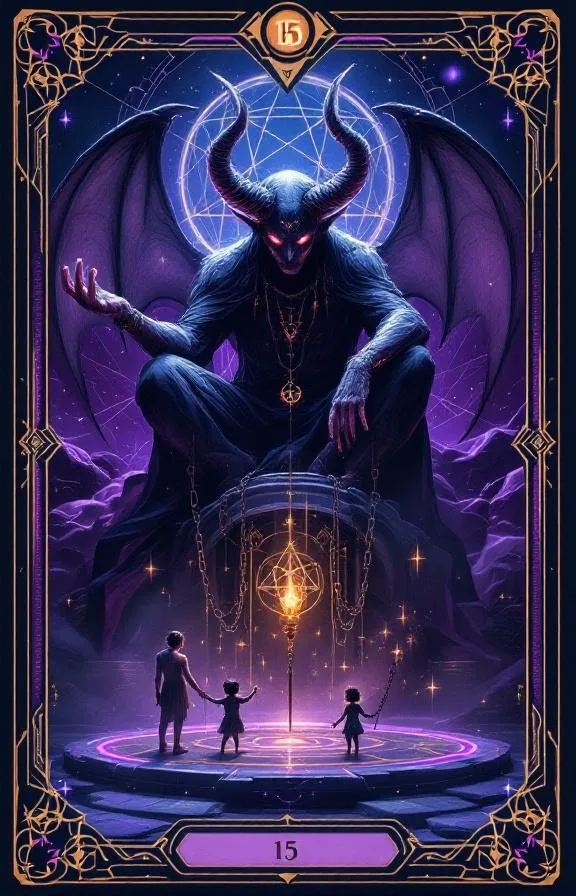
A woman I knew spent eleven years in a relationship she described as "passionate" to friends and "survival" in her journal. She left on a Tuesday. Not after a fight, not after an ultimatum. She woke up, looked at the ceiling, and realized she was performing the role of someone who needed this person — and had been for years. She packed one bag. The relief she felt was not joy. It was the sudden, disorienting lightness of a body that has been carrying something so long it forgot the weight was optional. That is The Devil reversed.
In short: The Devil upright holds you in place through attachment you mistake for necessity — addiction, obsession, toxic comfort. Reversed, it marks the moment you see the chains for what they are: voluntary. Gabor Mate's research into attachment-based addiction reveals that compulsive bonds are never about the substance or person but about the emotional wound they temporarily numb. The Devil reversed is the terrifying, exhilarating instant you choose the wound over the numbing.
Why The Devil appears reversed
The Devil reversed does not arrive because your problem has been solved. It arrives because your relationship to the problem has shifted.
Upright, The Devil represents bondage you participate in. The chains in the Rider-Waite-Smith imagery are famously loose — anyone could lift them off. The card's cruelty is not captivity but the illusion that captivity is required. It operates through your shadows: the desires you cannot admit, the patterns you refuse to name, the deals you have struck with your own comfort that cost more than they deliver.
Reversed, that mechanism breaks. Something has cracked the illusion, or you have grown so tired of maintaining it that honesty becomes easier than performance.
Gabor Mate spent decades working with addiction in Vancouver's Downtown Eastside, studying people at the extreme end of compulsive behavior. His conclusion upended the moralistic framework most people default to: addiction is not about the substance. It is about pain. Every addict he worked with was medicating an unbearable feeling — usually rooted in childhood attachment disruption — with a behavior that provided temporary relief at escalating cost. The substance or behavior was never the point. The point was the intolerable present moment they could not otherwise survive.
The Devil reversed is what happens when someone stops medicating. Not because the pain has disappeared. Because they have decided the cost of avoidance has exceeded the cost of feeling.
This is why The Devil reversed often feels worse before it feels better. The chains were not just binding you. They were holding you up. When they fall, you have to stand on your own legs — and you may discover those legs are weaker than you thought, because you have not used them in years.
The Devil reversed in love and relationships
In relationship readings, The Devil reversed is one of the most significant cards in the deck, and it cuts two ways depending on where you are in a situation.
If you are leaving a toxic dynamic, this card is confirmation. You have seen the pattern. The cycle of intensity — the highs that justify the lows, the reconciliation that erases the fight, the way the relationship demands more and more while delivering less — has become visible to you. Visibility is the beginning of the end for any addiction. You cannot unsee what you have seen.
The departure The Devil reversed describes is rarely dramatic. It is not the screaming exit. It is the quiet one. The person who stops responding. Who cancels plans without explanation. Who simply withdraws the energy that was maintaining the bond. From the outside, it looks cold. From the inside, it is the most exhausting act of self-preservation they have ever performed.
If you are in a relationship that is fundamentally healthy but has developed unhealthy patterns, The Devil reversed suggests a different kind of liberation. Maybe you have recognized a control dynamic. Maybe you have identified jealousy masquerading as care, or codependency performing as devotion. The card says: you see it now. The question is whether your partner can see it too, and whether you can rebuild without the scaffolding of dysfunction.
There is a harder reading, and it is worth naming. Sometimes The Devil reversed in love means you are leaving someone who genuinely loves you because your attachment to them was a compulsion, not a choice. This is devastating for both people. The person who leaves feels guilty. The person who stays feels blindsided. But a compulsive bond, no matter how intense, is not sustainable love. And staying in one is its own kind of cruelty — to both parties.
For single people, this card frequently points to a period of deliberate solitude. Not loneliness. Not avoidance. The conscious decision to stop filling a void with another person until you understand what the void actually is.
The Devil reversed in career and finances
Professional readings with The Devil reversed tend to be about power — specifically, about reclaiming power you handed to something that did not deserve it.
The most common manifestation: leaving a job that pays well but costs everything else. The golden handcuffs scenario. You know the pattern. Someone earns enough to fund a lifestyle they need the job to maintain, and the job requires a schedule that prevents them from actually living the lifestyle. The chain feeds itself. The Devil reversed says someone has done the math and realized the equation does not balance.
Financial liberation is the other major theme. This is the person who confronts their spending as a coping mechanism. Who cancels the subscriptions that make them feel successful. Who stops treating money as proof of worth.
Not every Devil reversed in career is about leaving. Sometimes it signals internal detachment — staying in a role but withdrawing your identity from it. You still do the work. You just stop believing the story that the work defines you. This is subtler and in some ways harder than quitting, because it requires sustained awareness. Quitting is one decision. Staying without attachment is a decision you make every morning.
One pattern I have noticed: The Devil reversed in career readings often coincides with the death of ambition as worship. The person stops chasing the title, the promotion, the acknowledgment from people whose approval they were seeking as a substitute for their own. This is not apathy. It is recalibration.
The Devil reversed as personal growth
Most people ask the wrong question about The Devil reversed. They ask "What am I being freed from?" The better question is: "What was I getting from staying?"
Every toxic pattern serves a function. The relationship that validated your existence. The substance that made social interaction bearable. The overwork that gave you permission to avoid your inner life. The Devil reversed asks you to identify the function and find a less destructive way to serve it.
Mate's framework is essential here. He found that the recovery process is not about eliminating the need — it is about meeting the need differently. The person addicted to approval does not need to stop wanting connection. They need to find connection that does not require self-abandonment. The person addicted to control does not need to become passive. They need to discover that surrender and weakness are not the same thing.
The shadow work The Devil reversed demands is specific: look at the thing you are most ashamed of wanting, and trace it back to its origin. The shame is almost never about the want itself. It is about a moment — usually early, usually formative — when the want was punished or ignored, and you learned to pursue it through indirect, often self-destructive channels.
This process is ugly. It should be. Growth that looks attractive from the outside is usually performance. Real liberation involves sitting with precisely the feelings you built the cage to avoid. That is the work. There are no shortcuts, and anyone selling you one is building another cage.
How to work with The Devil reversed energy
Practical steps, no mysticism required.
Name the chain. Write it down. Not what you think sounds insightful — what is actually true. "I drink because I am afraid of being boring." "I stay because I am afraid no one else will want me." "I spend because buying things is the only time I feel in control." The specificity matters. Vague admissions change nothing. Precise ones change everything.
Distinguish between withdrawal and loss. When you release a pattern, you will feel its absence acutely. Your brain will interpret this as evidence that the pattern was necessary. It was not. You are experiencing the discomfort of neural pathways that expected their usual hit. The feeling is real. The story the feeling tells is not.
Build before you burn. If possible, construct the replacement before destroying the thing you are leaving. This is practical, not cowardly. The person who leaves a job has a better chance of staying gone if they have savings. The person who leaves a relationship has a better chance of not returning if they have built a support network. The Devil reversed is not about dramatic gestures. It is about sustainable freedom.
Expect relapse. This is where Mate's work is most useful: he insisted that relapse is not failure. It is data. Each return to the pattern teaches you something about your triggers. The question after a relapse is not "why am I so weak?" but "what was happening right before?" That shift — from moral judgment to clinical curiosity — is the difference between recovery and self-punishment.
Sit with the void. When the pattern drops away, there will be a space where it used to be. Do not rush to fill it. The emptiness is not a problem to solve. It is the room you need to discover who you are without the thing that was defining you.
Frequently asked questions
Is The Devil reversed always a positive card?
It signals liberation, but liberation is not always comfortable. Think of it this way: a person released from prison after twenty years is free, but they still have to rebuild a life with skills that may have atrophied and relationships that may have dissolved. The Devil reversed promises the end of bondage. It does not promise that freedom will be easy. In readings where someone is in deep denial about a toxic pattern, The Devil reversed can mean the pattern is about to escalate until avoidance becomes impossible — liberation through crisis rather than choice.
What does The Devil reversed mean for someone struggling with addiction?
Mate's attachment-based addiction model provides the clearest lens. The card does not mean addiction is over. It means the person's relationship to their addiction has shifted — from unconscious participation to conscious awareness. They see the mechanism. This is the prerequisite for change, not the change itself. In practice, it often appears when someone has admitted the problem for the first time, when they have entered treatment, or when they have experienced a moment of clarity that cannot be undone even if the behavior continues temporarily. The chains are off. Walking away from where the chains were is a separate journey.
How is The Devil reversed different from The Devil upright?
Upright, you are inside the pattern. Reversed, you are seeing it from outside. That single shift changes everything. Upright, the chains feel like necessity. Reversed, they look like choices. The emotional experience is completely different too — upright feels like compulsion, like something is happening to you. Reversed feels like agency, sometimes terrifying agency, because you can no longer pretend you do not have a choice. The discomfort of upright is the discomfort of bondage. The discomfort of reversed is the discomfort of responsibility.
Explore The Devil's full meaning, see what it reveals as feelings, or discover The Devil as a person. Ready for deeper insight? Try a free reading.