Pull the Four of Cups from a deck and most readers will tell you about emotional dissatisfaction, missed opportunities, a figure sitting under a tree ignoring what's being offered. Fair enough. Now pull the Four of Pentacles, the Four of Swords, and the Four of Wands. Line them up. Look at them together.
All four cards — across completely different suits and life domains — share the same core energy: structure. Stability. A moment of pause where something has been built and must now be evaluated. The suits change the context. The number tells you what's actually happening underneath.
That's tarot numerology. And once you see it, you can't unsee it.
In short: Every tarot card carries two layers of meaning — the suit tells you the domain (emotions, thoughts, material world, action), and the number tells you where in the cycle you are. Numbers 0 through 10 repeat across all four suits and echo through the Major Arcana, creating a hidden grid that connects all 78 cards. Jung called these recurring patterns archetypes. Pythagoras believed numbers were the fundamental language of reality itself — truth's actual structure, more real than the physical objects they described. Both were pointing at the same thing tarot readers discover intuitively: numbers carry meaning that transcends context.
The number system in tarot
A standard tarot deck has 78 cards. Twenty-two Major Arcana (numbered 0 through 21) and fifty-six Minor Arcana split across four suits: Wands, Cups, Swords, and Pentacles.
Each suit runs from Ace (one) through Ten, followed by four court cards: Page, Knight, Queen, King. That gives you the same numerical journey repeated four times in four different domains of life, plus a parallel journey through the Major Arcana that hits many of the same numerical beats.
Here's what makes this system powerful: when you understand what "three" means — in the abstract, stripped of suit context — you can read any Three in the deck with more depth. The Three of Cups (celebration), the Three of Pentacles (collaboration), the Three of Swords (heartbreak), and the Three of Wands (expansion) all share the same underlying numerological principle: creation. Something new has emerged from the union of two forces. The suit determines whether that creation brings joy, productive teamwork, painful truth, or ambitious vision.
Pythagoras and his school didn't just study numbers as quantities. They studied numbers as qualities — each integer carrying its own character, its own behavior, its own relationship to the cosmos. They believed quantities were secondary to the qualitative essence each number embodied. Twenty-five centuries later, tarot's numbered system operates on exactly this principle. A Five isn't just "more than Four." A Five is a fundamentally different energy. It disrupts what Four stabilized. Every time.
Zero and The Fool — the number of infinite potential
Zero is the strangest number in the deck because it shouldn't exist. Most numbering systems in the ancient world didn't include it. The concept of "nothing as something" — a placeholder that contains all possibility precisely because it contains no fixed form — was revolutionary mathematics and revolutionary philosophy.
The Fool carries the number 0. He stands at the edge of a cliff with a small pack, a white rose, a dog at his heels, and absolutely no plan. He is pure potential energy. Every journey in the tarot begins here, and every journey could begin here again.
In readings, Zero energy shows up as the moment before commitment. You haven't chosen a path yet. You haven't even decided whether to walk. The question isn't "which direction?" — it's "will I step forward at all?"
No Minor Arcana card carries the number zero. The Fool stands alone. That's numerologically significant: infinite potential exists only once in the deck. The moment you step off the cliff, you become an Ace.
Ones and Aces — beginnings across all suits
One is the number of initiation. Spark. Seed. The first mark on a blank page.
In the Major Arcana, One belongs to The Magician — the figure who takes The Fool's raw potential and channels it into focused intention. He has all four suit symbols on his table. He's chosen to act.
The four Aces mirror this energy across every domain:
- Ace of Wands — a new creative or passionate impulse, a spark of inspiration that demands action
- Ace of Cups — the beginning of emotional experience, new love, a heart cracking open
- Ace of Swords — a breakthrough in clarity, a new idea cutting through confusion
- Ace of Pentacles — a new financial opportunity, a seed planted in material reality
Notice the pattern: none of these Aces describe completion. They describe ignition. The energy of One is always forward-facing, always incomplete by design. A beginning that already contained its ending would be no beginning at all.
Jung observed that the psyche treats beginnings with a particular kind of energy he called "numinosity" — a sense of the sacred or significant. This is why Aces in readings often carry emotional weight that seems disproportionate to their practical content. Drawing an Ace feels different. It should. You're holding a seed.
Twos — duality and choice
Two is the first number of relationship. One was alone. Two introduces the other.
The Major Arcana's Two is The High Priestess — seated between two pillars, one black, one white. She doesn't choose between them. She holds the tension. That's the essential Two energy: acknowledging that two forces exist without rushing to resolve them.
Across the suits:
- Two of Wands — standing at a crossroads of ambition, holding the world but deciding which direction to aim
- Two of Cups — partnership, connection, the moment two people recognize something in each other
- Two of Swords — mental stalemate, deliberately choosing not to see, a decision deferred
- Two of Pentacles — juggling resources, the dance of balance between competing material demands
Every Two card contains a choice. But the deeper message is this: the choice itself is less important than your willingness to acknowledge that it exists. The Two of Swords blindfolds herself. The Two of Cups extends a hand. Same number. Radically different responses to the same fundamental situation — "there are two things, and I must relate to both."
Threes through Fives — creation, stability, disruption
These three numbers form a dramatic arc that repeats in every suit.
Threes: creation. One plus Two equals Three — and what emerges is genuinely new. The Empress (III) in the Major Arcana is abundance, fertility, creation in its most visceral form. Across the suits, Threes produce: celebration (Cups), collaboration (Pentacles), heartbreak (Swords), and expansion (Wands). Wait — heartbreak as creation? Yes. The Three of Swords creates understanding through pain. The wound produces knowledge that didn't exist before. Creation isn't always comfortable.
Fours: stability. After the creative burst of Three, Four builds walls. The Emperor (IV) imposes order, structure, rules. Four is the number of foundations — four walls, four corners, four cardinal directions. In the suits: emotional withdrawal and evaluation (Four of Cups), defensive hoarding (Four of Pentacles), enforced rest (Four of Swords), and joyful celebration of home (Four of Wands). Four holds what Three created. Sometimes that holding is protective. Sometimes it becomes a prison.
Fives: disruption. Here's where it gets rough. Five breaks what Four built. Every time. The Hierophant (V) in the Major Arcana channels this as institutionalized challenge — the teacher who disrupts your comfortable worldview. In the suits, Fives are almost universally difficult: conflict and defeat (Five of Swords), grief and loss (Five of Cups), financial hardship (Five of Pentacles), and chaotic competition (Five of Wands).
Most people ask "why are all the Fives so hard?" Wrong question. The right question: what happens when stability goes unchallenged? It calcifies. It stops serving you. Five is the crack that lets new light in, even when the cracking hurts. Leonard Cohen knew this. So does every Five in the deck.
Sixes and Sevens — harmony and challenge
Sixes: restoration. After Five's destruction, Six repairs. The Lovers (VI) in the Major Arcana represents alignment — not just romantic love, but the harmony of values and choices. Sixes across the suits bring: emotional generosity and nostalgia (Six of Cups), financial generosity and fairness (Six of Pentacles), mental transition and moving forward (Six of Swords), and public victory (Six of Wands).
Six is the first "exhale" number after the tension of Four and Five. Things come back into balance. But it's a different balance than what existed before — it's post-crisis equilibrium, which is always wiser and usually more humble than the stability of Four.
Sevens: inner challenge. Seven is the most psychologically complex number in the deck. The Chariot (VII) wins through willpower alone — the horses pull in opposite directions and the driver holds them on course through sheer determination.
In the suits, Sevens test you internally:
- Seven of Cups — fantasy, illusion, too many options dissolving into paralysis
- Seven of Pentacles — patience, waiting for the harvest, questioning whether the investment was worth it
- Seven of Swords — deception, strategy, the uncomfortable question of when cleverness becomes dishonesty
- Seven of Wands — defending your position against pressure, standing your ground when it would be easier to step aside
Sevens don't attack you from outside like Fives do. They challenge you from within. Your own fantasies, your own impatience, your own rationalizations. This is why Seven is the number spiritual traditions associate with inner work — it requires you to confront yourself.
Eights through Tens — mastery, completion, transition
Eights: power and momentum. Strength (VIII) in the Major Arcana is quiet mastery — the woman closing the lion's mouth not through force but through calm authority. Eights across the suits carry intense forward motion: rapid communication and travel (Eight of Wands), self-imposed restriction and bondage (Eight of Swords), material skill and craftsmanship (Eight of Pentacles), and painful but necessary departure (Eight of Cups).
Eight is the number where you realize that power and limitation are inseparable. The Eight of Pentacles gains mastery through repetition — which requires accepting the limitation of doing one thing over and over. The Eight of Swords feels trapped, but the bindings are loose. Mastery and imprisonment share a border.
Nines: near-completion. The Hermit (IX) withdraws to integrate everything the journey has taught. Nines are the penultimate step — so close to the end that you can feel it. Nine of Cups: the wish card, satisfaction, having what you wanted. Nine of Pentacles: self-sufficiency, luxury earned through discipline. Nine of Wands: exhaustion and perseverance, battered but still standing. Nine of Swords: anxiety, the dark night of the soul that comes just before dawn.
The Nines reveal something honest about human psychology: proximity to completion intensifies emotion in both directions. The Nine of Cups is one of the most positive cards in the deck. The Nine of Swords is one of the most painful. Same number. The nearness of the end amplifies whatever you're carrying.
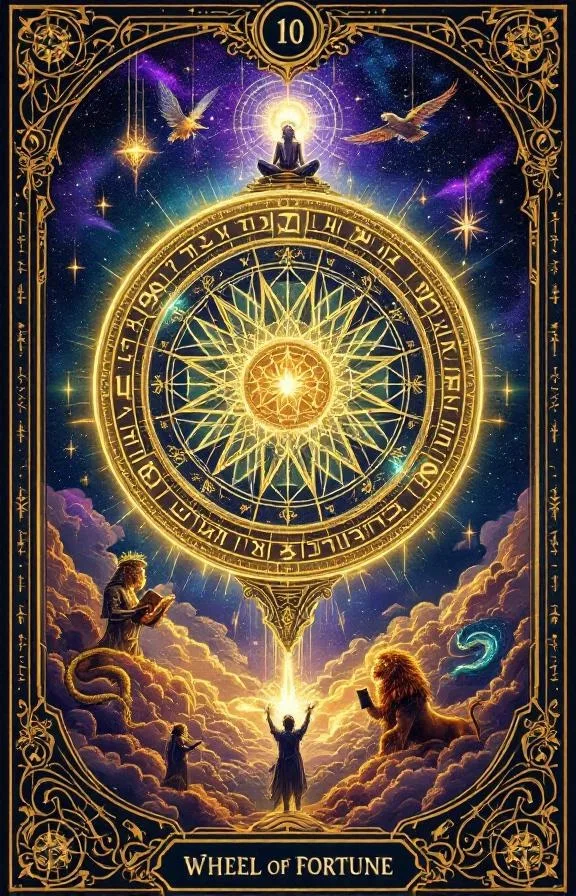
Tens: completion and transition. The Wheel of Fortune (X) — cycles turning, one phase ending as another begins. Tens complete the numbered sequence but they don't simply mean "the end." They mean: this cycle is done, and the energy now transforms into something else.
Ten of Cups: emotional fulfillment, family harmony, the rainbow after years of rain. Ten of Pentacles: generational wealth, legacy, material completion that extends beyond one lifetime. Ten of Wands: burden, carrying too much, the weight of everything you've accumulated across the entire journey.
And the Ten of Swords. A figure face-down with ten blades in their back. The most dramatic image in the deck. But look at the horizon — there's a golden sunrise. Ten of Swords is total ending, absolute rock bottom, and therefore: total permission to begin again. The cycle is complete. It had to break completely to release you.
Court cards and their numerical significance
The court cards — Page, Knight, Queen, King — extend the numerical sequence beyond ten. If Ace is one and Ten is completion, the court cards represent the human embodiment of each suit's energy at escalating levels of maturity.
Pages (11): The student. Raw enthusiasm mixed with inexperience. Pages carry messages and represent the beginning of conscious engagement with a suit's energy. Eleven reduces to Two (1+1=2), connecting Pages to duality and choice — the Page has chosen to study this energy but hasn't mastered it yet.
Knights (12): The activist. All action, sometimes reckless, always committed. Knights charge forward. Twelve reduces to Three (1+2=3), linking Knights to creation and expression. They create through action — sometimes brilliantly, sometimes destructively.
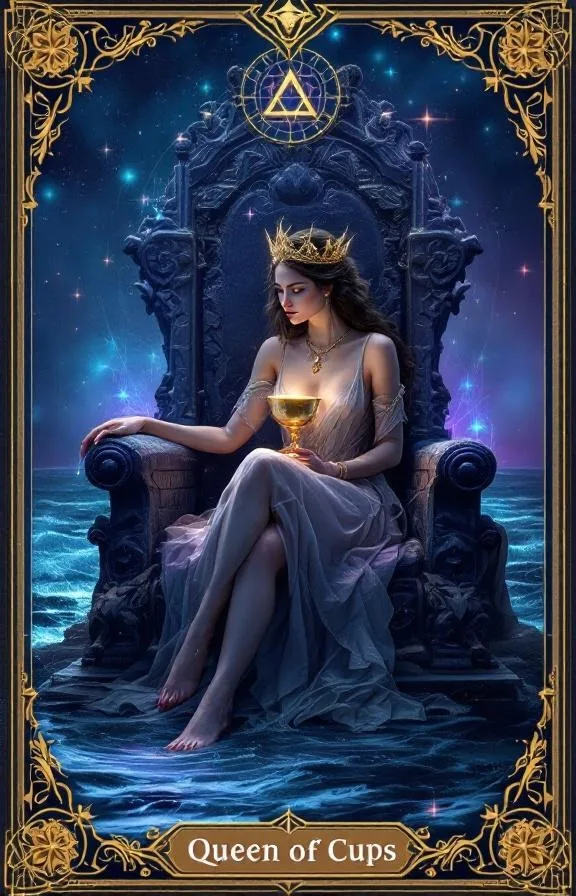
Queens (13): The master of inner experience. Queens have internalized their suit's energy so completely that it radiates outward without effort. Thirteen reduces to Four (1+3=4), connecting Queens to stability and structure — but this is internal architecture, not external walls.
Kings (14): The master of outer expression. Kings command, direct, and manifest their suit's energy in the external world. Fourteen reduces to Five (1+4=5), which is surprising — Five is disruption. Kings, for all their authority, carry the seed of change. Their mastery is never static. The moment a King stops evolving, his kingdom begins to crumble.
How to use numerology in readings
Theory is nice. Practice is better. Here are techniques you can use immediately.
Group by number, not by suit. When you lay out a spread and notice multiple cards of the same number — say, two Threes and a Three-equivalent Major Arcana — the universe is emphasizing that numerical energy. Three showing up repeatedly means creation is the dominant theme, regardless of which life domain the suits point to.
Reduce complex numbers. Major Arcana cards above IX carry compound numbers. The Tower (XVI) reduces to Seven (1+6=7) — internal challenge. The Moon (XVIII) reduces to Nine (1+8=9) — near-completion, the threshold of understanding. This reduction doesn't replace the card's primary meaning, but it adds a layer. The Tower isn't just destruction. It's Seven-type disruption that challenges you to confront what you've been avoiding.
Track the numerical arc of your spread. If your past-present-future spread shows a Two, then a Five, then an Eight, you're seeing a clear progression: choice led to disruption which led to mastery. The story tells itself through numbers alone, before you even consider the suits.
Pay attention to missing numbers. In a ten-card spread with no Fives anywhere, disruption might be conspicuously absent — which raises its own question. What are you avoiding? Where is the creative destruction that would free you? Sometimes what's missing from a reading matters as much as what's present.
Compare the same number across suits. When a client keeps drawing Sevens across multiple readings, I lay out all four Sevens and ask which image resonates most. The number seven is testing them internally — but through which lens? Fantasy (Cups)? Patience (Pentacles)? Strategy (Swords)? Defiance (Wands)? The suit they connect with reveals where the inner work is happening.
Frequently asked questions
Do I need to learn numerology separately to use it in tarot?
No, and you probably shouldn't try to graft a separate numerology system onto tarot. The deck has its own internal numerical logic that developed independently. While there's overlap with Pythagorean and Kabbalistic number meanings, tarot numerology is best learned through the cards themselves. Lay out all the Fives. Study them. What do they share? What differs? Your own observations will teach you more than any correspondence table.
Why doesn't the Major Arcana follow the same number pattern as the Minor Arcana?
It does — just not as neatly as most textbooks suggest. The Major Arcana runs 0-21, which means it passes through the 1-10 cycle twice (with 0 and the teens/twenties adding extra territory). The first ten Majors (Fool through Wheel of Fortune) deal with external forces and conscious experience. The second set (Justice through The World) deals with internal transformation and the unconscious. The numbers repeat but the depth changes. Think of it as the same scale played in two different octaves.
Can number patterns predict specific outcomes?
Tarot doesn't predict outcomes. Full stop. Numbers reveal patterns, tendencies, energetic trajectories — they show you where a current is flowing, not where the river ends. If you see three Tens in a reading, completion energy is overwhelming the spread. But what completes, and how, and whether you experience it as relief or loss — that depends on the suits, the positions, and the person sitting across from you. Numbers are the grammar of tarot. They structure the sentence. They don't write it.
Explore the Major Arcana complete guide or the Minor Arcana guide. For each card's meaning, visit the card library. Ready to see the numbers in action? Try a free reading.