A friend of mine spent two years in a job she hated. She told everyone she was "waiting for the right moment" to leave. She meditated on it. Journaled about it. Read books about career transitions. She did everything except actually transition. When I asked what she was waiting for, she paused for a long time and said, "I think I forgot."
That is The Hanged Man reversed in a single conversation.
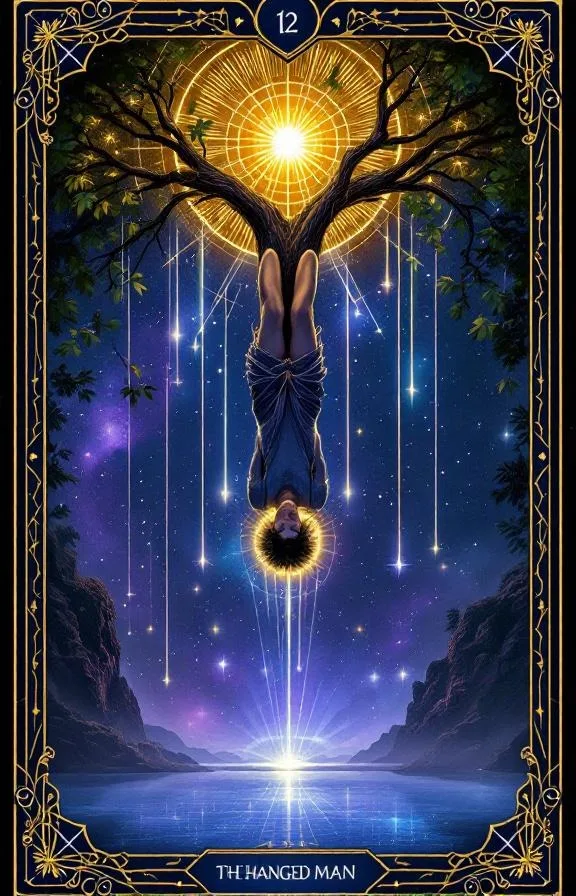
The upright Hanged Man is one of tarot's most misunderstood cards — a figure suspended by choice, gaining wisdom through voluntary stillness. The reversal strips away the wisdom and leaves only the suspension. You are hanging, but nothing is happening inside. The pause has become a prison you built yourself and then lost the key to.
In short: Where The Hanged Man upright represents chosen sacrifice and perspective-shifting stillness, the reversal points to meaningless stalling, martyrdom without purpose, and stubborn refusal to see things differently. Viktor Frankl's logotherapy distinguished between suffering that carries meaning and suffering that is simply endured — The Hanged Man reversed is suffering without the meaning, and that distinction changes everything about how you should respond to this card.
Why The Hanged Man appears reversed
Three patterns bring this card into a reversed position, and they look different on the surface but share the same root problem: suspension without purpose.
Stalling disguised as patience. You tell yourself you are being strategic, waiting for clarity, gathering information. But the information never feels sufficient. The clarity never arrives. Because the real issue is not insufficient data — it is unwillingness to act on what you already know. There is a difference between genuinely needing more time and using "more time" as a shield against the discomfort of deciding.
Martyrdom. This is sacrifice that has become identity. You suffer, and somewhere along the way the suffering stopped being a means to an end and became the end itself. People who wear their sacrifices as badges often cannot articulate what they are sacrificing for. The question "what is this achieving?" makes them uncomfortable. Not because the answer is complex, but because there is not one.
Locked perspective. The upright Hanged Man gains a new viewpoint precisely because of his unusual position — seeing the world inverted reveals what right-side-up hides. Reversed, this gift disappears. You are stuck in a single way of seeing things, and the stuckness feels like conviction. "I know what I think" becomes a wall rather than a foundation.
Viktor Frankl survived Auschwitz and built an entire therapeutic framework around one observation: humans can endure almost anything if they find meaning in it. His logotherapy patients were not told to avoid suffering — they were helped to find purpose within it. The Hanged Man reversed is what happens when you skip the meaning part. You endure. You sacrifice. You wait. But for what? Frankl would ask that question gently, and he would keep asking until you either found an answer or admitted you did not have one.
The Hanged Man reversed in love and relationships
In romantic readings, this reversal usually manifests as one of two extremes — and both are equally damaging, just in different directions.
The first: staying in a relationship out of obligation, fear, or inertia. You know something is wrong. Your body knows. Your friends know. You have probably had the same conversation with your therapist six times. But leaving feels like failure, or cruelty, or waste. So you stay. You call it loyalty. You call it patience. You call it "working on things." Sometimes those labels are accurate. When The Hanged Man shows up reversed, they usually are not.
The second extreme looks like impatience dressed up as standards. You leave before things have a chance to develop. You interpret early friction as incompatibility. You confuse the discomfort of genuine intimacy with the discomfort of a bad match. Relationships require a kind of willing vulnerability — a chosen suspension of self-protection — and the reversed Hanged Man refuses that suspension entirely.
For people currently single, this card often points to a pattern of emotional unavailability that masquerades as independence. "I am happy alone" and "I am terrified of what vulnerability might cost me" can sound identical from the outside.
The honest question this card asks in love: are you staying because it matters, or because moving feels too hard? Are you leaving because it is right, or because staying requires a kind of surrender you cannot stomach?
The Hanged Man reversed in career and finances
Most people who pull this card reversed in a career reading already know they are stuck. The card is not news. It is confirmation.
The pattern looks like this: you have been in the same role, same industry, same salary range for longer than makes sense given your skills. You have reasons — good ones, even. The market is tough. The timing is bad. You need more experience first. You need another certification. You need to save more before you make a move.
Some of those reasons are real. But The Hanged Man reversed suggests they have calcified from legitimate concerns into permanent excuses. The gap between "I cannot do this yet" and "I will not do this ever" has gotten so narrow you cannot see it anymore.
Financially, the reversal can indicate money being spent to maintain a situation that is not serving you. Rent on an apartment in a city you do not enjoy. Tuition for a degree you have lost passion for. Payments on a lifestyle that impresses people you do not particularly like. The expenditure becomes its own justification — "I have already invested so much, I cannot stop now." Economists call this the sunk cost fallacy. The Hanged Man reversed lives there.
What makes this card particularly frustrating in work readings is that it often appears for talented people. People with options. The stalling is not caused by lack of ability — it is caused by a strange attachment to the discomfort of waiting. As if movement would shatter something fragile that stillness is protecting.
The Hanged Man reversed as personal growth
Here is the uncomfortable truth about this reversal: the person pulling this card is almost certainly aware of the problem. This is not The Moon reversed, where confusion obscures everything. The Hanged Man reversed comes with a gnawing awareness that you are wasting time. That awareness makes it worse, not better, because now you are stuck AND you know you are stuck, and the knowledge itself becomes another weight.
Personal growth with this card is not about gaining insight. You have plenty of insight. You have possibly over-analyzed the situation to the point where analysis has become a substitute for action.
The growth edge is simpler and harder than any book can prepare you for: do something. Not the perfect thing. Not the optimally researched thing. Something. Break the pattern of suspension with any act of forward motion, even a clumsy one.
A client once told me she had been "working on herself" for four years before making any external changes. Four years of therapy, journaling, retreats, reading. All valuable. None of it moved her life forward in any concrete way. The Hanged Man upright would honor that inner work. The Hanged Man reversed asks: at what point does inner work become another form of hiding?
How to work with The Hanged Man reversed energy
Stop romanticizing your sacrifices. That is step one, and it is harder than it sounds because our culture loves a martyr narrative. The person who suffers nobly, who waits with grace, who puts everyone else first — these are celebrated qualities. The Hanged Man reversed asks you to distinguish between sacrifice that builds something and sacrifice that just... continues.
Practical approaches:
Set a deadline for your waiting. Not an arbitrary one — a real boundary. "If nothing has changed by [date], I will [specific action]." Write it down. Tell someone. Waiting without an endpoint is not patience. It is avoidance with better branding.
Ask Frankl's question directly. What meaning does this suffering serve? If you can answer clearly — "I am enduring this because it protects my children / builds toward a specific goal / honors a commitment I genuinely value" — then you might not be reversed at all. If the answer is vague, or circular, or absent, the card is doing its job.
Move your body. This sounds simplistic. It is not. The Hanged Man is literally a figure in physical suspension. Reversed, the stagnation often manifests physically — you stop exercising, your posture deteriorates, you spend more time sitting than standing. Physical movement breaks psychological patterns in ways that thinking alone cannot.
Relinquish one fixed opinion. Pick something you are certain about and spend a day considering that the opposite is true. Not as a permanent shift — as an exercise. The reversed Hanged Man has locked into a perspective. Any crack in that certainty is progress.
Frequently asked questions
Is The Hanged Man reversed always negative?
No card is always anything. The Hanged Man reversed can indicate that a period of necessary waiting is ending — that you are finally ready to come down from the suspension and move forward. Context matters enormously here. If you have genuinely been in a period of productive stillness and this card appears reversed, it might simply mean: the lesson is learned, the waiting is over, get moving. The negative interpretation applies when the waiting has no clear purpose or when sacrifice has become habitual rather than strategic.
What does The Hanged Man reversed mean for someone else's feelings about me?
When representing another person's feelings, this reversal often indicates frustration — specifically the frustration of feeling unable to reach you. They may perceive you as emotionally distant, perpetually unavailable, or impossible to move toward action. Alternatively, they could be the one stalling, unwilling to commit or make a decision about the relationship. The card asks you to consider who is actually doing the hanging, and why.
How is The Hanged Man reversed different from the Four of Swords reversed?
Both cards involve disrupted stillness, but the energy is completely different. The Four of Swords reversed is about interrupted rest — being forced back into activity before you have recovered. There is an element of exhaustion. The Hanged Man reversed is about purposeless suspension — the rest was never productive to begin with, or it was productive once and stopped being so long ago. The Four of Swords reversed says "I need more time." The Hanged Man reversed says "more time will not help."
Explore The Hanged Man's full meaning, see what it reveals as feelings, or discover The Hanged Man as a person. Ready for deeper insight? Try a free reading.