Business decisions pretend to be rational. They arrive dressed in spreadsheets, market analyses, and five-year projections — as though the future were a mathematics problem with a correct answer. But anyone who has built something knows that the most consequential business decisions are made in the space between the data and the gut feeling, between what the numbers say and what your body knows about risk, timing, and trust. This 8-card spread is not a substitute for business planning. It is a complement to it — a structured reflection tool that surfaces the psychological patterns, blind spots, and intuitions that your spreadsheet cannot capture but your results will inevitably reflect.
In short: This 8-card business spread maps a venture's full strategic landscape: vision, current position, advantage, risk, blind spot, next action, external forces, and likely trajectory. Daniel Kahneman and Amos Tversky's prospect theory demonstrated that humans are predictably irrational about risk — we feel losses roughly twice as intensely as equivalent gains. This asymmetry warps every business decision. The spread makes it visible so you can account for it rather than be controlled by it.
Why business needs reflection
The most expensive business mistakes are not technical. They are psychological. Kahneman and Tversky's prospect theory, developed through decades of behavioral economics research, reveals two systematic biases that affect every entrepreneur: loss aversion (the tendency to overweight potential losses relative to equivalent gains) and the endowment effect (the tendency to overvalue what you already own, including your current strategy, simply because it is yours).
Prenez un moment pour réfléchir à ce que vous venez de lire. Qu'est-ce qui résonne avec votre situation actuelle ?
These biases explain why founders hold failing products too long, why executives avoid strategic pivots even when the data demands them, and why investment committees double down on losing positions rather than cutting losses. The problem is not lack of intelligence. It is the predictable distortion that occurs when ego, identity, and financial risk converge.
Gary Klein's research on naturalistic decision-making adds another dimension. Klein studied firefighters, military commanders, and emergency room physicians and found that experts in high-stakes environments rarely compare options analytically. Instead, they recognize patterns from experience and test a single option mentally until it either fits or fails. The implication for business: strategic thinking is less about analyzing multiple possibilities and more about developing the pattern recognition that allows you to see what matters quickly. A tarot spread trains exactly this capacity — the ability to look at symbolic information and extract meaning relevant to your situation.
The 8 positions
| Position | Meaning |
|---|---|
| 1 | The vision — what you are building and why it matters |
| 2 | Current position — where the business actually stands (not where you think it stands) |
| 3 | Core advantage — the genuine strength your venture carries |
| 4 | Primary risk — the threat you most need to address |
| 5 | Blind spot — what you are not seeing that could change everything |
| 6 | Next strategic action — the single most important move to make now |
| 7 | External forces — market conditions, timing, and forces beyond your control |
| 8 | Trajectory — where this path leads if current patterns continue |
Position-by-position guide
Position 1 — The vision. Every business exists to solve a problem or fulfill a desire. This card reflects the essence of your vision — not your elevator pitch, but the deeper purpose that keeps you working when the pitch stops impressing even you. The Magician means your vision is about transformation through skill and willpower. The Emperor means your vision is about building structure, authority, and lasting systems. The Ace of Pentacles means the vision is fundamentally about creating tangible value — material, practical, real.
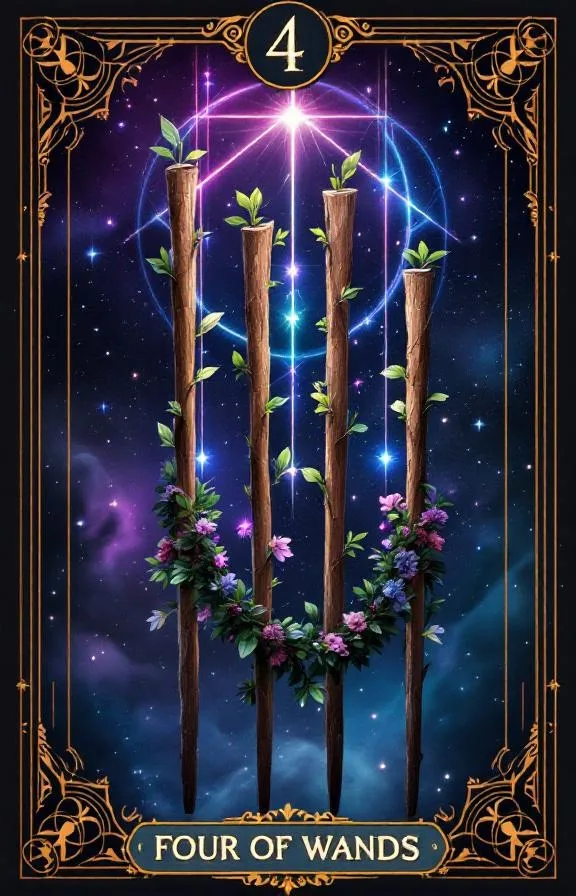
Position 2 — Current position. This is the honesty card. Not where your business plan says you should be, but where you actually are. The Five of Pentacles means financial strain or the feeling of being on the outside of your industry's warm rooms. The Four of Wands means you have achieved a genuine milestone worth celebrating before pushing forward. Kahneman's research shows that accurate self-assessment is the rarest business skill. Let this card provide it.
Position 3 — Core advantage. What do you do better than your competition, not in theory but in practice? The Queen of Pentacles means your advantage is practical wisdom, financial prudence, and the ability to nurture resources. The Knight of Swords means your advantage is speed, directness, and the willingness to cut through ambiguity. Do not confuse your advantage with your aspiration. This card names what is already true.
Position 4 — Primary risk. Prospect theory predicts that you will either underestimate this risk (if acknowledging it threatens your identity as a founder) or overestimate it (if anxiety is your default mode). The Tower means the risk is structural — something foundational about the business model is unstable. The Seven of Swords means the risk involves deception, misalignment, or someone acting in bad faith. The Ten of Wands means the risk is burnout — yours, your team's, or both.
Position 5 — Blind spot. The most valuable card in the spread. By definition, you cannot see your blind spot, which is why an external reflective tool is useful. The Moon means your blind spot is emotional — something about this venture triggers unconscious fears or desires that you are not accounting for. The Eight of Swords means you are more constrained by your own thinking than by actual circumstances. The Hermit means you are so deep in solitary work that you have lost perspective — you need outside input.
Position 6 — Next strategic action. Not a five-year plan. One move. Klein's research shows that effective action in complex environments comes from committing to a single, well-considered move rather than trying to optimize across multiple variables simultaneously. The Two of Wands means the action is strategic planning — map the territory before moving. The Eight of Pentacles means the action is skill development — invest in mastery. The Knight of Wands means act now, with boldness and speed.
Position 7 — External forces. Markets, competitors, economic cycles, regulatory changes — the factors you cannot control but must navigate. The Wheel of Fortune means timing is significant; forces larger than your venture are shifting. The Three of Pentacles means external conditions favor collaboration, partnerships, and working with established players rather than against them.
Position 8 — Trajectory. If current patterns persist — your habits, your strategy, your team dynamics, the market conditions — where does this end up? This is not a prediction. It is a trend line. The Nine of Pentacles means the trajectory leads to financial independence and mastery. The Five of Wands means the trajectory leads to competition and conflict unless something shifts. Trajectories can be altered. That is the point of reading them.
Sample interpretation
Imagine you are launching a consulting practice. Position 1 (vision) shows The Hierophant — your vision is about teaching, mentoring, and transmitting expertise. Position 5 (blind spot) shows The Moon — your fear of being exposed as insufficiently credentialed is warping your pricing and marketing. You are undercharging because imposter syndrome tells you your expertise is not worth premium rates. The blind spot reframes everything: the business challenge is not marketing strategy but psychological self-permission.
This is the kind of insight that no business plan produces but every successful founder eventually discovers, usually the hard way.
Tips for business readings
Separate identity from strategy. If you feel defensive about a card, that defensiveness is information. The cards that sting reveal the places where your ego is entangled with your business decisions — exactly the places where Kahneman's biases operate most powerfully.
Read with a partner. Business tarot readings benefit enormously from a second perspective. Your co-founder, advisor, or trusted colleague will see things in the cards that your proximity to the venture makes invisible.
Revisit quarterly. Unlike personal readings, business readings benefit from regular repetition. Markets change, strategies evolve, and the blind spot in January may be the core advantage by September. A quarterly business spread creates a reflective rhythm that complements your financial reporting.
Frequently asked questions
Is tarot appropriate for business decisions?
Tarot is a structured reflection tool, not a fortune-telling device. The same psychological research that drives executive coaching, scenario planning, and design thinking supports the use of symbolic frameworks to surface unconscious assumptions. If you use personality assessments, strategy retreats, or brainstorming exercises in your business, tarot operates by the same cognitive principles.
What suits are most relevant in business readings?
Pentacles address material and financial dimensions. Wands address vision, energy, and creative direction. Swords address strategy, communication, and conflict. Cups address team dynamics, customer relationships, and emotional culture. All four suits are relevant; the dominant suit tells you where the business's energy is concentrated.
Can I use this spread for a job search or career pivot?
Yes. Replace "business" with "career" and the positions translate directly. Position 1 becomes your professional vision. Position 5 becomes the career blind spot. Position 6 becomes the next move in your job search or transition.
The best business decisions are not made by ignoring intuition in favor of data, or by ignoring data in favor of intuition. They are made by people who have learned to integrate both — who can read a balance sheet and read a room, who can analyze a market and sense a shift. This spread trains that integration. Explore how The Emperor, The Magician, and the full suite of 78 cards reflect your professional landscape. Ready to see your business clearly? Try a free reading.