Il existe un raccourci pour lire le tarot que personne ne présente comme tel, parce qu'il ressemble trop à un devoir scolaire : apprendre les nombres. Pas les significations individuelles des cartes — ce sont soixante-dix-huit faits à mémoriser, ce qui explique pourquoi la plupart des débutants abandonnent en cours de route. Apprenez ce que signifient un à dix, et vous pouvez lire quarante des cinquante-six cartes des Arcanes Mineurs sans en avoir mémorisé une seule. Ajoutez les quatre éléments des couleurs, et vous disposez d'une formule couvrant l'ensemble du jeu.
Ce n'est ni un truc ni une astuce. C'est ainsi que le jeu a été conçu. Les créateurs du système Rider-Waite-Smith — le tarot le plus utilisé au monde, publié en 1909 — ont construit les Arcanes Mineurs sur une structure numérique délibérée. Chaque nombre, de l'As au Dix, raconte la même histoire à travers les quatre couleurs, adaptée à l'élément de chaque couleur. Les Cinq parlent toujours de conflit. Les Dix parlent toujours d'achèvement. La différence, c'est le lieu où ce conflit ou cet achèvement se produit : dans le cœur (Coupes), dans le monde matériel (Pentacles), dans l'esprit (Épées) ou dans la volonté (Bâtons).
Une fois ce schéma vu, le jeu cesse d'être soixante-dix-huit images sans lien et devient un système. Les systèmes s'apprennent.
En résumé : Comprendre ce que signifient les nombres un à dix vous permet de lire quarante cartes des Arcanes Mineurs sans mémoriser de définitions individuelles. Les As sont des débuts, les Cinq sont des conflits, les Dix sont des achèvements. Combinez le thème du nombre avec le domaine de la couleur (Coupes pour les émotions, Pentacles pour la vie matérielle, Épées pour l'esprit, Bâtons pour l'énergie) et vous disposez d'une formule d'interprétation fiable intégrée à la conception originale du jeu.
Le plus ancien langage de schémas
Les humains attribuent une signification aux nombres depuis aussi longtemps qu'ils comptent. Pythagore, mathématicien et philosophe grec du VIe siècle avant notre ère, est souvent crédité de la tradition occidentale de numérologie — l'idée que les nombres portent une signification qualitative, pas seulement quantitative. Pour Pythagore, un était l'unité. Deux était la dualité. Trois était l'harmonie, synthèse de un et deux. Il croyait que la structure même de la réalité était mathématique, et que comprendre les nombres signifiait comprendre le monde.
Nul besoin de croire que les nombres ont des propriétés mystiques pour que ce cadre soit utile. Ce que Pythagore observait — et ce que les sciences cognitives ont depuis confirmé — c'est que les humains attribuent naturellement un sens narratif aux nombres séquentiels. Nous percevons un comme un début, cinq comme une crise de mi-parcours, dix comme une fin. Ce n'est pas du mysticisme. C'est la façon dont nos cerveaux organisent l'information séquentielle. Le système du tarot a simplement codifié cette intuition dans un jeu de cartes.
Jung a écrit sur la signification psychologique des schémas numériques à travers les cultures, notant que les mêmes associations — trois comme création, quatre comme stabilité, sept comme réflexion — apparaissent indépendamment dans les systèmes religieux, la mythologie et le folklore du monde entier. Que cela reflète quelque chose d'inhérent aux nombres ou à la cognition humaine est une question philosophique. Pour la lecture pratique du tarot, cela n'a aucune importance. Les associations fonctionnent — elles produisent des interprétations fiables et utiles.
Les significations des nombres : l'As au Dix
Voici chaque nombre et ce qu'il signifie à travers les quatre couleurs. Ces attributions ne sont pas arbitraires. Chacune décrit une étape dans un cycle naturel allant du début à l'achèvement.
As (1) — la graine
L'As est le potentiel pur. L'étincelle avant le feu, l'idée avant l'action, le sentiment avant la relation. Dans chaque couleur, l'As représente quelque chose d'offert — un cadeau, une opportunité, un début si frais qu'il n'a pas encore pris forme.
L'As de Coupe est le début d'une expérience émotionnelle — un nouvel amour, une nouvelle compassion, un débordement soudain de sentiment. L'As de Pentacles est une nouvelle opportunité financière ou matérielle — une offre d'emploi, une aubaine, une chance de construire quelque chose de tangible. L'As d'Épées est une percée de clarté — une nouvelle idée, un moment de vérité, une coupe à travers la confusion. L'As de Bâtons est une explosion d'énergie créatrice — l'inspiration, l'ambition, l'envie soudaine de faire bouger les choses.
Quand vous voyez un As, le message est simple : quelque chose commence. La couleur vous dit le domaine. Votre question vous donne les détails.
Deux — dualité et choix
Le Deux introduit un second élément. Là où l'As était singulier, le Deux est dual. Partenariat, équilibre, et — inévitablement — choix. Chaque Deux présente une situation où deux choses coexistent et où il faut naviguer la tension entre elles.
Le Deux de Coupes est un partenariat — connexion émotionnelle, reconnaissance mutuelle, deux cœurs qui se rencontrent. Le Deux de Pentacles est l'équilibre — jongler avec les responsabilités, gérer des exigences concurrentes, maintenir plusieurs préoccupations pratiques en mouvement sans en laisser tomber aucune. Le Deux d'Épées est une décision — une figure aux yeux bandés tenant deux épées en parfait équilibre, un choix que l'esprit refuse de faire parce que les deux options ont un coût. Le Deux de Bâtons est un choix entre rester et partir — debout au bord du monde connu, tenant le potentiel entre ses mains, décidant d'agir ou non.
Trois — création et premiers fruits
Trois est le nombre de la création. Un et deux se rejoignent pour produire trois — un enfant, un projet, un résultat. Dans chaque couleur, le Trois représente le premier résultat tangible de ce qui a commencé avec l'As et pris forme avec le Deux.
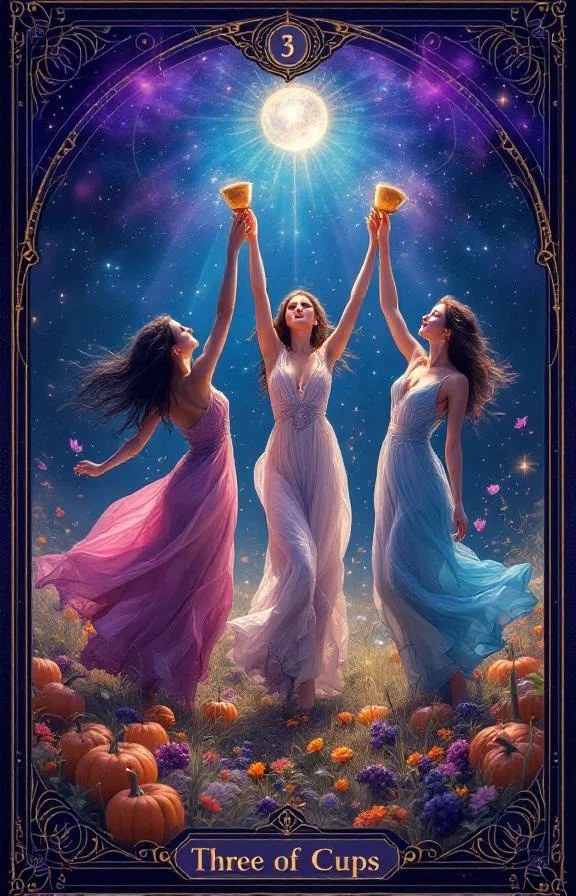
Le Trois de Coupes est la célébration — trois figures levant leurs coupes dans la joie, marquant une étape dans la connexion émotionnelle. Le Trois de Pentacles est la collaboration — un travail qualifié reconnu, le premier résultat visible de l'effort. Le Trois d'Épées est le chagrin — un cœur percé de trois épées, la vérité douloureuse que la création signifie parfois la destruction de ce qui précédait. Le Trois de Bâtons est l'expansion — regarder les navires que vous avez envoyés atteindre enfin l'horizon, la première confirmation que votre ambition va quelque part de réel.
Quatre — stabilité et structure
Quatre est le fondement. Quatre murs. Quatre coins. Quatre pieds d'une table. Dans chaque couleur, le Quatre représente un moment de stabilité — un point de repos où les choses sont maintenues en place. Cela peut être réconfortant ou étouffant, selon la couleur et la question.
Le Quatre de Coupes est la stagnation émotionnelle — une figure assise sous un arbre, bras croisés, ignorant la coupe offerte. La stabilité est devenue apathie. Le Quatre de Pentacles est la sécurité matérielle poussée à l'extrême — s'accrocher si fort qu'on ne peut plus rien recevoir de nouveau. Le Quatre d'Épées est le repos mental — une pause nécessaire, un retrait du conflit, l'esprit qui récupère. Le Quatre de Bâtons est la célébration de la stabilité — une fête, un retour à la maison, le moment où un fondement est assez solide pour être fêté.
Cinq — conflit et rupture
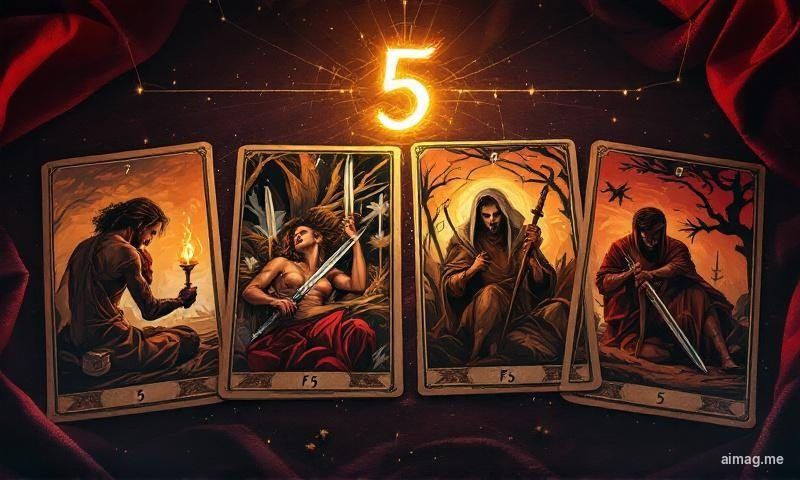
Cinq est le point médian, et il est toujours turbulent. La stabilité du Quatre se fissure. Quelque chose se brise, s'effondre ou est mis à l'épreuve. Dans chaque couleur, le Cinq est une rupture nécessaire — la crise qui teste si la structure peut tenir.
Le Cinq de Coupes est le deuil — trois coupes renversées, deux encore debout, une figure fixant ce qui a été perdu plutôt que ce qui reste. Le Cinq de Pentacles est la difficulté matérielle — deux figures dans le froid, passant devant une fenêtre éclairée, vivant le manque et l'exclusion. Le Cinq d'Épées est la victoire à la Pyrrhus — gagner l'argument mais perdre la relation, un conflit intellectuel qui laisse tout le monde meurtri. Le Cinq de Bâtons est la compétition chaotique — cinq figures s'affrontant sans but précis, de l'énergie dispersée, un conflit créatif qui n'a pas encore trouvé sa direction.
Les Cinq sont des cartes inconfortables. C'est leur rôle. Elles représentent la partie de tout processus où l'on découvre ce dont on est vraiment fait — non pas quand les choses sont faciles, mais quand elles s'effondrent.
Six — harmonie et résolution
Après la rupture du Cinq, le Six restaure l'équilibre. Mais ce n'est pas un retour à la stabilité du Quatre — c'est un nouvel équilibre qui intègre ce qui a été appris lors de la crise. Dans chaque couleur, le Six représente l'harmonie, la générosité ou la résolution.
Le Six de Coupes est la nostalgie et l'innocence — retourner à des temps plus simples, donner et recevoir à mains ouvertes, la clarté émotionnelle de l'enfance. Le Six de Pentacles est la générosité et l'échange — donner aux autres depuis une position d'abondance, équilibrer donner et recevoir. Le Six d'Épées est la transition — s'éloigner d'eaux agitées vers des eaux plus calmes, la paix mentale qui vient après avoir accepté une vérité difficile. Le Six de Bâtons est la reconnaissance — la reconnaissance publique de vos efforts, la confiance qui vient d'avoir été mis à l'épreuve et d'en être sorti victorieux.
Sept — réflexion et défi intérieur
Sept est le nombre de la réflexion. Là où le Six trouvait une résolution à l'extérieur, le Sept se tourne vers l'intérieur. Dans chaque couleur, le Sept est un défi intérieur — une question de valeurs, de stratégie ou de but à laquelle regarder au-dehors ne peut pas répondre.
Le Sept de Coupes est le fantasme et l'illusion — sept coupes dans les nuages, chacune contenant une vision différente, et le défi de distinguer le désir authentique de la pensée magique. Le Sept de Pentacles est la patience et l'évaluation — debout dans le jardin, regardant ce que vous avez fait pousser, vous demandant si la récolte vaut le travail. Le Sept d'Épées est la stratégie et la tromperie — parfois votre propre habileté, parfois celle de quelqu'un d'autre, le jeu mental consistant à comprendre ce qui se passe réellement sous la surface. Le Sept de Bâtons est la défense de sa position — debout sur une colline, repoussant les challengers, la question de savoir si cette chose vaut la peine d'être défendue.
Huit — maîtrise et mouvement
Huit est la puissance en mouvement. La réflexion du Sept a clarifié votre direction, et l'énergie se déplace avec un but. Dans chaque couleur, le Huit représente la maîtrise, la compétence ou un mouvement décisif — l'élan qui se construit quand on sait où l'on va.
Le Huit de Coupes est le départ — laisser derrière soi quelque chose qui semble complet mais ne comble plus, le courage de se diriger vers quelque chose de meilleur même quand on ne voit pas ce que c'est. Le Huit de Pentacles est la compétence et le dévouement — l'artisan à son établi, produisant carte après carte avec une attention soutenue, la maîtrise par la répétition et le soin. Le Huit d'Épées est l'emprisonnement mental — une figure aux yeux bandés, ligotée, entourée d'épées, représentant les croyances et les schémas de pensée qui vous enferment. Le paradoxe : les liens sont assez lâches pour s'échapper. La restriction est mentale, pas physique. Le Huit de Bâtons est le mouvement rapide — huit bâtons volant dans un ciel dégagé, des projets qui s'accélèrent, des messages qui arrivent, les choses qui se passent vite.
Neuf — quasi-achèvement et sagesse
Neuf est à un pas de la fin. Dans chaque couleur, le Neuf représente soit le point culminant de l'énergie de la couleur, soit la sagesse qui vient d'avoir parcouru presque tout le cycle. Les Neuf portent une qualité de maturité — ils savent quelque chose que les nombres précédents ne savaient pas.
Le Neuf de Coupes est la satisfaction — la "carte du vœu", une figure assise avec contentement devant neuf coupes dorées, ayant obtenu ce qu'elle désirait. Le Neuf de Pentacles est l'autosuffisance — une figure seule dans un beau jardin, ayant construit sa sécurité matérielle par un effort personnel, indépendante et satisfaite. Le Neuf d'Épées est l'anxiété et l'inquiétude — une figure assise dans son lit, la tête entre les mains, tourmentée par les créations de son propre esprit. Pas de danger réel — la souffrance que produit la pensée. Le Neuf de Bâtons est la résilience — une figure éprouvée par la bataille s'appuyant sur un bâton, fatiguée mais toujours debout, ayant presque terminé l'épreuve.
Dix — achèvement, excès et tournant
Dix est la fin du cycle et le début du suivant. Dans chaque couleur, le Dix est l'achèvement — mais l'achèvement est rarement simple. Il porte souvent le poids du trop, la question de ce qui vient après, et la reconnaissance que les fins et les débuts sont le même moment vu de côtés différents.
Le Dix de Coupes est l'accomplissement émotionnel — l'arc-en-ciel, la famille heureuse, la vision de tout ce qu'on voulait dans la sphère émotionnelle. Le Dix de Pentacles est l'héritage — la richesse multigénérationnelle, l'achèvement matériel qui s'étend au-delà de sa propre vie. Le Dix d'Épées est le fond absolu — une figure face contre terre avec dix épées dans le dos, la fin d'un cycle mental si définitive que la seule direction restante est vers le haut. Le Dix de Bâtons est le fardeau — porter trop, avoir assumé plus de responsabilités qu'une seule personne ne devrait en porter, le poids du succès devenant lui-même un problème.
La formule : nombre + couleur = signification
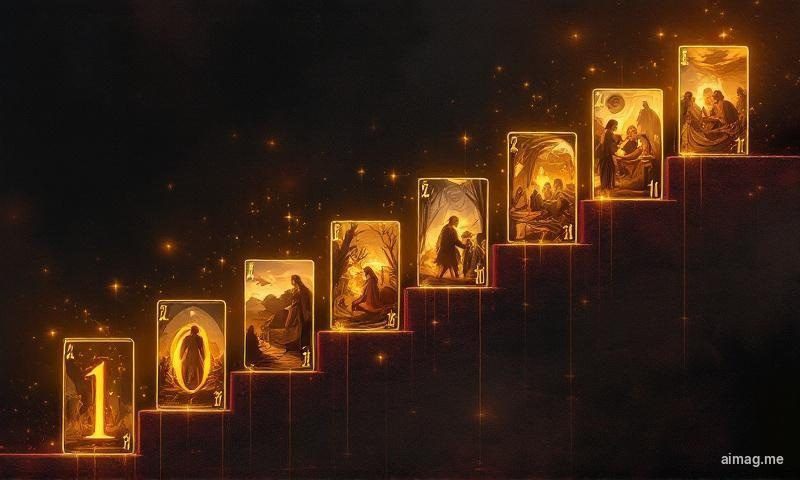
Voici l'application pratique. Quand vous tirez une carte des Arcanes Mineurs dont vous ne connaissez pas la signification, combinez le thème du nombre avec le domaine de la couleur.
| Thème du nombre | + Coupes (émotions) | + Pentacles (matériel) | + Épées (esprit) | + Bâtons (énergie) |
|---|---|---|---|---|
| 1 : Début | Nouveau sentiment | Nouvelle opportunité | Nouvelle idée | Nouvelle inspiration |
| 2 : Dualité | Partenariat | Équilibre | Décision | Choix d'agir |
| 3 : Création | Célébration | Collaboration | Chagrin | Expansion |
| 4 : Stabilité | Stagnation émotionnelle | Cramponner | Repos mental | Célébrer les fondations |
| 5 : Conflit | Deuil | Difficulté | Victoire à la Pyrrhus | Compétition chaotique |
| 6 : Harmonie | Nostalgie | Générosité | Transition | Reconnaissance |
| 7 : Réflexion | Fantasme contre réalité | Patience | Stratégie | Défendre sa position |
| 8 : Mouvement | Partir | Dévouement | Emprisonnement mental | Progression rapide |
| 9 : Quasi-achèvement | Satisfaction | Autosuffisance | Anxiété | Résilience |
| 10 : Achèvement | Accomplissement | Héritage | Le fond | Fardeau |
Ce tableau n'est pas une antisèche à mémoriser. C'est un outil de réflexion. Quand vous tirez le Cinq de Coupes et que vous ne vous souvenez pas de la signification "officielle", vous pensez : Cinq = conflit, rupture. Coupes = émotions, sentiments. Donc le Cinq de Coupes est une rupture émotionnelle — deuil, perte, quelque chose de renversé dans le monde des sentiments. Ce raisonnement vous amènera très près de l'interprétation traditionnelle à chaque fois, parce que l'interprétation traditionnelle a été construite sur la même logique.
Comme nous l'expliquons dans notre guide des quatre couleurs, chaque couleur correspond à un élément : Coupes à l'Eau, Pentacles à la Terre, Épées à l'Air, Bâtons au Feu. Ces associations élémentaires approfondissent les significations numériques. Le Feu (Bâtons) brûle fort et vite, donc les nombres des Bâtons tendent à être intenses et orientés vers l'action. L'Eau (Coupes) coule et s'accumule, donc les nombres des Coupes tendent à être émotionnels et relationnels. La Terre (Pentacles) est solide et lente, donc les nombres des Pentacles tendent à être pratiques et matériels. L'Air (Épées) coupe et se déplace, donc les nombres des Épées tendent à être mentaux et tranchants.
Les cartes de cour : le spectre des personnalités
Les seize cartes de cour — Valet, Cavalier, Reine, Roi de chaque couleur — ne suivent pas directement le système numérique, mais elles ont leur propre logique cohérente.
Les Valets sont des débutants. Le stade le plus précoce de l'énergie d'une couleur — curiosité, ouverture, volonté d'apprendre. Le Valet de Coupes est émotionnellement ouvert, peut-être naïf. Le Valet de Pentacles est désireux d'apprendre des compétences pratiques, travaille dur, tout juste au début.
Les Cavaliers sont des extrêmes. L'énergie de la couleur dans sa forme la plus active, parfois excessive. Le Cavalier de Bâtons est feu pur — passionné, impulsif, qui fonce sans plan. Le Cavalier d'Épées est air pur — intellectuellement agressif, poursuivant la vérité sans se soucier des dommages collatéraux.
Les Reines sont une expression intérieure mature. L'énergie de la couleur tournée vers la maîtrise du monde intérieur — intelligence émotionnelle, sagesse, connaissance incarnée. La Reine de Coupes est émotionnellement à l'écoute, profondément intuitive, à l'aise avec le sentiment.
Les Rois sont une expression extérieure mature. L'énergie de la couleur appliquée au monde extérieur — leadership, autorité, la capacité à structurer le domaine de la couleur. Le Roi de Pentacles est matériellement maîtrisé, financièrement sécurisé, pratiquement sage.
Les Arcanes Majeurs : une histoire numérotée
Les cartes des Arcanes Majeurs sont numérotées de 0 à 21, et la numérotation raconte une histoire qui reflète les significations numériques des Arcanes Mineurs — mais à une échelle plus grande, plus archétypale.
Le Mat est 0 — potentiel pur avant que le cycle ne commence, le moment juste avant le pas. Le Bateleur est 1 — le premier acte, le début, l'As des Arcanes Majeurs. La Papesse est 2 — la dualité, le seuil entre le connu et l'inconnu. L'Impératrice est 3 — la création, la fertilité, les premiers fruits. L'Empereur est 4 — la structure, l'ordre, la stabilité.
Ce schéma continue. La carte 10, la Roue de Fortune, représente le même achèvement-et-renouveau que les Dix des Arcanes Mineurs. La carte 13, la Mort, se réduit à 4 (1+3=4), la reliant aux cartes de structure — et en effet, la Mort parle de la dissolution d'une structure pour faire place à une nouvelle. La carte 21, le Monde, est l'achèvement final — le cycle complet, tout intégré, le moment avant que le Mat ne saute à nouveau de la falaise au 0.
La réduction numérologique — additionner les chiffres jusqu'à obtenir un seul chiffre — crée des connexions entre les cartes des Arcanes Majeurs que les lecteurs expérimentés utilisent pour une interprétation plus profonde. Le Chariot (7), la Force (8 dans certains jeux, 11 dans d'autres) et l'Étoile (17, qui se réduit à 8) partagent un ADN thématique. Vous n'avez pas besoin de maîtriser ce système immédiatement, mais savoir qu'il existe vous donne une autre couche interprétative à développer avec le temps.
Comment pratiquer la lecture par les nombres
Le moyen le plus rapide d'intérioriser le système numérique est de trier votre jeu. Sortez les quarante cartes numérales des Arcanes Mineurs (As à Dix de chaque couleur) et disposez-les en grille : les nombres en lignes, les couleurs en colonnes. Regardez la grille. Remarquez comment les images changent en descendant chaque colonne — du potentiel ouvert des As à l'achèvement lourd des Dix. Remarquez comment le même nombre semble différent selon les couleurs — comment le Cinq de Coupes et le Cinq de Bâtons parlent tous deux de conflit mais donnent une impression entièrement différente parce que le conflit se produit dans des domaines différents.
Tirez ensuite une carte au hasard et pratiquez la formule. Nombre + couleur = signification. Ne regardez pas l'image en premier. Raisonnez à partir du nombre et de la couleur, puis vérifiez votre raisonnement avec l'image. Vous serez surpris de la fréquence à laquelle l'image confirme exactement ce que le nombre et la couleur suggéraient.
Quinze minutes de cet exercice, pratiqué quelques fois, transformeront votre relation avec les Arcanes Mineurs. À la place de quarante images mystérieuses nécessitant une mémorisation individuelle, vous verrez un système cohérent — un langage avec une grammaire, où les nombres sont des verbes et les couleurs des noms. Apprenez la grammaire, et vous pouvez construire n'importe quelle phrase, même pour une carte que vous n'avez jamais rencontrée auparavant. C'est l'approche que nous recommandons dans notre guide pour lire les cartes de tarot : comprendre le système, et les significations individuelles émergent naturellement.
Questions fréquentes
Dois-je apprendre la numérologie pour lire le tarot ?
Non, mais comprendre les schémas numériques rend la lecture nettement plus facile et plus rapide. Vous pouvez apprendre chaque carte individuellement par l'étude et la pratique — de nombreux excellents lecteurs ont fait exactement cela. Mais le système numérique vous donne un cadre qui élimine la plupart des mémorisations et vous permet d'interpréter des cartes inconnues sur le moment. C'est la différence entre mémoriser chaque phrase d'une langue et en apprendre la grammaire. Les deux mènent à la fluidité, mais la grammaire est plus rapide.
Le système numérique fonctionne-t-il avec des jeux non Rider-Waite ?
Oui, avec quelques variations. Le système Rider-Waite-Smith a été spécifiquement conçu autour de ces significations numériques, et la plupart des jeux de tarot modernes en sont issus — même quand l'œuvre d'art semble complètement différente. Si vous utilisez un jeu de style marseillais (cartes numérales non illustrées), le système numérique devient encore plus important parce que vous n'avez pas d'images figuratives à interpréter. Les nombres et les couleurs sont tout ce que vous avez. Pour les jeux d'oracle et autres systèmes non-tarot, le système numérique peut ne pas s'appliquer directement, car ils suivent une logique structurelle différente.
Comment les cartes renversées interagissent-elles avec la numérologie ?
Une carte renversée modifie mais ne change pas la signification centrale du nombre. Pensez à un renversement comme l'énergie du nombre qui est bloquée, retardée ou intériorisée. Un Cinq renversé décrit toujours un conflit, mais le conflit peut être interne plutôt qu'externe, ou il peut s'agir d'un conflit que vous évitez plutôt qu'affrontez. Un As renversé décrit toujours un début, mais ce début peut être retardé ou vous n'êtes peut-être pas prêt à le recevoir. Le nombre vous dit quoi. Le renversement vous dit que le flux est perturbé.
Qu'en est-il du zéro sur le Mat ?
Zéro est un cas fascinant. Mathématiquement, zéro est à la fois rien et le potentiel de tout — l'ensemble vide d'où émergent tous les nombres. Dans le tarot, le Mat à la position 0 représente exactement cela : le potentiel pur avant qu'aucun nombre n'ait été assigné, le moment avant que l'histoire commence. Certaines traditions placent le Mat à la fin des Arcanes Majeurs (position 22 ou sans numéro), ce qui déplace l'interprétation de "avant le début" à "au-delà de la fin". Les deux placements sont valides. Les deux capturent l'idée que le Mat existe en dehors de la séquence numérotée — la carte sauvage, l'indéfini, le pas qui précède tous les pas.
Les nombres sont le squelette du jeu de tarot. Les images en sont la chair, le symbolisme en est le vêtement, et la réponse intuitive en est l'esprit — mais les nombres sont la structure qui tient tout ensemble. Apprenez ce que signifient un à dix, apprenez ce que représentent les quatre couleurs, et vous disposez d'un système de lecture qui fonctionne pour n'importe quelle carte dans n'importe quel tirage, sans guide en main. Non pas parce que les nombres sont magiques. Parce qu'ils sont logiques — un langage de schémas fabriqué par l'humain qui correspond à la façon dont nous vivons naturellement les cycles de début, de croissance, de conflit, de maîtrise et d'achèvement. Le jeu n'est pas aléatoire. Il est construit. Et une fois que vous voyez l'architecture, chaque carte a plus de sens qu'avant.
Essayez une lecture gratuite guidée par l'IA sur aimag.me/reading