On the second of November, millions of people in Poland drive to cemeteries. Not for funerals — just to visit. They light grave candles called znicze, lay chrysanthemums, and stand beside graves of people who died a year ago or thirty years ago. Cemeteries that evening look like second cities: thousands of small lights in the dark.
The tradition is called Zaduszki — All Souls' Day. It is a holiday of presence: acknowledging that your relationship with someone continues, even though their body ended long ago. That acknowledgment is what makes this day psychologically potent — whether or not you believe in souls or the afterlife.
Prenez un moment pour réfléchir à ce que vous venez de lire. Qu'est-ce qui résonne avec votre situation actuelle ?
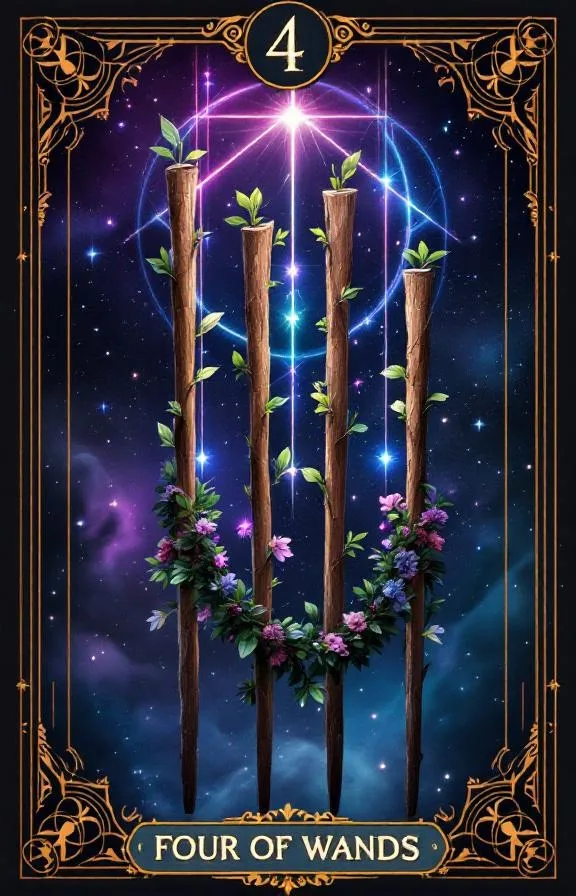
In short: All Souls' Day creates cultural permission for what grief psychology calls continuing bonds — maintaining a relationship with the deceased instead of forcing "closure." A 4-card spread gives structure to what usually goes unspoken: what we carry from them, what we wanted to say, and what we can finally leave behind.
Continuing Bonds — Grief That Does Not Need to "End"
For decades, the Kubler-Ross stage model implied that healthy grief has an endpoint — you reach acceptance, the relationship closes, you move on. In 1996, Klass, Silverman, and Nickman published Continuing Bonds: New Understandings of Grief, demonstrating the opposite: healthy grief does not mean severing the bond with the deceased. It means transforming it. The person leaves physically, but the relationship continues in internal conversations, inherited habits, memories summoned at moments of decision.
Polish Zaduszki intuited this thirty years before the research caught up. You do not say goodbye at the grave. You say "I am here."
Unfinished Conversations and Why They Weigh
There is a particular kind of pain that has nothing to do with missing someone. It is the pain of incompleteness. Things you did not say. Questions that will never be answered. Confessions that got stuck because "there will be time," and then there was not.
James Pennebaker's expressive writing research shows that giving form to the unspoken brings measurable relief. The mind treats an unfinished thought like an open loop (the Zeigarnik effect), and that loop closes when the thought finds external form. Tarot is one of those forms. When you draw a card for the Unfinished Conversation position, your unconscious receives an anchor point — the same mechanism that makes shadow work through cards more effective than a blank journal page.
Four Cards That Speak the Language of All Souls' Day
Certain archetypes resonate with the energy of remembrance more deeply than others — not because they have magical power, but because their symbolism hits precisely what is happening inside us on this day.
The High Priestess guards the threshold between conscious and unconscious. On All Souls' Day she becomes a guide: your memory is holding something important that you have been consciously avoiding.
Six of Cups — structural nostalgia. Where the past is still alive in your present behavior: a habit inherited from your father, a phrase you repeat after your mother without realizing. This card does not say "miss them." It says "see how they live on in you."
Five of Cups — grief in its raw form. Sorrow hypnotizes us with what was lost, obscuring what remains. On All Souls' Day, an invitation to turn around and see what you still have.
Judgement — an angel with a trumpet, figures rising from graves. You cannot connect a card to November 2 more literally. But Judgement is about a calling, not resurrection: what would that person want from you, if they could tell you one thing?

The "Memory and Letting Go" Spread — 4 Cards for All Souls' Day
This spread is not about "closing" a relationship with someone who died. It is about conscious differentiation: what do I want to keep, and what can I finally stop carrying?
| Position | Card | Question |
|---|---|---|
| 1 | Inheritance | What did I inherit — a pattern, a trait, a lesson, a habit? |
| 2 | Unfinished Conversation | What did I want to say and never got the chance to? |
| 3 | The Candle | What do I want to honor and consciously keep? |
| 4 | Letting Go | What can I leave behind — at the cemetery, in the past, where it belongs? |
How to read it: Position 1 is broad — a trait, a belief, a relational pattern. What remained of someone inside you, consciously or not.
Position 2 is the hardest. Unspoken words toward a deceased person function as an open cognitive loop the mind tries to close again and again. The card gives shape to what got stuck — sometimes just "I wanted to tell you that you were right."
Position 3 is the candle. Like a real grave candle, it marks what you want to keep — not out of obligation, but gratitude.
Position 4 is conscious release. Not everything inherited serves us. This card says: you can leave this here. You do not have to carry it further to remember.
When to do it: November 2, evening. Place a photograph of the person beside the cards to anchor attention.
Why All Souls' Day, Not an Ordinary Tuesday
You could do this spread on any day of the year. Technically, it would work the same. Psychologically, it would not. Narrative identity (Dan McAdams, Northwestern University) shows that people construct their sense of self not from facts but from stories — and stories need frames. A ritual that separates an ordinary day from the day you sit down and truly think about your grandfather.
All Souls' Day provides that frame. An entire country turns toward those who are gone — the culture gives permission automatically. And the four cards protect against rumination: position 1, 2, 3, 4 — and you close. Not "think about grandmother all day," but "answer four questions, light a candle."
Before You Begin
Say aloud who this spread is for. Choose one person, not "everyone I have lost" — grief is specific. Turn off your phone. Three deep breaths. And remember: if the spread pulls you into deepening sadness without clarity, that material may need professional companionship. A therapist is not an alternative to a card — a therapist is a fellow traveler when the journey becomes too heavy for one person.
On a Polish cemetery on November 2, it is quiet but not empty. A candle burns for a few hours — then it goes out, and that is okay. It does not have to burn forever. It has to burn long enough to mark: I remember. I am here. And some things I can finally say — not to you, but to myself.
Four cards. One person who is gone. And one question: what of what they left in me is a gift — and what is a weight I can finally set down?
Try a free AI-powered tarot reading at aimag.me/reading — and let the cards give shape to what is still searching for words.