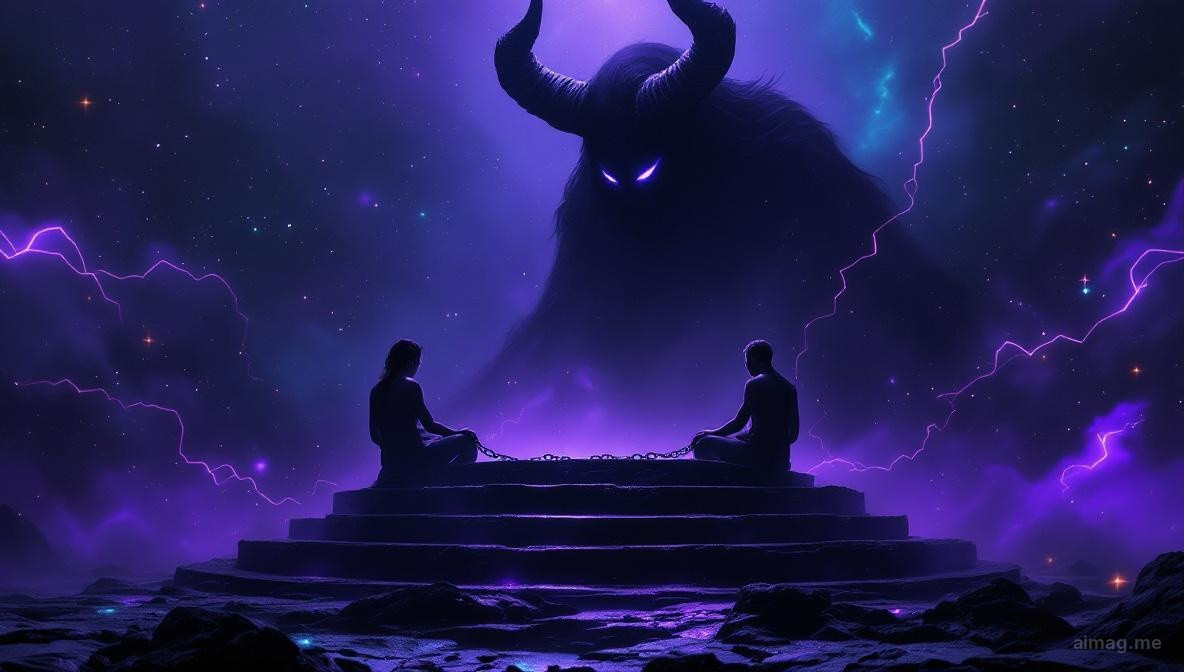
When The Devil appears as feelings, someone is caught in desire they recognize as unhealthy but cannot release. This card captures the specific emotional experience of wanting something — or someone — with an intensity that overrides reason, self-interest, and sometimes self-respect. It is not love in its healthy form. It is attachment at its most consuming, where the line between passion and compulsion has dissolved.
In short: The Devil as feelings represents the psychology of obsessive attachment and the shadow self. Gabor Mate's research on addiction demonstrates that compulsive bonds are not about the substance or person but about the emotional void they temporarily fill. Carl Jung's concept of the shadow — the parts of ourselves we refuse to acknowledge — explains why this card's energy feels simultaneously terrifying and magnetic. Upright, it reflects intense attachment, shadow desires, and emotional bondage. Reversed, it signals liberation and the courage to break free.
The emotional core of The Devil
The Devil is the most honest card in the tarot about the parts of love that polite conversation avoids. It does not represent evil. It represents the shadow — Jung's term for the aspects of ourselves that we suppress, deny, or project onto others because acknowledging them feels too threatening to our self-image.
Prenditi un momento per riflettere su ciò che hai letto. Cosa risuona con la tua situazione attuale?
Jung argued that the shadow is not inherently destructive. It becomes destructive only when it remains unconscious. The person who insists they are "not the jealous type" while monitoring their partner's phone is living their shadow. The person who claims complete independence while manufacturing crises to keep a partner's attention is being controlled by desires they refuse to name.
Gabor Mate, whose work on addiction reframed compulsive behavior as a response to emotional pain rather than a moral failing, provides the clinical framework for understanding The Devil as feelings. Mate found that addiction — to substances, to people, to patterns — is fundamentally about an unmet need being addressed in a way that creates more suffering than it relieves. The Devil as a feeling is precisely this: the awareness that what you want is hurting you, paired with the inability to stop wanting it.
What distinguishes this card from simple desire is the element of bondage. Look at the traditional imagery: the figures chained to the devil's pedestal could remove their chains at any time. The chains are loose. The imprisonment is voluntary — which makes it far more psychologically complex than external constraint. The feeling of The Devil is not "I am trapped." It is "I am choosing to stay trapped, and I cannot understand why."
The Devil upright as feelings
Upright, The Devil describes desire at its most consuming and least rational. Someone feeling The Devil upright toward another person is in the grip of an attraction that operates below the level of conscious choice. They know, on some level, that the intensity is unsustainable or unhealthy. They cannot stop.
The primary emotional experience is obsessive fixation. The person thinks about the other person constantly — not in the pleasant, daydreamy way of early attraction, but in the compulsive, intrusive way that disrupts sleep, concentration, and other relationships. The desire does not feel like a choice. It feels like a force.
In relationships, this manifests as what trauma researcher Judith Herman would recognize as a "traumatic bond" — a connection forged not through mutual respect and safety but through cycles of intensity: idealization followed by disappointment, closeness followed by distance, ecstasy followed by anguish. Each cycle deepens the attachment because the relief of the "good" phase becomes more desperately needed after the pain of the "bad" phase.
Imagine someone who knows their relationship follows a destructive pattern. Every few weeks, there is a fight that feels like the end. Then there is a reconciliation that feels like the beginning. The reconciliation is so intense, so relieving, that it overrides the memory of the fight. Until the next one. The Devil is the feeling during the reconciliation — the rush of returning to someone you know you should leave, experienced as love because the alternative (acknowledging the pattern) is too painful.
Mate would add that the person feeling The Devil is often medicating an older wound with this relationship. The intensity is not actually about the other person. It is about a need — for validation, for excitement, for the feeling of being needed — that predates this relationship entirely.
The Devil reversed as feelings
Reversed, The Devil describes one of the most powerful emotional experiences available to a human being: breaking free from a pattern that controlled you. This is not gentle release. It is the feeling of chains dropping and the simultaneous terror and exhilaration of no longer being bound.
The central emotion is liberation mixed with grief. Someone feeling The Devil reversed has seen their shadow clearly — the need, the compulsion, the pattern — and has chosen to stop participating. This does not mean the desire has disappeared. It means they have decided that the cost of indulging it exceeds the cost of facing withdrawal.
Jung wrote that integrating the shadow is the most difficult and most necessary work of psychological maturity. It requires acknowledging the parts of yourself that you find most shameful: the neediness, the jealousy, the capacity for manipulation, the willingness to accept treatment you know is wrong. The Devil reversed is the feeling of that acknowledgment — uncomfortable, raw, and ultimately freeing.
In relationships, this shows up as the moment someone finally leaves a toxic dynamic. Not in anger, not in self-righteousness, but in clear-eyed recognition that the bond, however intense, is not love. It is addiction. And like all addictions, the only way through withdrawal is through.
The warning with The Devil reversed is that liberation can feel like loss. The person may grieve the intensity even as they recognize it was destroying them. This grief is real and should be honored — but it should not be mistaken for evidence that the attachment was healthy.
In love and relationships
In romantic contexts, The Devil as feelings requires careful interpretation. When someone feels The Devil toward you, their feelings are intense and genuine — but they may not be healthy. Upright, this person is consumed by desire that has more to do with their own unmet needs than with who you actually are.
This connects to what attachment researchers call "anxious-preoccupied attachment" — a style characterized by intense desire for closeness paired with constant fear of abandonment. People with this attachment style experience love as The Devil describes it: all-consuming, anxiety-driven, and resistant to the kind of secure, steady connection that would actually satisfy their needs.
If you are drawing The Devil, ask yourself honestly: is this attraction or addiction? The distinction is not always obvious from the inside. Attraction allows space for the other person to be themselves. Addiction requires them to be your source of emotional regulation.
Reversed in love, The Devil signals someone who has recognized an unhealthy pattern and is actively working to break it. They may be pulling away not because they have stopped feeling, but because they have realized that the feeling itself was the problem. This is the beginning of healthier attachment — painful but necessary.
When you draw The Devil as feelings in a reading
If The Devil appears when you ask about feelings, do not dismiss the intensity as "just attraction." This card asks you to examine the difference between desire and compulsion, between choosing someone and needing them to fill a void.
Ask yourself: if this person gave me everything I think I want, would I be at peace? Or would a new anxiety take the place of the old one? The Devil's chains are always self-imposed, which means they can always be removed.
If reversed, honor the courage it takes to see your own shadow. Breaking free from an emotional pattern does not happen through willpower alone — it happens through awareness. You have already done the hardest part.
For support in understanding the patterns your feelings reveal, try a free reading.
Frequently asked questions
What does The Devil mean as feelings for someone?
The Devil as feelings means someone is experiencing intense, consuming desire toward you that borders on obsession. The feelings are real but may be driven more by their unmet emotional needs than by genuine connection. There is an addictive quality to their attachment.
Is The Devil a positive card for feelings?
The Devil upright indicates powerful feelings but warns of unhealthy attachment patterns — obsession, codependency, or trauma bonding. Reversed, it is more positive: it signals awareness and the courage to break free from destructive emotional cycles.
How does The Devil reversed differ as feelings?
Reversed, The Devil shifts from bondage to liberation. The person is breaking free from an obsessive pattern, seeing the attachment clearly for the first time, and choosing healthier emotional engagement. The intensity fades, replaced by clarity.
Explore the full guide to all 78 cards as feelings or discover The Devil's complete meaning. Ready to explore what the cards reflect about your emotions? Try a free reading.