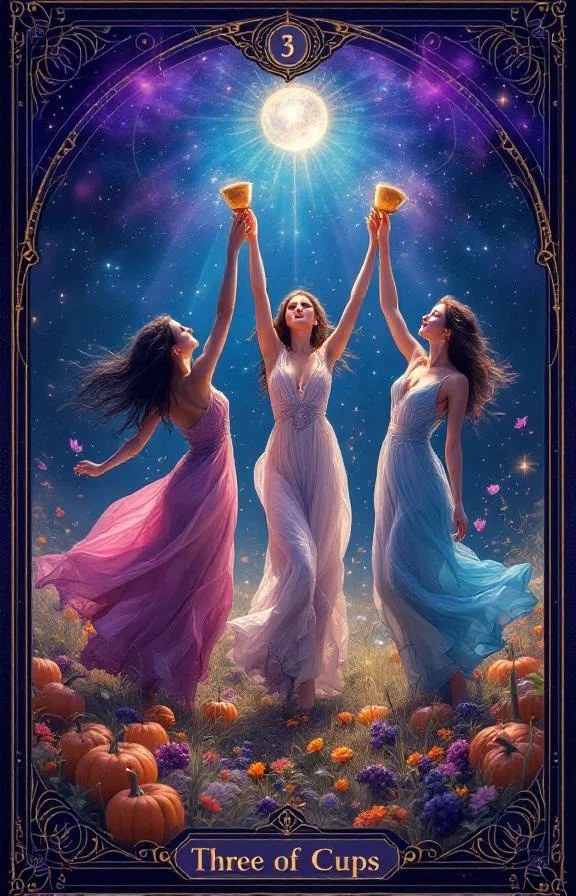
When the Three of Cups appears as feelings, someone is experiencing the specific joy that comes from belonging. Not the private happiness of a solitary achievement or the intensity of romantic passion, but the expansive warmth of being included, celebrated, and genuinely connected to people who are glad you exist. This is the emotional experience of community at its finest — the feeling of raising a glass with people who know you and like you anyway.
In short: The Three of Cups as feelings captures the emotional warmth of genuine social connection — friendship, celebration, and the sense that you belong. Upright, it signals joy shared and multiplied through community. Reversed, it points to exclusion, social anxiety, or relationships where superficial fun has replaced real intimacy. Sheldon Cohen's research on social support demonstrates that perceived belonging directly buffers stress and improves emotional resilience. This card says: you are not alone in what you feel.
The emotional core of the Three of Cups
The Three of Cups occupies a unique place in the emotional spectrum of tarot. While most Cups cards deal with intimate, one-to-one feelings — love, grief, longing, connection — the Three opens the lens wider. This is not a card about a single relationship. It is about the emotional experience of belonging to a group, a circle, a community that holds space for joy.
Sheldon Cohen, professor of psychology at Carnegie Mellon University, spent decades researching the relationship between social support and health outcomes. His landmark studies demonstrated that people who perceive themselves as socially connected are measurably more resilient — not just emotionally, but physiologically. They get sick less often, recover faster, and experience lower rates of depression and anxiety. The key word is "perceive." It is not the number of friends that matters but the felt sense of belonging.
Roy Baumeister and Mark Leary, in their influential 1995 paper "The Need to Belong," argued that belongingness is not a luxury but a fundamental human motivation — as basic as hunger or the need for safety. When this need is met, people experience a distinctive emotional state: relaxed, expansive, generous, playful. When it is unmet, they experience anxiety, depression, and a pervasive sense that something essential is missing. The Three of Cups upright captures the first state perfectly. It is the feeling of having your belonging need genuinely satisfied.
What distinguishes this card from mere socializing is its emotional authenticity. The Three of Cups is not about networking events or obligatory family gatherings. It is about the moments when connection is real — when laughter is genuine, when the people around you know your story and celebrate your wins without jealousy.
Three of Cups upright as feelings
When the Three of Cups appears upright as someone's feelings, they are experiencing emotional abundance through connection. This person feels supported, included, and genuinely happy — not in isolation, but in the company of others who matter to them. Their emotional cup is not just full; it is being raised in a toast.
In romantic contexts, this card does not always point directly to romantic love. Instead, it often indicates that the person feels so emotionally secure in their broader social world that they can bring that groundedness into romance. Cohen's research supports this: people with strong social networks tend to form healthier romantic attachments because they are not placing the entire weight of their emotional needs on one person.
When the Three of Cups does appear as romantic feelings, it often indicates the joyful stage of a relationship where you are introducing each other to friends, celebrating together, building a shared social life. The person feels proud of the connection — happy enough to let it be visible.
Imagine a group of old friends who have not seen each other in months finally gathering for an evening. The conversation picks up exactly where it left off. Someone tells a story that makes everyone cry with laughter. Someone else mentions a struggle they have been having, and the group responds not with advice but with presence. By the end of the night, everyone feels lighter. That specific emotional quality — joy multiplied by sharing — is the Three of Cups.
In self-reflection, drawing this card as your own feelings suggests you are in a period where community and friendship are actively nourishing you. You may be realizing that the connections you have built are more valuable than you previously recognized.
Three of Cups reversed as feelings
The Three of Cups reversed points to the painful side of social experience: exclusion, superficiality, or the sense that the celebration is happening somewhere without you. This reversal does not mean you have no friends. It means that your emotional experience of social connection has been compromised — either because the connections are not genuine, or because something has made you feel like an outsider in your own circle.
Baumeister and Leary's research on belongingness shows that social rejection activates the same neural pathways as physical pain. The Three of Cups reversed, when it appears as feelings, often reflects exactly this: a social wound that hurts more than the person wants to admit. Being left out of a group text, learning about a gathering you were not invited to, noticing that conversations go quiet when you enter the room — these small exclusions can produce disproportionate emotional pain precisely because belonging is so fundamental.
Another manifestation is the experience of social overindulgence as emotional avoidance. The reversed Three can indicate someone who uses constant socializing to avoid being alone with their feelings. The parties never stop, the plans are always full, but beneath the activity is a growing emptiness. The celebration has become a performance.
Gossip and social betrayal also live in this reversal. The feeling of discovering that people you trusted have been talking about you, or that a friendship group has fractured into factions, carries a specific emotional signature — a mix of hurt, anger, and the disorienting sense that the ground you were standing on was not as solid as you believed.
In love and relationships
In romantic readings, the Three of Cups upright as feelings often indicates that the emotional context around a relationship is positive. The person not only feels good about you — they feel good about the world you inhabit together. Their friends like you. Your friends like them. The relationship does not exist in a vacuum but is woven into a broader social fabric that supports it.
This card can also signal the feeling of celebration within a relationship — engagement joy, pregnancy announcements, the emotional warmth of shared milestones. The love is not private and contained; it wants to be witnessed and shared.
Cohen's social buffering hypothesis is relevant here: romantic relationships that exist within a supportive social network tend to be more resilient than those that are isolated. The Three of Cups in a love reading suggests that the relationship has this kind of community support, and that the person's feelings include gratitude for this broader holding.
Reversed in love, the Three of Cups can indicate jealousy, a third-party situation, or the uncomfortable feeling that a relationship is performing happiness without actually producing it. If the reversed Three represents someone's feelings, they may be comparing their relationship to others' and finding it lacking, or feeling that the social pressure to appear happy is drowning out their actual emotional experience.
When you draw the Three of Cups as feelings in a reading
If the Three of Cups appears as feelings in your reading, the question centers on community. Where do you feel genuinely included? Where are you performing belonging without actually experiencing it?
Ask yourself: Which relationships in my life fill me with genuine warmth? Am I investing enough in the friendships that sustain me? Have I been neglecting community in favor of romantic intensity or solitary ambition?
The Three of Cups reminds you that joy is not a solitary sport. Never was. Some emotions can only be fully experienced in the company of others — and the willingness to share your joy is itself a form of emotional courage.
Explore what the Three of Cups reflects about your emotional connections with a free reading.
Frequently asked questions
What does the Three of Cups mean as feelings for someone?
The Three of Cups as someone's feelings toward you indicates warmth, inclusion, and genuine happiness in your company. They feel that being with you is celebratory — you bring joy not just privately but in shared, social contexts. They want others to see what you have together.
Is the Three of Cups a positive card for feelings?
Upright, very much so. It signals authentic joy, strong friendships, and the emotional nourishment of genuine belonging. Reversed, it warns of exclusion, superficial connections, or using social activity to avoid deeper feelings that need attention.
How does the Three of Cups reversed differ as feelings?
Reversed, the celebration becomes hollow. Instead of genuine belonging, there is a sense of exclusion, social performance, or connection that lacks depth. The person may feel left out, betrayed by their social circle, or exhausted by maintaining appearances of happiness.
Explore the full guide to all 78 cards as feelings or discover the Three of Cups' complete meaning. Ready to explore what the cards reflect about your emotions? Try a free reading.