A CEO I read about a few years ago made headlines for paying all his employees a minimum of seventy thousand dollars a year. The story went viral. He was profiled in magazines. He gave TED-style talks about equity and fairness. Employees cried on camera about how the policy changed their lives.
Within two years, several senior staff had quit. In interviews — always anonymous — they described a workplace where the salary policy functioned as a loyalty test. Disagreeing with the CEO on any issue was met with a specific look and a variation of: "I gave you seventy thousand dollars a year and this is how you repay me?" The generosity was real. The strings attached to it were also real. And the strings cost more than the money was worth.
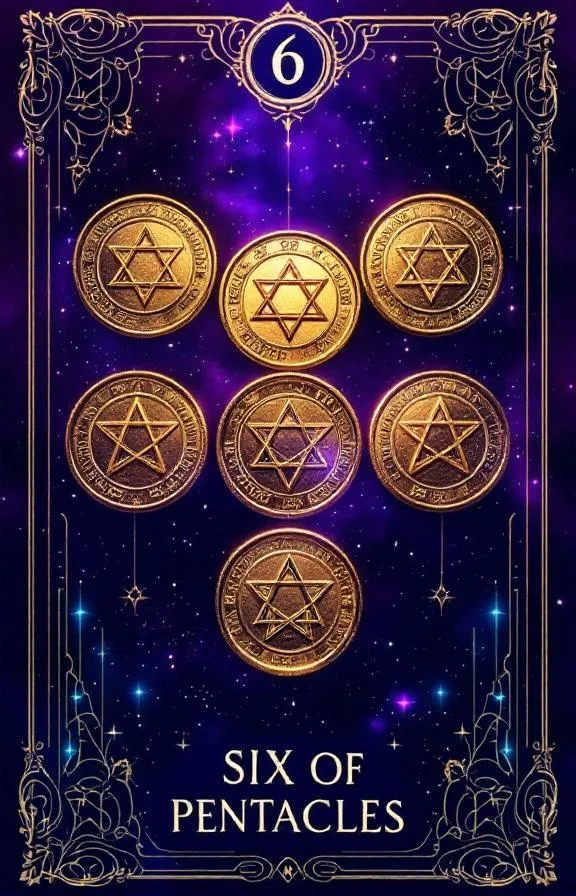
That CEO is the Six of Pentacles reversed in its purest form: a gift that is actually a leash.
In short: The Six of Pentacles reversed exposes the shadow side of generosity — giving that controls, receiving that enslaves, or an exchange that looks fair on the surface but is profoundly imbalanced underneath. Adam Grant's research on reciprocity styles identified "takers" who disguise themselves as "givers," creating relationships where apparent generosity masks exploitation. This card appears when that mask slips.
Why the Six of Pentacles appears reversed
The upright Six of Pentacles shows a wealthy figure distributing coins to two kneeling recipients while holding a balanced scale. The image is deliberately ambiguous. Is this genuine charity? Patronage? Noblesse oblige? The upright card asks you to consider the power dynamics of giving and receiving. The reversed card gives you the answer, and the answer is usually uncomfortable.
There are three primary manifestations of this reversal.
The first and most common: generosity with conditions. Someone gives — money, time, opportunity, emotional support — but the gift comes with expectations that are never stated aloud. The parent who pays for college and then dictates your career. The friend who always picks up the check and then holds it over you during arguments. The employer who offers "flexibility" but tracks every minute. The giving is genuine. The debt it creates is also genuine. And the debt never seems to get paid off.
The second: you are on the receiving end of an unfair arrangement and cannot see it clearly. This happens more than people admit. The relationship where one person is always the helper and the other is always the helped. The friendship where one person's problems are always the priority. Over time, the receiver starts to believe they deserve less — that the imbalance is natural rather than constructed.
The third is rarer but worth naming: you are the one exploiting someone's generosity. Taking advantage of a kind boss. Accepting a friend's help repeatedly without reciprocating. Leaning on a partner's emotional labor while offering none of your own. The card does not accuse. It reveals.
Grant's research uncovered a category he called "disagreeable givers" — people who are genuinely generous but also direct, demanding, and unwilling to be exploited. These individuals produce the best outcomes in organizations because they give strategically. They help others succeed without sacrificing their own boundaries. The Six of Pentacles reversed often appears for people who are agreeable givers — generous, accommodating, and slowly being drained by their own niceness. The card is not asking them to stop giving. It is asking them to give with teeth.
Six of Pentacles reversed in love and relationships
This card in a love reading is about power. Full stop.
Healthy relationships involve give and take, and that exchange is never perfectly balanced at any given moment — sometimes you carry more, sometimes your partner does. The Six of Pentacles reversed is not about temporary imbalance. It is about structural imbalance. One person consistently holds more power, more resources, more control, and uses their generosity as the mechanism of that control.
The classic pattern: one partner earns significantly more and uses that financial advantage — consciously or not — to dominate decisions. Where you live. Where you vacation. What you eat for dinner. These decisions are technically shared, but the person with money has veto power, and everyone knows it. "I pay for everything" becomes an unspoken trump card that ends any disagreement.
A subtler version plays out emotionally. The partner who is always the caretaker, always the strong one, always the one who sacrifices. On paper this looks selfless. In practice it creates a relationship where one person is perpetually in debt — emotionally indebted to someone who will never declare that debt satisfied.
For single people, the Six of Pentacles reversed sometimes warns about entering a relationship from a position of excessive need. If you are looking for someone to rescue you — financially, emotionally, from loneliness — the card is saying that the relationship you attract from that position will replicate the power dynamics it depicts. Rescuers become controllers. Dependence becomes resentment. The healthiest thing you can do before entering a relationship is make sure you are not entering it as a beggar.
Grant's research distinguishes between "otherish" givers — who maintain boundaries and give strategically — and "selfless" givers, who give until they collapse. In relationships, the Six of Pentacles reversed frequently appears for selfless givers who have given away so much of themselves that they no longer recognize what belongs to them.
Six of Pentacles reversed in career and finances
Workplace dynamics are where this card does its sharpest work.
Consider the manager who mentors junior employees but only the ones who display adequate gratitude. The company that offers incredible perks — free meals, gym access, game rooms — while expecting sixty-hour weeks in return. The investor who funds your startup and then micromanages every decision because "it is my money on the line." Each of these is a version of the Six of Pentacles reversed: resources flowing downward with invisible strings pulling upward.
If you are the employee in this scenario, the card is asking you to calculate what you are actually receiving. Not just the salary. The full package: the stress, the lost autonomy, the gratitude you are expected to perform, the freedom you have given up. Sometimes the math still works. Sometimes it does not. The card is not telling you to quit. It is telling you to do the math honestly.
Financially, this reversal frequently appears in readings about debt — particularly the kind of debt that comes from personal relationships rather than institutions. Money borrowed from family. The friend who lent you rent money three years ago and still mentions it. Business loans with informal terms that keep shifting. A bank charges interest in percentages. People charge interest in loyalty, silence, and compliance.
Here is the controversial statement: some people cannot afford to be generous, and they do it anyway, and it damages everyone involved. The Six of Pentacles reversed sometimes appears for the person who keeps giving despite being broke, who picks up the check despite maxed credit cards, who lends money they will never see again because saying no feels like a moral failure. This is not virtue. It is a different kind of selfishness — the kind that prioritizes feeling good about yourself over actual financial survival.
Six of Pentacles reversed as personal growth
The growth work of this card is about dismantling your relationship with the concepts of deserving and owing.
Most people carry an internal ledger. They track — not always consciously — what they have given and what they have received. Who owes them. Who they owe. This ledger governs behavior in ways that are almost invisible. You help a colleague because they helped you last month. You avoid asking a friend for a favor because you still "owe" them for the last one. You accept mistreatment from a parent because "they sacrificed so much for me."
The Six of Pentacles reversed says: look at your ledger. Is it accurate? More importantly, is it serving you?
Grant found that the most successful professionals were neither pure givers nor pure takers. They were what he called "matchers" who had learned to give strategically — with clear boundaries, without expectation of immediate return, and with the wisdom to recognize when someone was exploiting their generosity. The growth invitation of the Six of Pentacles reversed is to become this kind of giver: generous but not naive, open-hearted but not open-wounded.
There is a deeper layer too. This card sometimes appears for people who define their worth entirely through what they give to others. Remove the giving and they feel worthless. Purposeless. This is a profound identity issue, and the card names it directly. You are not your generosity. You are not your usefulness. You have value that exists independent of what you provide. If that sentence makes you uncomfortable, the card is talking to you.
How to work with Six of Pentacles reversed energy
Audit your relationships for hidden transactions. Every significant relationship involves some exchange — that is normal. What the Six of Pentacles reversed asks you to examine is whether the exchanges are transparent and fair. Do you know what is expected of you in return for what you receive? Does the other person know what you expect? If either answer is no, a conversation is overdue.
Practice receiving without guilt. This is harder than it sounds for people conditioned to equate receiving with owing. Someone compliments you — say thank you, not a deflection. Someone offers to pay — let them, once, without performing reluctance. Someone gives you a gift — enjoy it without immediately calculating what you need to give back.
If you are the one with strings attached to your generosity, examine why. Usually the strings exist because the giving is not actually about the recipient. It is about your need to be needed, your fear of being forgotten, or your desire to maintain control in a relationship where you feel otherwise powerless. Removing the strings does not mean giving less. It means giving honestly — without the invisible invoice.
Frequently asked questions
Does the Six of Pentacles reversed mean someone is taking advantage of me?
It can, and it frequently does. But the card is equally likely to appear when you are the one creating the imbalance — either by giving with conditions or by taking without reciprocating. Before looking outward, look inward. The card appeared in your reading, which means your role in the dynamic is the one that needs examination first.
Is it bad to receive help when this card appears?
No. The card is not anti-generosity or anti-receiving. It is anti-exploitation and anti-imbalance. Receiving help is healthy and necessary. The card asks you to be honest about the terms of the help you are receiving. Is it freely given? Are there expectations attached? Can you accept it without losing your autonomy?
How do I know if my generosity has strings attached?
Ask yourself this: if the person you helped never acknowledged your help, never thanked you, never reciprocated in any way — would you still be glad you helped? If the honest answer is no, your generosity has conditions. That does not make you a bad person. It makes you human. But acknowledging the conditions allows you to either remove them consciously or stop pretending they do not exist. Both options are better than the alternative, which is performing unconditional generosity while secretly keeping score.
Explore the Six of Pentacles' full meaning, see what it reveals as feelings, or discover the Six of Pentacles as a person. Ready for deeper insight? Try a free reading.