Most beginners ask "should I start with tarot or oracle cards?" and get some version of: tarot has structure, oracle cards are intuitive, pick whichever calls to you. That answer is not wrong. It is shallow enough to be useless — like telling someone choosing between chess and freeform jazz that one has rules and the other has vibes.
The more honest answer: the choice between tarot and oracle cards reveals how your brain prefers to process complexity. Some people need a framework to push against. Others need open space to think freely. Neither is superior. But knowing which one you are will save you months of fighting a system that works against your natural cognitive style instead of with it.
This is a comparison built on what these two systems actually do to your thinking — not which one is more "spiritual" or "accurate" or "powerful." Those categories are meaningless. What matters is mechanism.
In short: Tarot is a fixed 78-card symbolic system that works through ambiguous projective interpretation, like a Rorschach test with six centuries of accumulated meaning. Oracle cards are freeform decks with direct keyword messages that work through guided reflection. Tarot suits analytical thinkers, complex questions, and shadow work; oracle cards suit daily practice, emotional comfort, and people who prefer open space over frameworks. Most experienced readers use both.
What tarot actually is
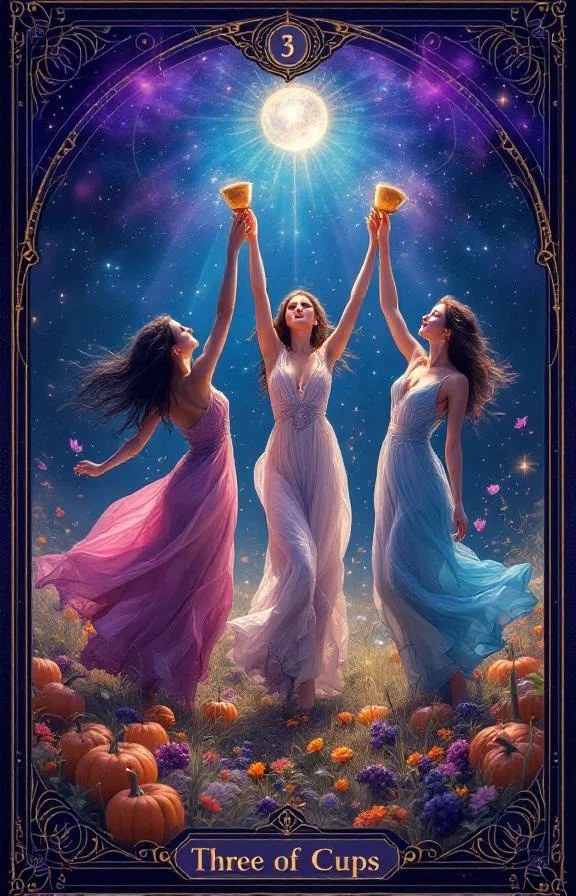
Tarot is a 78-card system with a fixed architecture. Every tarot deck — from the Rider-Waite-Smith published in 1909 to the thousands of modern variants — follows the same structural blueprint:
- 22 Major Arcana — archetypal cards representing universal human experiences. The Fool is the beginning of a journey. Death is transformation. The Tower is sudden disruption. Big themes of human life, encoded in images.
- 56 Minor Arcana — divided into four suits (Cups, Pentacles, Swords, Wands), each with cards numbered Ace through Ten plus four court cards (Page, Knight, Queen, King). These cover the everyday textures of experience — emotions, material concerns, thoughts, actions.
This structure is not arbitrary. It evolved over centuries, starting as playing cards in 15th-century Italy, passing through occult societies in 18th-century France, and arriving at its modern form when Pamela Colman Smith illustrated the Rider-Waite-Smith deck in 1909. Smith did something revolutionary: she gave every card — including the numbered Minor Arcana — narrative scenes rather than simple pip patterns. Suddenly every card told a story you could read.
The psychological power of tarot's structure is what Jung would have predicted. His concept of archetypes — universal patterns of human experience in the collective unconscious — maps almost perfectly onto the Major Arcana. The Fool is the innocent beginning. The Emperor is structure and authority. The Hermit is introspective withdrawal. These are observable patterns in human storytelling, mythology, and behaviour that show up across cultures and centuries. The tarot gave them pictures and a sequence.
What this means in practice: when you draw a tarot card and feel a jolt of recognition, you are not receiving a message from the universe. You are encountering a symbolic representation of something already present in your psychological experience. The card did not know. You knew. The card just made you look. Psychologists call this the projection effect — the same mechanism that makes inkblot tests work.
The structure matters because it forces interpretation. A tarot card is deliberately ambiguous. The Ten of Swords shows a figure lying face down with ten swords in their back — but is this catastrophe or the end of catastrophe? The dawn breaks in the background. The image holds both readings at once, and your mind has to choose which one resonates. That act of choosing is where the self-reflection happens.
What oracle cards actually are
Oracle cards are everything tarot is not — by design. No fixed structure. No standard card count. No universal system. Each oracle deck is a self-contained creation by its designer, with its own theme, its own rules, its own internal logic.
A typical oracle deck has 30 to 60 cards, though some go as low as 12 and others past 80. Themes range from animals and angels to chakras, affirmations, goddesses, moon phases, and abstract emotions. Cards usually carry a keyword or phrase — "Trust," "Release," "New Beginning" — along with artwork and a guidebook explanation.
The lack of structure is not a weakness. It is the entire point.
Where tarot demands that you interpret ambiguous symbolism through a fixed framework, oracle cards hand you a direct message with room for personal resonance. Draw a card that says "Boundaries" with an image of a walled garden, and you do not need suit correspondences or elemental associations or positional meanings. You sit with the concept of boundaries and notice where your mind goes.
This makes oracle cards psychologically accessible in a way tarot is not. No learning curve. No wrong interpretation. No anxiety about reading it "right." You draw, you receive, you reflect. The barrier to entry is essentially zero.
Key differences at a glance
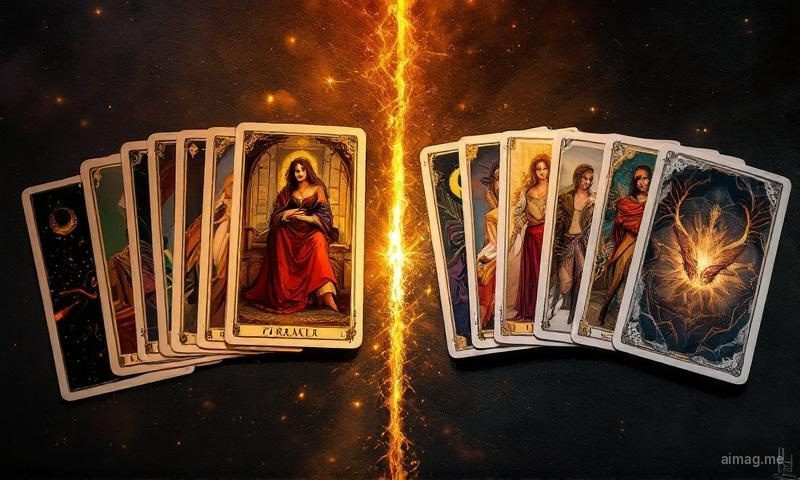
| Dimension | Tarot | Oracle cards |
|---|---|---|
| Structure | Fixed 78-card system (22 Major + 56 Minor Arcana) | Creator-defined, typically 30-60 cards, no standard |
| Learning curve | Moderate to steep — card meanings, spreads, suit systems, reversals | Minimal — guidebook and intuition |
| Interpretation style | Symbolic, layered, requires active analysis | Direct, intuitive, often keyword-based |
| Depth per card | High — each card holds multiple meanings depending on position, question, and surrounding cards | Variable — depends on deck design, generally more focused |
| Versatility | Very high — one deck handles any question domain | Theme-dependent — an angel oracle will not help with career strategy |
| Reading approach | Analytical + intuitive — you must think and feel simultaneously | Primarily intuitive — you receive and reflect |
| Psychological mechanism | Projective interpretation of ambiguous stimuli (similar to Rorschach) | Directed reflection on explicit prompts (closer to affirmation) |
| Card relationships | Cards interact — position matters, combinations create new meanings | Cards are typically read independently |
| Reversals | Yes (most systems) — doubles the interpretive range | Rarely |
| Historical lineage | ~600 years of accumulated symbolic tradition | Modern — most decks created in the last 30 years |
This table simplifies things, of course. Some oracle decks have deep symbolic systems and some tarot readers work purely intuitively. But as general categories, these distinctions hold.
When tarot works better
Tarot excels when the question is complex, when you need to examine multiple dimensions at once, or when you want to push past your first reaction.
Complex relationship dynamics. A Celtic Cross spread with ten tarot cards can map the conscious and unconscious factors in a relationship, the pull of the past, the trajectory of the present, outside influences, hopes, fears, and a possible outcome — all in a single reading. Oracle cards cannot do this. They lack the positional structure that lets cards represent different aspects of a situation in conversation with each other.
Shadow work. Jung's concept of the shadow — the parts of yourself you deny, suppress, or refuse to see — needs a tool that can show you what you do not want to see. Tarot's ambiguous imagery is built for this because it slips past your conscious defenses. You cannot control what you project onto an ambiguous image the way you can dismiss a direct affirmation. The Death card does not politely suggest change. It confronts you with ending, and your reaction to that confrontation reveals something you may have been dodging for years. This is why tarot has real utility for shadow work — the discomfort is the mechanism.
Pattern recognition over time. When you notice recurring cards across multiple readings, tarot's fixed structure makes those patterns meaningful. Drawing the Three of Swords three times in a month hits differently than drawing three random "Heartbreak" oracle cards, because the tarot card exists within a system where its position relative to other swords, other threes, and other readings creates a web of connections. The pattern becomes readable because the system stays consistent.
Analytical thinkers who need structure. If your mind works best with frameworks — if you enjoy systems, categories, and logical relationships — tarot will feel like a tool rather than a toy. The structure gives you something to push against intellectually while still engaging intuition. Tarot provides concrete structures — suits as elements, numbers as progressions, court cards as personality modes — that let you think abstractly about your life through a stable metaphorical framework.
When oracle cards work better
Oracle cards are not tarot-lite. They serve genuinely different psychological functions, and for certain purposes, they are the better tool.
Daily reflection practice. Pulling a single oracle card each morning and sitting with its message for thirty seconds is one of the most efficient self-reflection habits you can build. It works because it is fast, requires no expertise, and gives you a theme for the day — a lens through which you notice things you might otherwise miss. Tarot can do this too, but oracle cards do it with less friction. You are not wondering whether you drew a reversed Seven of Cups and what that means in a daily context. You drew "Patience." You know what to sit with.
Emotional comfort during crisis. When you are in acute distress, you do not need a complex symbolic system that might deal you the Tower or the Ten of Swords. You need something gentler. Oracle decks built around healing, comfort, or affirmation provide emotional support without the risk of encountering imagery that amplifies anxiety. This is not a weakness of tarot — it is a recognition that different emotional states need different tools.
Creative practice and brainstorming. For creative professionals using cards as brainstorming tools, oracle cards often hit a better balance between stimulus and accessibility. Direct prompts ("Abundance," "Release," "Threshold") work as creative triggers without the interpretive overhead of tarot symbolism. You can use the concept right away instead of spending cognitive resources decoding it first.
People who resist frameworks. Some minds work best in open space. If structured systems feel constraining rather than supporting — if your first reaction to "there are 78 cards divided into Major and Minor Arcana with four suits of fourteen cards each" is exhaustion rather than excitement — oracle cards will serve you better. That is not a character flaw. It is a cognitive style. Respect it.
Can you use both?
Yes. Many experienced readers do, and the combination often beats either one alone.
The most common approach: use tarot as the primary reading tool and draw one or two oracle cards as clarifiers. Lay out a tarot spread, interpret the symbolic relationships between cards, then draw an oracle card to provide a thematic summary or spotlight an unclear aspect. The oracle card acts as a lens — it does not replace the tarot interpretation, but it focuses it.
Another approach is contextual selection. Tarot for complex questions where you need to examine multiple dimensions. Oracle cards for daily check-ins, quick questions, or situations where you need emotional support rather than analytical depth. The systems are not competitors. They are complementary tools in a reflective practice, the way a telescope and a magnifying glass both help you see — just at different scales.
Some readers also use oracle cards as a bridge into tarot. Starting with an oracle deck builds comfort with drawing cards and reflecting on them. Once that habit takes root, tarot's deeper symbolic system becomes more accessible because the core skill — honest self-reflection triggered by an external stimulus — is already in place.
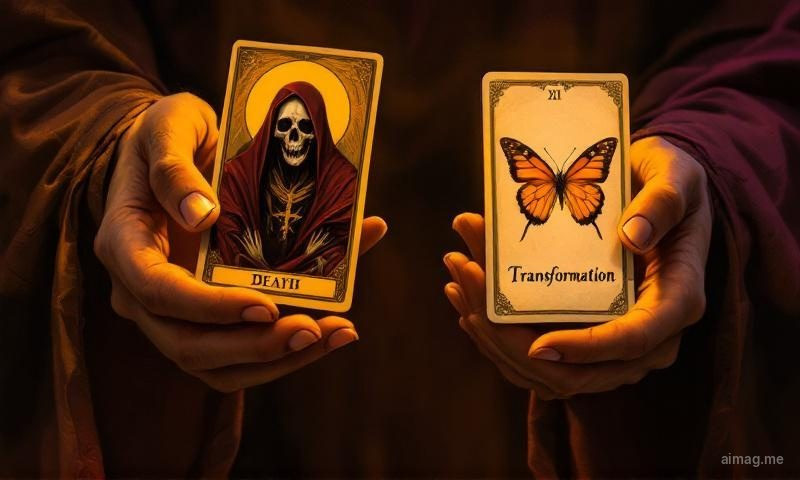
The psychological difference — structured vs. unstructured projection
Here is the distinction most comparisons miss, and it is the one that matters.
Both tarot and oracle cards run on the same fundamental psychological mechanism: they give you an external stimulus, and your response reveals something about your internal state. This is projection — the same principle behind Rorschach inkblot tests, free association in therapy, and the reason you see faces in clouds.
But the type of projection differs sharply.
Tarot works as an ambiguous projective tool. The imagery is rich, symbolic, and open to multiple interpretations on purpose. When you see the Seven of Cups — a figure silhouetted against seven floating cups containing a castle, jewels, a wreath, a dragon, a veiled figure, a snake, and a glowing figure — your mind must make choices. Which cup draws your eye? Which repels you? What story do you build? The answers reveal your values, fears, desires, and blind spots because you had to actively construct meaning from ambiguity. The work is yours, and so is the insight.
Oracle cards work as directed reflective prompts. The message is explicit — "Surrender," "New Path," "Trust Your Instincts" — and your job is not to decode it but to apply it. Where does "Surrender" land in your body? What are you holding onto that this word brings to mind? The mechanism is closer to what therapists call a "thought experiment" — a deliberately introduced concept that you examine against your actual experience.
Neither mechanism is deeper or more valid. They access self-knowledge through different doorways. Tarot enters through symbolic analysis and pattern recognition — the same processes you use when interpreting literature, art, or dreams. Oracle cards enter through direct emotional resonance and narrative application — the processes at work when a friend says exactly the right thing at the right moment and it lands.
The choice between them is not about spiritual advancement or seriousness. It is about which doorway leads more naturally to honest self-examination for you, right now, about the specific question you are holding. And that can change over time, or even from day to day.
Which one should you start with?
Forget the "which calls to you" advice. Here is a more practical framework:
Start with tarot if you:
- Enjoy learning systems and frameworks
- Like the idea of a practice that deepens over time as your knowledge grows
- Are drawn to symbolism, mythology, or Jungian psychology
- Want to dig into complex questions about relationships, patterns, and archetypes
- Find ambiguity interesting rather than frustrating
- Are willing to invest some time in learning (though less than you think — a beginner's reading is achievable in an afternoon)
Start with oracle cards if you:
- Want an immediate reflective practice with no learning curve
- Prefer direct messages over symbolic interpretation
- Are mainly interested in daily inspiration or emotional support
- Find complex systems overwhelming or unnecessary
- Want a creative brainstorming tool rather than an analytical one
- Are in a difficult emotional period where gentle support matters more than deep analysis
Start with both if you:
- Are curious about reflective practices in general and want to experiment
- Already meditate or journal and want to add a visual element
- Do not feel strongly about structure vs. freedom and want to find your preference through experience
The best deck to start with is the one you will actually use. A beautiful tarot deck sitting untouched on your shelf because the learning curve scared you off is less useful than an oracle deck you pull from every morning. And an oracle deck that bores you after two weeks because it feels too simple is less useful than a tarot deck that keeps showing you new layers as your knowledge grows.
If you are curious about tarot specifically, this guide to reading tarot cards breaks down the practical steps without mystifying the process. The science of randomness behind card draws is also worth understanding — it shifts how you relate to the experience from "is this magic?" to "this is psychology, and it is more interesting than magic."
Frequently asked questions
Can I mix tarot and oracle cards in one reading?
Yes, and experienced readers do it regularly. The typical approach is a tarot reading first, then one or two oracle cards as thematic clarifiers. The oracle card acts as a summary or spotlight — it does not replace the tarot interpretation but adds directional emphasis. Some readers place the oracle card at the center of the tarot spread as a theme card before laying out the tarot positions around it.
Are oracle cards easier than tarot?
They are easier to start with. Not necessarily easier to use well. Drawing an oracle card and reading its keyword takes seconds. But sitting with that keyword honestly, applying it to your actual life without deflection or wishful thinking, and letting it shift your perspective — that takes the same emotional courage tarot demands. The skill is not decoding symbols. The skill is being honest with yourself about what you see. Both systems require that equally.
Which is more accurate?
Neither system predicts the future, so "accuracy" in that sense does not apply. What both do — when used honestly — is help you see your present situation more clearly. Tarot does this through structured symbolic interpretation. Oracle cards do this through direct reflective prompts. The "accuracy" you experience is the accuracy of your own self-knowledge, reflected back through whichever system you are using. A thoughtful oracle reading is more "accurate" than a careless tarot reading, and vice versa.
Do I need psychic ability to use either one?
No. Both tarot and oracle cards work through documented psychological mechanisms — projection, pattern recognition, narrative construction, and reflective self-examination. You do not need to be psychic. You need to be willing to pay attention to your own reactions honestly. The cards are mirrors, not crystal balls. What you see in them comes from you. That is what makes them useful.
Is tarot more "serious" than oracle cards?
Tarot has a longer lineage and a more complex system, which gives it a weight oracle cards do not carry. But "serious" is the wrong frame. A daily oracle card practice maintained consistently over a year will generate more genuine self-knowledge than an occasional tarot reading done casually. The seriousness lives in the practitioner's intention, not the tool. That said, tarot's structured depth allows for analysis that oracle cards structurally cannot provide — so for deep psychological work, tarot has an inherent advantage.
The choice that is not really a choice
Here is the thing about the tarot vs. oracle cards question: it frames two complementary tools as competitors, as if picking one means rejecting the other. In practice, the people who get the most from reflective card practices treat the question as temporary. They start with one, explore the other, and settle into a practice that uses both when each fits best.
The real question is not "tarot or oracle cards." It is "am I willing to sit with an external stimulus and respond honestly?" If you are, both systems will work. If you are not, neither will.
Tarot offers the deeper well. Six centuries of symbolic tradition, a structured archetypal framework, and the capacity for complex multi-card analysis make it a tool that grows with you indefinitely. You will never exhaust it. Every reading teaches you something about the cards and something about yourself, and those two streams feed each other in a cycle that has no ceiling.
But oracle cards offer the wider door. Their accessibility, their gentleness, and their directness make reflective practice available to people who would never pick up a 78-card system with Latin names and medieval imagery. And getting people through the door matters more than which door they use.
Start wherever you are. The practice will tell you where to go next.
Experience tarot's structured depth in a free AI reading at aimag.me/reading